




Vietnam's foreign policy - A beacon of hope for the whole world: Austrian expert
WVR - Sharing with The world and Vietnam Report just before the 14th National Party Congress, Dr. Patrick Horvath, Secretary General of the Foundation for Scientific Economic Policy (WIWIPOL), Austria, expressed strong confidence in Vietnam's development goals in the new era and affirmed that Vietnam is on the right track.
Latest
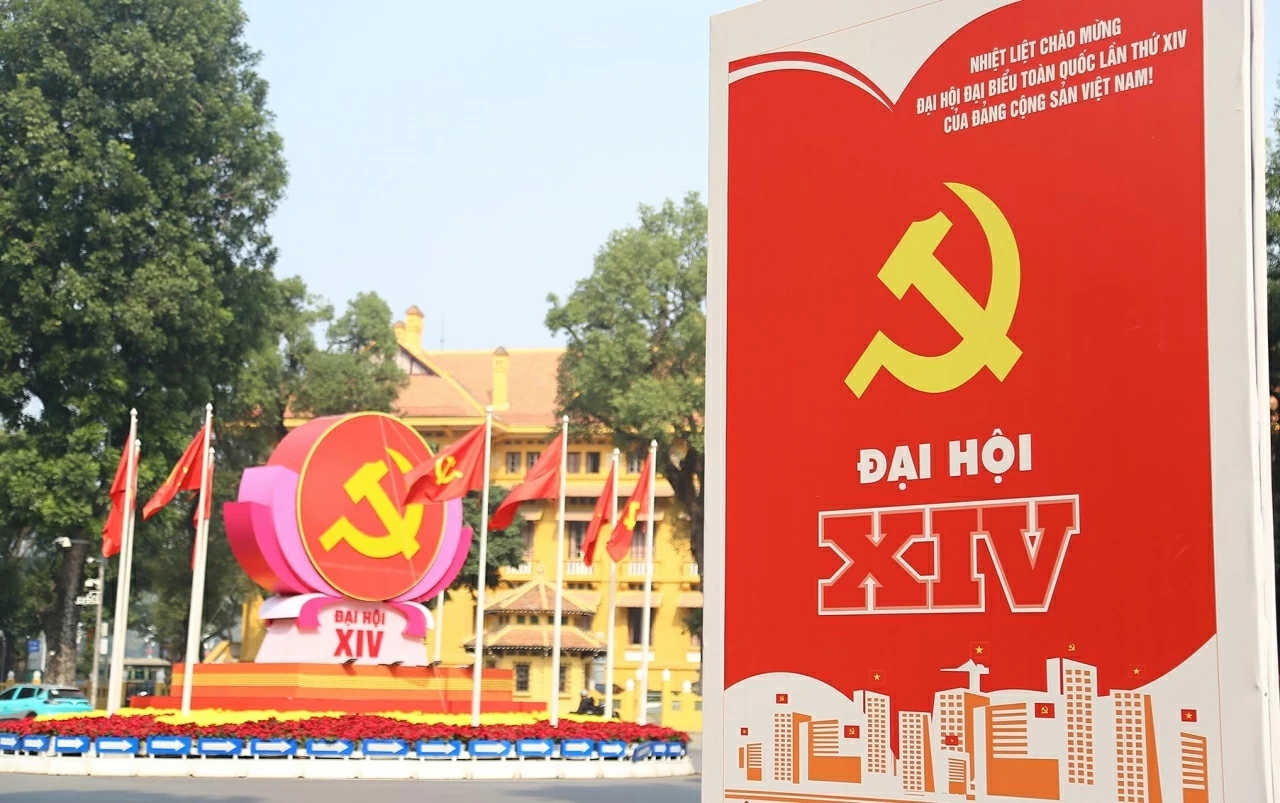 |
| Models, banners, slogans, and posters celebrating the 14th Congress of the Communist Party of Vietnam are displayed at the Independence-Dien Bien Phu intersection. (Photo: Thanh Long) |
The 14th National Congress of the Communist Party of Vietnam is approaching. The draft Documents to be submitted to the Congress set out a new growth model driven primarily by science and technology, innovation, and digital transformation, with the goal of achieving an average annual GDP growth rate of around 10 per cent. How do you assess this new growth model?
I think that the defined goals are very ambitious, but success is possible.
Vietnam has during the last years proven to be one of the world’s largest growing economies. Even during the corona crisis Vietnam has managed to achieve growth, which was very rare and exceptional at this time.
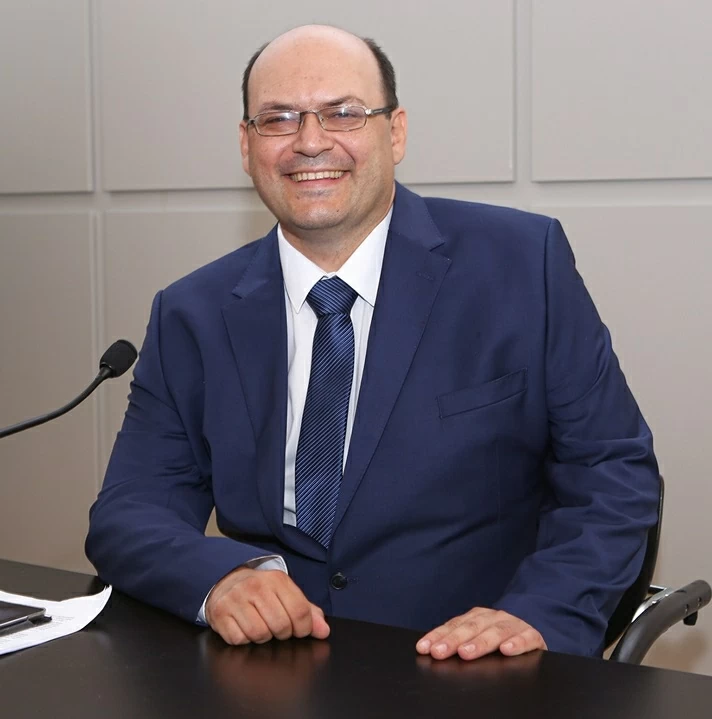 |
| Dr. Patrick Horvath, Secretary General of the Foundation for Scientific Economic Policy (WIWIPOL), Austria. (Photo: Chu Van) |
I believe that the growing population alone will give Vietnam a certain amount of guaranteed economic growth during the next one or two decades. Additionally, digital transformation and artificial intelligence promise more efficiency in production. If Vietnam wants to enhance its economic growth even further, it is on the right way to enhance its competence in these areas.
If in 2045 Vietnam reached its goal of becoming a high-income and largely industrialised developed country, it would have to reconsider its prorities. Like in my country Austria, people will shift their priorities when they have acquired a satisfying amount of wealth and will want to concentrate on quality of life instead of earning even more. Another future National Congress will then have to adjust the rules again.
In the current international context, how do you view Vietnam's vision of integrating into the global mainstream, as well as its foreign policy of independence, self-reliance, and being a friend and a reliable partner of the international community, while actively contributing to peace-building and jointly addressing common global challenges?
In my opinion Vietnam’s foreign policy is a beacon of hope for the whole world and Vietnamese Ministry of Foreign Affairs does a truly excellent job.
We today live in a new era where new empires emerge. Their idea is that there should be no moral or legal restrictions for their power and they instead promote the „law of the jungle“ , according to which the strong is able to terrorize the weak without limits in international politics. This perspective is truly frightening and if this view prevailed, it would turn out to be a backlash for civilisation and humanity, causing hundreds of unnecessary armed conflicts, resulting in undescribable suffering.
Vietnam is very much different in this respect. Your country is a credible advocate of a rule-based international order, governed by international law and shaped by multilateral cooperation based on mutual trust. I believe that today’s global problems can not be resolved by one country alone but only if different countries stand together. Soft power is the key for mulitlateral success.
Vietnam has suffered greatly from war and knows that it is wise to keep peace. This agenda is shared by Austria as well, which is a small, neutral and peace-loving nation located in the heart of in Europe. Austria was among the first nations to start diplomatic relations with Vietnam and I hope that our two nations will stay reliable friends. There is a huge potential in future cooperations and alliances for the promotion of peace!
 |
| The Austrian expert believes in Vietnam's vision for scientific, technological, innovative, and digital transformation development in the spirit of Resolution 57. (Photo: Chu Van) |
In order to achieve a growth target of 10 percent after the 14th National Party Congress, Vietnam has previously issued a number of breakthrough resolutions, emphasizing institutional reform, innovation, the development of the private sector, and international integration for development. How do you assess this early and proactive approach in laying the groundwork for major breakthroughs in Vietnam's new development era?
Several recent resolutions in Vietnam have laid the groundwork for further positive development. It seems to me that the Vietnamese leadership has defined the priorities for the country 100% correctly.
The most famous resolution everyone talks about is resolution 57 that aims to lead Vietnam into a new digital future. While many European politicians only think about the next elections, I can admire that Vietnam’s leaders look decades ahead. I also admire the courage of resolution 57 which in absolute transparency speaks out some problems Vietnam still has to work on. For instance it demands a reform of the education system and aims to make it more open for creativity and project work, which is essential for the solution of problems in the digital world. I am very sure that the Vietnamese people have the spirit and intelligence to one day rank among the world’s best programmers.
Some demands of resolution 57 must in my opinion still be worked out in greater detail, for instance the goal of training 50.000 Vietnamese artificial intelligence engineers, how shall this happen exactly? I hope that Austria with its renowned universities and educationial centers like the Technical Universities in Vienna and Graz can help train a new Vietnamese "digital generation".
In pursuing its two centenary goals — the 100th anniversary of the founding of the Communist Party of Vietnam and the 100th anniversary of the establishment of the country — and its aspiration to become a high-income, developed nation by 2045, what key opportunities and challenges, both domestic and international, do you believe Vietnam will face?
I think that Vietnam is on a very good track, but of course there are challenges ahead that might hinder or slow down Vietnam’s future development. I want to distinguish between short-, medium and long-term challenges for Vietnam.
A short-term challenge is this: The European Union and Vietnam have concluded a free trade agreement, that is in already force. It offers many chances for both sides. To fulfill ist full potential, a second agreement has to be ratified, the investment protection agreement. 20 member states of the European Union have by now ratified the treaty, the last so far was Poland in November 2025. The ratification of seven EU member states is still missing but is needed so the agreement can be set into force. We must accelerate the ratification process to ensure future good economic relations. I am confident that this important project will sooner or later work out.
About the medium-term challenge I can point to resolution 57. The Vietnamese strategic document rightfully states that in order to handle the process of digital transformation, Vietnam must invest in the creation of new infrastructure. One example is a full coverage of 5G in the whole country, at some places it is still not efficient. Vietnamese leadership has identified this problem and is working on modern solutions. I am also very confident that Vietnam will be able to handle this challenge of infrastructure building.
In a long term view it is very important to maintain stability and peace in the region of South East Asia. Aside from financial market or bank crashes, you must see that wars rank about the most costly endeavours that exist.Wars are huge black holes that swallow the wealth of nations. The Vietnamese people have heroically defended their independence in the past from all invaders which is truly admirable. If they had not been forced to fight wars and had invested their hard work and creative potential in science and economy instead, I am sure that they would already rank among the world’s wealthiest nations.
The weather phemomena in 2024 and 2025 regarding typhoons and flooding in Vietnam deeply concern me. Vietnam must increase its foresight and resilience to natural catastrophe and again I hope that Austria can assist with know-how and technology.
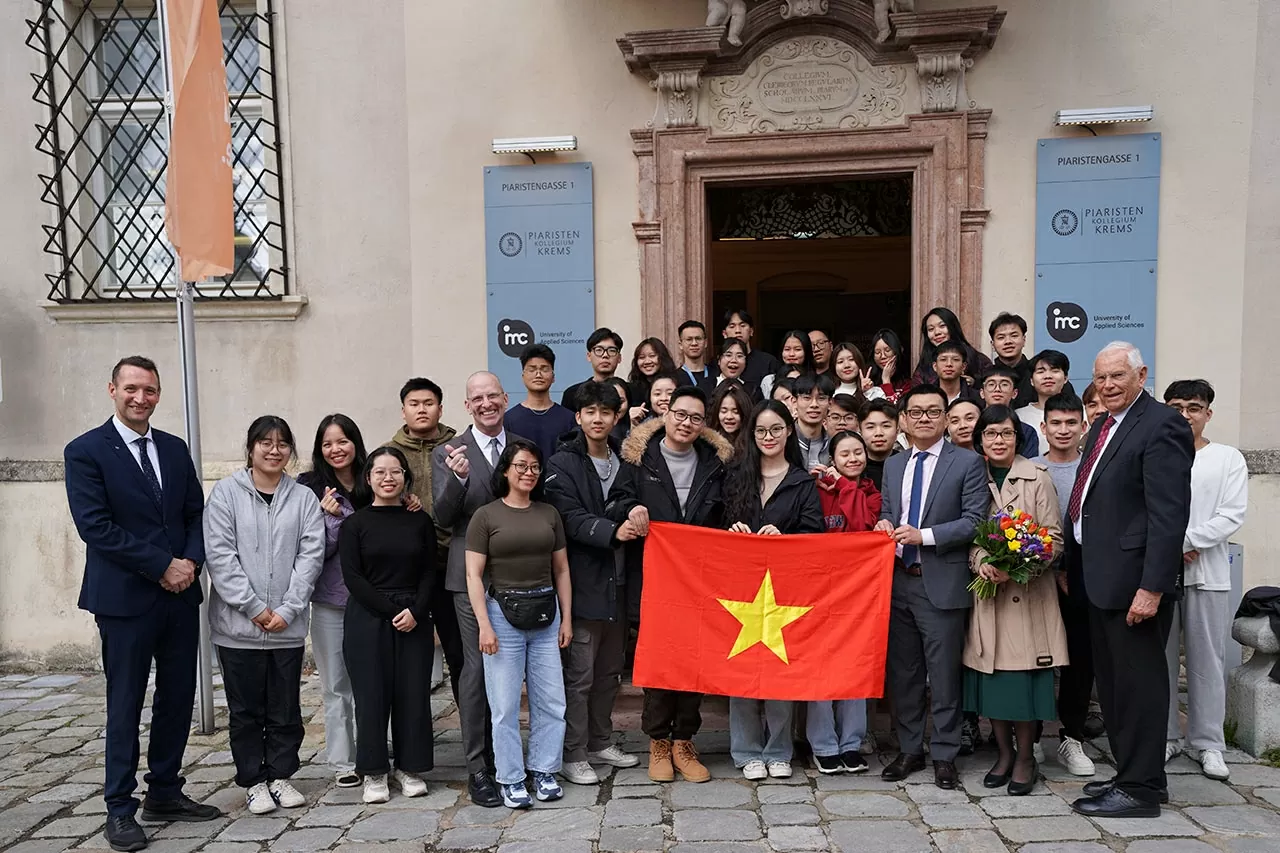 |
| Vietnamese Ambassador to Austria Vu Le Thai Hoang interacted with Vietnamese students in Austria. (Photo: Chu Van) |
From the perspective of an international expert, what policy recommendations and proposals would you offer to help Vietnam achieve its stated objectives over the next five years?
The Vietnamese Embassy in Vienna has with great success initiated a „Technology Dialogue“. It brings together representatives of administration, enterprises and academia from both Vietnam and Austria so they can exchange knowledge. Austria is a highly developed, industrialised country with many assets. This includes a thriving semi-conductor industry of global importance or knowlege in fields like cybersecurity. In the area of life science Austria hosts renowned educational instituions like life science university BOKU or the well-known Vienna Bio Centre. Vienna is an international cluster of pharmaceutical industry. Recently Austrian researcher Prof. Zeilinger received the Nobel Prize for his research on quantum mechanics. This has sparked much development in this field. The university in Leoben (a town in the province of Styria) is dedicated exclusively to mining and is one of the leading developer’s of mining machinery, granting a de facto 100% job guarantee for its graduates.
This list of Austrian valuable assets could be continued endlessly. But most important seems to me: Austria is a world market leader in environmental technology. If Vietnam wants to follow a path to growth it still has to protect its nature for the next generations. Austria’s expertise on green industry and smart urban development can certainly help Vietnam on its way into a new era.
My recommendation is to continue and deepen this form of international technology cooperation. I also advise to put a special emphasis on education, which is the key for a country‘s development. There is a saying: If you really want to help someone, do not give him a fish but show him how to catch one.
Every country is blessed with special resources. In Austria the mountains provide us with immense sweet water reserves, natural treasures like salt, and options for tourism and hydro power plants. I believe that the greatest treasure Vietnam has are its young people, which is a huge human resource potential.
Former Ambassador of Vietnam in Austria asked me to do mentoring for Vietnamese students in my country. Since then via a facebook group and in personal contact, I pass information about study options to young Vietnamese. I also organise free concert and opera tickets so they can experience first hand why Vienna is called the world capital of classical music. On this way I met young people with great talent, men and women alike. One example is a Vietnamese student at Vienna Medical University who develops computer models to predict the effects pharmaceutical products. Another example is a student at Vienna Bio Centre who researches on biological mechanisms inside fungus types like Candida auris which might increase therapy options. It is people like these who will bring Vietnam forward!
Unfortunately, I find international exchange programs for Vietnamese in Europe still much too rare and underfunded. If we want to create a better future for Vietnam we must not only talk about it but invest real money in the future of young people! Since budgets are tight also in the West new models must be developed. I believe that the old model of a full-time student might be outdated. My idea would rather be to convice international enterprises to hire young people half-day, enabling them to collect real work experience abroad. Additionally, through their earnings, they could finance their academic studies for the rest of the day.
So my recommendation is that more funds for international student exchange should be raised and invested in young talented Vietnamese people. I am sure that they will be the champions who bring wealth and prosperity to Vietnam’s future!
Thank you very much, Doctor!