


80 years of Vietnam's diplomacy: The unique military-diplomatic offensive in the Ho Chi Minh Campaign
WVR - After the signing of the Paris Agreement, the US had to accept defeat and take a step back strategically. However, its deeper scheme was to continue the invasion of Vietnam through the policy of “Vietnamization of the war.” The US still commanded the Saigon army and government in conducting the “land-grabbing and pacification” war.
Latest
 |
| 80 years of Vietnam's diplomacy: Members of the Two-Party Joint Military Commission and the Four-Party Joint Military Commission at Camp Davis. (Photo: Archive) |
Learning from the implementation of the Geneva Agreement, the struggle to implement the Paris Agreement was regarded as an integral part of the revolutionary struggle, aimed at defeating the “Vietnamization of the war” strategy, overthrowing the Saigon regime, liberating the South, and unifying the country. “Vietnamization of the war” by the US and the Saigon regime essentially meant the complete abolition of the Paris Agreement.
After six months of implementing the Paris Agreement, the Supreme Command (i.e., the Politburo, the Central Military Commission, the Commander-in-Chief of the People’s Army, and supporting agencies in the Ministry of National Defense and Ministry of Foreign Affairs) had a clear view of the situation: peace could not be restored, and the situation was developing toward increasingly serious war. The 21st Plenary Session of the Central Committee in July 1973 analyzed: “Eighteen years of resisting US aggression for national salvation have brought us great victories, but in some areas we are still hesitant and tentative in responding to the enemy, allowing them to seize more land and tighten control over the people”. The conference affirmed many extremely important issues regarding the revolutionary path, revolutionary war, and strategic direction.
On July 6, 1973, Camrade Le Duan concluded the 21st Plenary Session of the Central Committee as follows: “The core spirit of this Central Committee meeting is that the Southern revolution must continue advancing by the path of revolutionary violence. We must always uphold the banner of peace and justice, struggle to force the enemy to implement the Paris Agreement to defeat them. But if the enemy stubbornly continues the war, we must wage revolutionary war to completely liberate the South and unify the country”.
After the meeting, our Party urgently defined the tasks: “Build truly strong forces, stronger than the enemy. Create a deep, broad, and firm strategic posture nationwide and in each battlefield. Prepare opportunities by developing the basic strategic plan and the opportunistic strategic plan, seizing the right moment to be ready to defeat the enemy”.
By late 1974, seeing that the great opportunity was approaching, the Supreme Command decided: “Urgently prepare and launch the strategic General Offensive and Uprising, with the determination to liberate the South within two years—1975 and 1976. If the opportunity rises, liberate the South immediately in 1975”.
The basic strategic plan began to be carried out. The decisive blow at 2 a.m. on March 10, 1975, in Buon Me Thuot city was a great success. The breakthrough was opened and in just over a week, by March 18, 1975, the Central Highlands battlefield was basically liberated.
The second strategic strike liberated Tri Thien–Hue on March 26, 1975, and then Da Nang on March 29, 1975. The final decisive strategic battle—the historic Ho Chi Minh Campaign—was then launched. On April 26, 1975, the military, political, and diplomatic fronts coordinated magnificently to attack Saigon. At exactly 11:30 a.m. on April 30, 1975, Saigon was liberated, followed by the complete liberation of the South. This was a tremendous, swift, heroic, and glorious victory, marking the complete success of the resistance war against the US, the liberation of the South, and the reunification of the country.
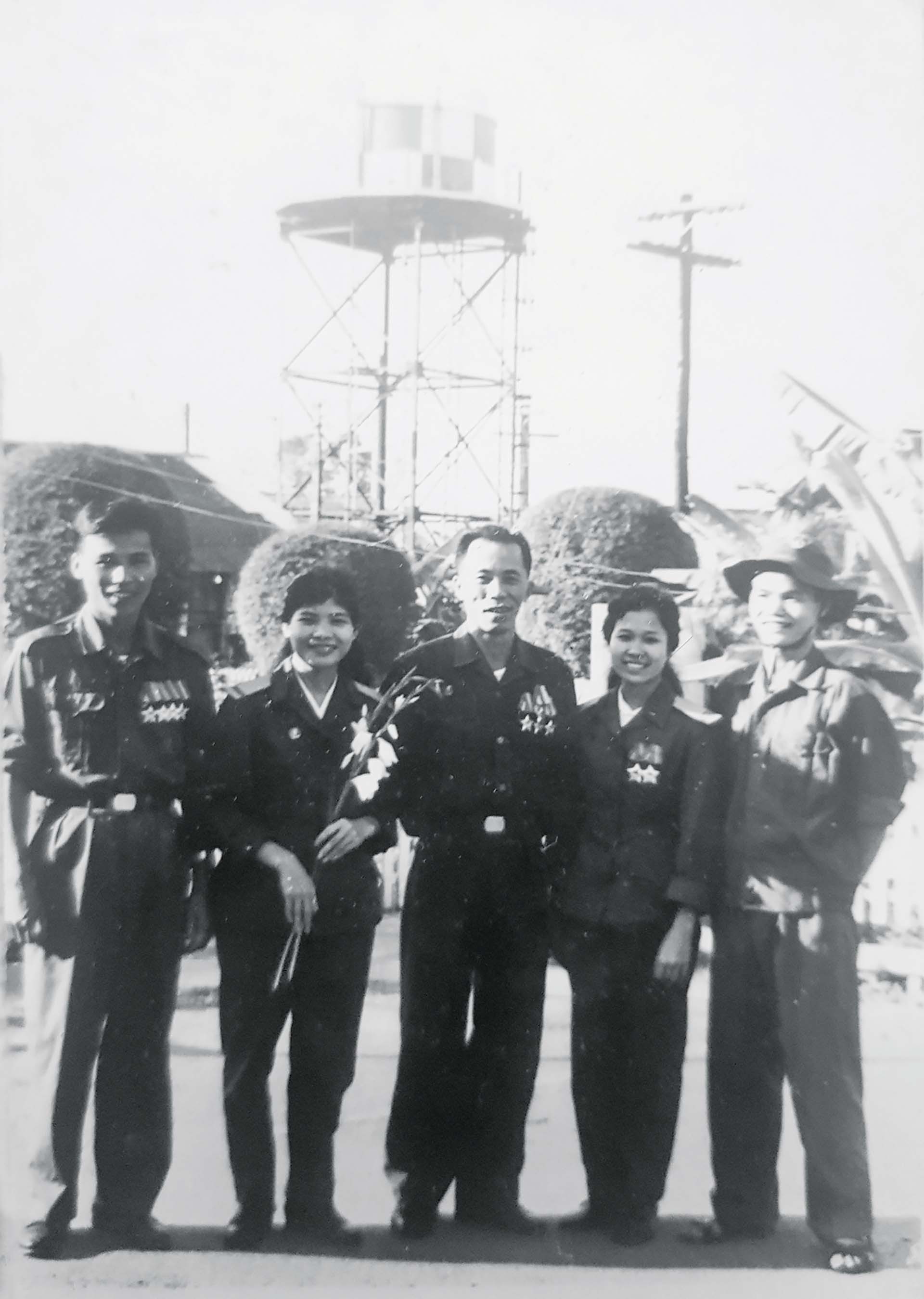 |
| Vu Nam Binh (center) at Camp Davis. (Photo: by author) |
So, what missions were assigned to military diplomacy to effectively serve the strategic General Offensive and Uprising and the historic Ho Chi Minh Campaign—over the course of 55 days and nights?
We were the only revolutionary force with a legal, public presence in the enemy’s heart, right inside the nerve center of the opposing side—well-versed in the enemy, experienced in direct confrontation, and possessing the composure, intellect, and confidence needed, along with all favorable conditions in this highly dynamic situation, to ensure outstanding completion of our assigned tasks.
First, the most active contribution was to maximize public opinion struggle, thoroughly isolating the enemy. We focused on exposing and denouncing the deeply-calculated scheme of the US and the Saigon regime to carry out “Vietnamization of the war,” violating all clauses of the Paris Agreement—especially its military provisions.
From October 1973, the Southern Command condemned US land-grabbing and pacification operations and declared retaliation wherever the enemy seized territory. The US–Saigon forces pressed forward, intensifying attacks across South Vietnam. We had to use revolutionary violence to defeat them. For the US–Saigon regime at that time, no legal argument was as effective as the “law” of revolutionary force.
We launched the General Offensive and Uprising on a large scale. The harder and more decisively we fought and won, the more strongly we had to wage the public opinion struggle—to accuse and condemn the US and the Saigon regime as the culprits violating the Paris Agreement, isolating them completely to defeat them swiftly.
Second, to make strong, effective, and timely use of the “political-military thermometer”—that was Camp Davis—located right in the enemy’s heart. Understanding the enemy’s situation was the top priority for the Supreme Command and commanders at all levels.
Strategic intelligence, technical intelligence, on-site observation, and direct contact within the enemy’s command centre had immense value. We were advancing like a storm, with great and rapid victories, so the enemy—especially the US and Saigon top leadership—were anxious to probe and assess: Where would our strategic attacks occur? Which forces were involved? Would we stop to negotiate afterward…?
From US Ambassador Graham Martin to Thomas Polgar—the CIA chief in South Vietnam—they actively probed our forces, inadvertently revealing their own secret intentions to counter us. Some CIA agents sent from the US even hinted that America had admitted defeat—asking whether it was necessary to attack Saigon and requesting that we not “humiliate” the US, as in not to strike the city militarily.
Senior officials of the Saigon regime hurried to our military delegation’s headquarters. Many came under various pretexts, proposing to hand over power and avoid an attack on Saigon, seeking political negotiations. Tran Van Huong, newly installed as president after Nguyen Van Thieu, sent newly appointed Minister of Information Phan Hoa Hiep to request an urgent meeting in Hanoi with the DRV government to negotiate—but we fully understood their intentions and refused.
All of this military-diplomatic intelligence was promptly reported to the Supreme Command in Hanoi and the Command of the historic Ho Chi Minh Campaign. In the enemy’s dying hours, such information was truly valuable.
Third, to contribute to strategic deception regarding the General Offensive and Uprising and the historic Ho Chi Minh Campaign.
As a military-diplomatic force with unique characteristics and specific conditions, we could play a role in strategic deception. In wide-ranging contacts with various parties, we always said: “We must remain here to struggle for the implementation of the Paris Agreement” and demanded that the other side do the same.
Even though the Two-Party and Four-Party Joint Military Commissions had ceased operation, we still regularly held weekly press conferences, reporting extensively on the enemy’s violations of the Paris Agreement.
We frequently met with journalists from 77 foreign news agencies in Saigon, day and night.
We continued sending diplomatic notes accusing the enemy of violating the Agreement’s clauses and demanding that the International Commission investigate serious cases.
We increased work with the International Commission, especially with the Hungarian and Polish delegations, from whom we learned important internal news about the Saigon regime, and through whom we passed information to make it harder for the enemy to guess our intentions.
All our military-diplomatic activities maintained normal routine—nothing to indicate that fighting was imminent here. Notably, when we secretly dug battle positions near dozens of enemy guard posts along the fence, they knew nothing.
The enemy was clearly taken in by the Supreme Command’s strategic deception, in which the military-diplomatic force in the enemy’s heart played a definite role.
 |
| Author Vu Nam Binh. |
Conclusion
I am truly honoured and proud to have stood among those who directly engaged in military-diplomatic struggle to implement the military clauses of the Paris Agreement.
I deeply realize that it was because our Party had the right revolutionary line, strategy, and method—independent, self-reliant, correct, and creative, suited to each stage of the revolution—that we gradually achieved great victories.
It is important to mention the very wise strategic decision to open the diplomatic front at the right time in 1967. From then on, the political, military, and diplomatic fronts were tightly combined, creating the situation of “fighting while negotiating”.
Thus, after 14 years of fighting, we forced the US to the negotiating table. After five years of negotiations, we forced the US to sign the Paris Agreement, and in just 823 days of its implementation, we compelled the US and the Saigon regime to suffer total defeat, and our entire nation concluded the resistance war against the US with complete victory.
Specifically for the military-diplomatic front, the Party proactively focused on the military provisions of the Paris Agreement, establishing the Joint Military Commissions to implement them, under the direction of the four signatories to the Agreement. From there, the Politburo—directly the Central Military Commission and the Southern Military Commission—closely monitored and strictly directed operations, ensuring firm results.
This was also due to the Party’s careful selection of a high-quality, disciplined team to go into the enemy’s heart for military-diplomatic struggle. This team had strong political resolve, fighting spirit, revolutionary vigilance, a firm offensive mindset in dealing with the enemy, fully grasped Ho Chi Minh’s diplomatic thought, and had absolute loyalty to the revolutionary cause—thus building a solid revolutionary fortress that was politically steadfast, diplomatically sharp, and militarily creative and resilient.
This was the solid foundation for the military-diplomatic struggle to excellently fulfill its mission in any difficult, fierce, and complex situation caused by the enemy’s extremely sinister, cunning, and aggressive sabotage.
Immediately after completing the historic Ho Chi Minh Campaign, on May 2, 1975, the Command of the historic Ho Chi Minh Campaign announced: “Camp Davis was a unit directly participating in the Ho Chi Minh Campaign. Alongside the five main army columns entering Saigon, our military delegation was the sixth offensive spearhead—the uniquely distinctive military-diplomatic offensive of the Vietnamese people’s war”.
Later, the military-diplomatic force was awarded the title of Hero of the People’s Armed Forces by the President of the Socialist Republic of Vietnam for its particularly outstanding achievements in the resistance war against the US, according to Decision 1553/QD-CTN dated September 12, 2011.
On March 9, 2017, the Minister of Culture, Sports & Tourism issued Decision 827/QD recognizing Camp Davis as a national historical-cultural relic, affirming it as a unique symbol of the military-diplomatic front in implementing the Paris Agreement in Vietnam.
Colonel Vu Nam Binh, real name Nguyen Van Kha, born June 16, 1929, in Phu My, Ngoc My, Quoc Oai, Hanoi, former Head of Security and Deputy Head of the Prisoner Exchange Subcommittee of the Military Delegation of the Provisional Revolutionary Government of the Republic of South Vietnam.