


80 years of Viet Nam’s diplomacy: Through the eyes of Venezuela’s diplomat
From half a world away, former Ambassador of Venezuela to Viet Nam Jorge Rondon Uzcategui, a member of the Communist Party of Venezuela, shared his reflections with the World and Viet Nam Report on the occasion of the 80th anniversary of Viet Nam’s diplomacy.
Latest
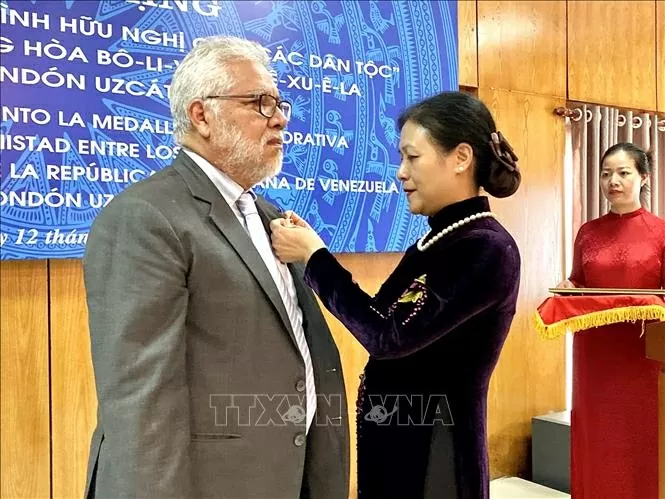 |
| Ms Nguyen Phuong Nga, President of the Viet Nam Union of Friendship Organizations, presented the Medal “For Peace and Friendship among Nations” to Mr Jorge Rondon Uzcategui, Ambassador of Venezuela to Viet Nam, November 2019. (Source: VNA) |
It can be said, without a doubt, that Viet Nam's first step onto the international scene began long before its declaration of independence in 1945, when the young dreamer Nguyen Tat Thanh - later known as Ho Chi Minh - embarked on June 5, 1911, aboard the Latouche Trévulle, bound for France.
During his long journey until 1941, he accumulated vast political and cultural knowledge; he came to know, as Martí would say, the entrails of the colonialist monster; he learned about the forms of rebellion of oppressed peoples; he established bonds of solidarity in the global anti-colonialist struggle; he proclaimed to the world Viet Nam's inalienable right to independence and sovereign and democratic development; and he laid the foundations for organizing a common revolutionary force for the freedom of Indochina.
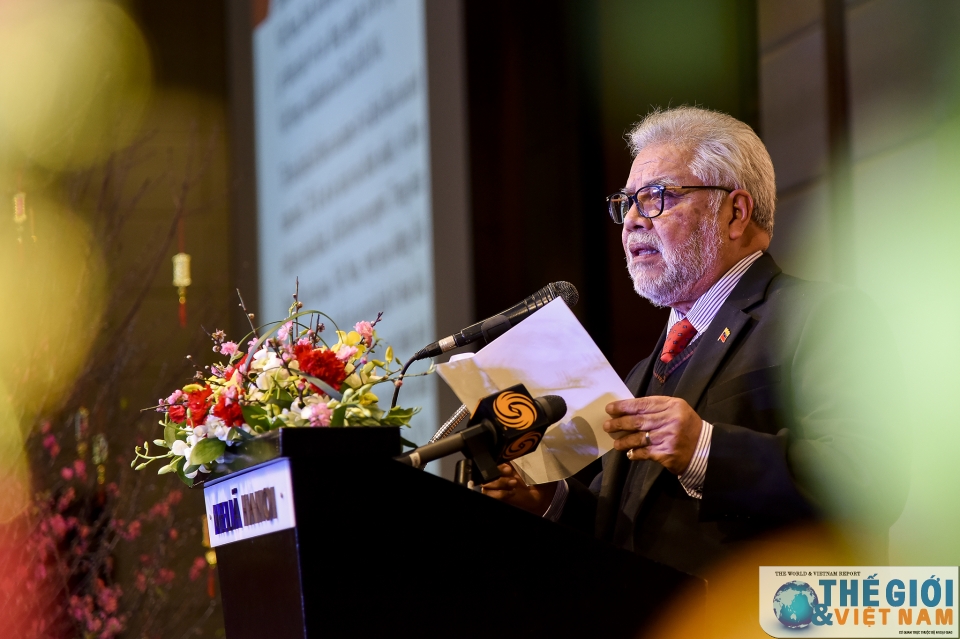 |
| Ambassador Jorge Rondon Uzcategui served as the Dean of the Diplomatic Corps in Viet Nam for many years. |
The Testament of President Ho Chi Minh, a true guide for the Vietnamese people, written between May 1965 and May 1969, reflects President Ho Chi Minh's aspirations for independence, freedom, and national integration, as well as his instructions for building a transparent, sustainable, and united government, maintaining national defense and security, and the implementation of a sovereign, responsible, and solidary foreign policy.
In President Ho Chi Minh's thinking, foreign policy is an essential instrument of national development and a lever for strengthening political solidarity among peoples.
In implementing President Ho Chi Minh's foreign policy guidelines, Viet Nam developed an intricate network of friendship and solidarity worldwide, first with the socialist camp and, gradually, with progressive countries and leftist political movements. All of this greatly contributed to the 1975 victory and national unity.
At the end of the War of Liberation and Unification in 1975, Viet Nam was virtually isolated from the international community and subjected to a series of economic and political sanctions. However, like the national bamboo, it remained firm in its sovereign principles and flexible in its decisions. To this end, it has maintained four basic principles: Not joining any military alliance, not linking itself to one country to oppose another, not allowing foreign countries to establish military bases or use Vietnamese territory to oppose other countries, and not using force or threats in international relations.
With great skill, determination, and patience, Viet Nam occupies one of the most eminent positions in the international community, thanks to its flexible, proactive, and supportive diplomacy. Viet Nam's foreign policy has been committed to peace, stability, and cooperation in the international arena. The country has pursued a policy of diversification and multilateralization of international relations, earning it recognition as a reliable partner and a responsible member of the global community.
Today, Viet Nam maintains diplomatic relations with 194 countries; it belongs to the United Nations and its agencies; and is a member of, among other organizations, the Association of Southeast Asian Nations (ASEAN), the World Trade Organization, the Asia-Pacific Economic Community (APEC), and the Comprehensive and Progressive Agreement for Trans-Pacific Partnership (CPTPP).
It should be noted that Viet Nam has twice served as a Non-Permanent Member of the United Nations Security Council (2008-2009 and 2020-2021), during which it acted with great restraint and skill. Additionally, since 2014, Viet Nam has become an active and committed participant in peacekeeping and security operations in Sudan and the Central African Republic, where it has distinguished itself with its humanitarian interventions in infrastructure construction, medical assistance, and agricultural training.
In June 2025, Viet Nam has become BRICS partner country, “in line with its policy of proactive, comprehensive, in-depth, and effective international integration, Viet Nam will continue to make substantive contributions to various multilateral mechanisms, so as to actively contribute to regional and global peace, stability, cooperation, and development.”
Along with the achievements in the political sphere, Viet Nam's foreign activity has reaped great successes in the economic field. Embassies and consulates have become true strengths in promoting Viet Namese products, attracting investment, fostering tourism, disseminating national culture, expanding technological cooperation, and facilitating the economic, strategic, and legal conditions for systematizing multilateral and bilateral trade relations.
New realities pose extraordinary challenges for all countries, particularly in Southeast Asia. Viet Nam must be prepared to overcome enormous political problems of confrontation between major powers, economic and commercial pressures forcing it to take particular positions, and even the paralysis of the country in the midst of a regional war.
These scenarios must be addressed clearly and firmly, as indicated by the clear guidance of the Father of the Nation, with the goal of consolidating an independent, sovereign, socialist, and developed Viet Nam with a prosperous and happy people.
We are confident that in the coming years, Viet Nam, thanks to its vast experience and strength, will continue to exercise active diplomacy consistent with the objectives set by the Communist Party and the state, to overcome any challenge, no matter how difficult.
| Mr Jorge Rondón Uzcátegui served as Venezuela’s Ambassador to Viet Nam from 2006 to 2019, making significant contributions to bilateral relations, particularly through a number of important high-level visits. As a veteran member of the Communist Party of Venezuela, Ambassador Jorge Rondón Uzcátegui once shared that his affection for Viet Nam began at the age of 14, when he joined the Party. From that moment, he dreamed of learning about President Ho Chi Minh and meeting General Vo Nguyen Giap. In 2006, upon being appointed as the first Ambassador of Venezuela to Viet Nam, he knew that this dream had come true. |