


Thai Nguyen: A true destination for investors
Following its merger and expansion of development space, Thai Nguyen continues to emerge as a beacon for investors thanks to its synchronised infrastructure, abundant land resources, transparent business environment, and substantial administrative reforms. In 2025, the province launches a series of large-scale IZs, attract both FDI and DDI, and affirm its position as a modern industrial hub.
Latest
Despite global and domestic economic fluctuations, Thai Nguyen remains an attractive destination for investors. Its well-developed infrastructure, ample industrial land, and favourable investment policies form a solid foundation for the province’s goal of becoming the modern industrial centre of the northern midland and mountainous region.
A bright economic picture
Over the past nine months, the industry has remained the main growth driver. The Industrial Production Index (IIP) for September 2025 is estimated to increase by 13.25% year-on-year. Cumulatively, the IIP for the first nine months rose by 9.45%. Many key sectors achieved double-digit growth, including garment manufacturing, metallurgy, rubber and plastics, mechanical engineering, and engine production.
Provincial departments and agencies are actively implementing a Master Plan to develop high-tech and priority industries under an inter-regional value chain for 2026–2030; a plan to extend state management of industry and trade down to the commune and ward levels; and a program to survey and address the challenges faced by enterprises operating in industrial clusters.
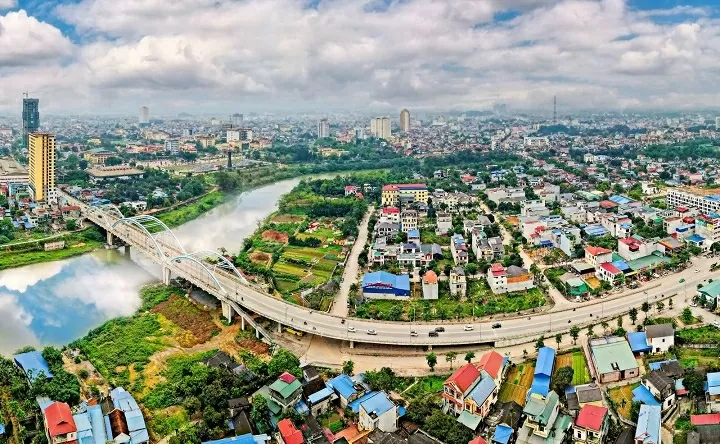 |
| Despite global and domestic economic fluctuations, Thai Nguyen remains an attractive destination for investors. (Photo: VnEconomy) |
Alongside industrial production, exports continue to play a leading role in growth. From October 1-19, 2025, the province’s total import-export turnover reached USD 1.89 billion, including USD 1.15 billion in exports and USD 0.74 billion in imports. For the first ten months of 2025, total trade reached USD 40.5 billion, of which exports accounted for USD 24.7 billion and imports for USD 15.8 billion.
Thai Nguyen currently boasts 561 OCOP (One Commune One Product) items rated from 3 to 5 stars, including 438 three-star, 113 four-star, and 10 five-star products. The economic value of these OCOP-rated products has increased by about 20%, and at least 40 new OCOP items are expected to be added in 2025.
In the first nine months of 2025, the province welcomed an estimated 6.36 million visitors (6.12 million domestic and 241,475 international), generating over VND 6.48 trillion in revenue. Thai Nguyen aims to attract 7.3 million visitors annually, maintaining revenue above VND 6.48 trillion.
Under Government Resolution No. 226/NQ-CP dated August 5, 2025, Thai Nguyen was assigned a GRDP growth target of 8%. Demonstrating strong determination to drive growth and contribute to the national economy, the province has set its own target of at least 8.5%-0.5 percentage points higher than the government’s goal laying the foundation for double-digit growth in the years ahead.
A “magnet” for investment
Thai Nguyen has long been recognised as a leading FDI destination in Viet Nam, particularly in the Northern Midland and Mountainous region. Following its merger, the province continues reinforcing its status as a high-tech industrial hub and a favoured site for global capital inflows.
FDI remains a key pillar of growth, with 16 new projects totalling USD 169.8 million in newly registered capital. Investor confidence is further demonstrated by 36 existing projects expanding operations, adding another USD 192.4 million in capital. The province currently hosts 232 valid FDI projects with total registered capital exceeding USD 11.35 billion most located within industrial zones.
Thai Nguyen currently has six industrial zones, five of which are operational and have high occupancy rates. Major zones such as Song Cong I, Diem Thuy, Yen Binh, Nam Pho Yen, and Song Cong II have all recorded impressive results. Song Cong I Industrial Zone now hosts 23 FDI projects worth USD 81.84 million and 75 domestic projects with over VND 7.6 trillion in capital. Diem Thuy Industrial Zone has attracted 82 FDI projects with nearly USD 875 million in total investment. In comparison, Yen Binh Industrial Zone accommodates 48 FDI and 10 domestic projects—significantly contributing to the province’s industrial growth.
According to the 2021–2030 planning period, Thai Nguyen still has more than 6,000 hectares of land for industrial development, of which 70% is designated for industrial parks. Notably, in 2025, the province will consecutively approve and commence several large-scale projects.
In early May, the Provincial People’s Committee approved the Yen Binh 2 Industrial Park, covering nearly 300 hectares with a total investment of over VND 3.65 trillion.
Just three months later, the project broke ground demonstrating the determination of the authorities and investors. Previously, the Yen Binh 3 Industrial Park, with an investment of over VND 4 trillion, had also been approved and launched. Establishing the Yen Binh 2 and 3 industrial parks will create a clean and well-connected land fund, favourable for attracting more secondary investors.
According to the Development Plan for Industrial Clusters (ICs) 2021–2030 approved by the Prime Minister, the expanded Thai Nguyen Province will have 68 ICs covering a total area of 2,743.47 hectares.
So far, 40 out of 68 ICs have been established, occupying 1,590 hectares with a total registered capital of VND 16.692 trillion. Currently, 16 ICs are operational, hosting 97 projects/business facilities, of which 65 are active, achieving an occupancy rate of around 56% and creating approximately 13,799 jobs.
Building on this foundation, Thai Nguyen is repositioning its FDI attraction strategy toward a more selective approach prioritising high-tech industries, renewable energy, green manufacturing, digital transformation, and deep processing.
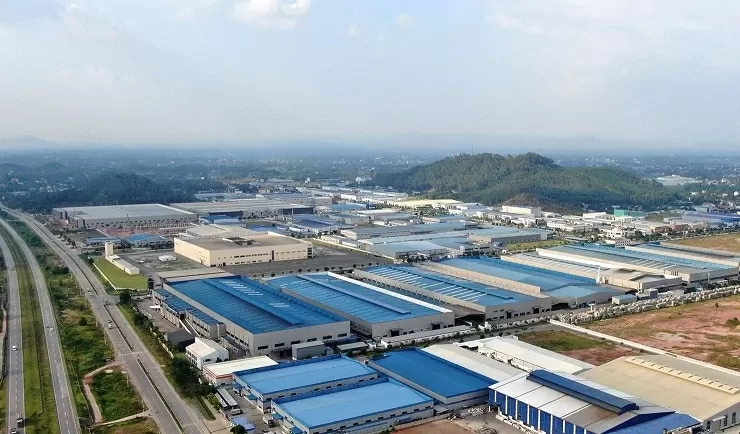 |
| According to the 2021–2030 planning period, Thai Nguyen still has more than 6,000 hectares of land for industrial development. (Photo: Thai Nguyen Provincial People's Committee) |
The province aims to balance economic growth with environmental protection by developing green, smart, and energy-efficient industrial zones.
Investor selection criteria have also become more stringent, requiring strong financial capacity, advanced technology, and long-term commitment to the locality. Additionally, the province seeks to enhance linkages between FDI enterprises and domestic businesses through supply-demand connection programs, technology innovation support, and workforce training.
This approach is essential for spreading the benefits of FDI across the local economy.
The provincial government continues to promote administrative reform and digital transformation in investment management while maintaining regular dialogue with enterprises to resolve obstacles promptly. Investment promotion missions have been organised in South Korea, Japan, the US, and the EU to showcase local potential and attract strategic investors.
In 2025, Thai Nguyen aims to attract VND 90 trillion in non-budget investment capital, of which approximately VND 39.3 trillion is expected from the FDI sector, mainly in industrial parks and clusters.
Harnessing potential, maximising strengths
Thai Nguyen is well-known for the Nui Phao polymetallic mine—one of the world’s largest tungsten reserves—invested by Nui Phao Mining Company Ltd. (under Masan High-Tech Materials) with a total capital of over USD 500 million.
Covering nearly 152 hectares, the project extracts and deeply processes associated minerals such as fluorite, bismuth, copper, and gold, playing a strategic role in the global high-tech materials supply chain.
Meanwhile, Bac Kan is rich in mineral resources, including precious metals such as lead, zinc, antimony, copper, and gold.
The merger of the two provinces opens opportunities to connect the mining–processing–consumption value chain, supported by synchronised infrastructure, a skilled technical workforce, and Thai Nguyen’s existing industrial processing capacity. According to Deputy Prime Minister Nguyen Chi Dung, Bac Kan and Thai Nguyen share a long history and cultural similarities. The merger of the two provinces holds significant meaning—it expands development space, unlocks resources, and connects Thai Nguyen’s dynamic industrial–urban hub with Bac Kan’s ecological and cultural potential.
The Deputy Prime Minister also directed Thai Nguyen to focus on developing key growth pillars such as high-tech industry, clean agriculture, green tourism, digital economy, and innovative industrial zones, while proactively proposing special mechanisms and breakthrough policies to promote private-sector and high-tech enterprise development.
In recent years, domestic and foreign investment flows into the Thai Nguyen–Bac Kan area have grown strongly, particularly in high-tech industries, supporting industries, mining, and deep mineral processing.
With the synergy between industrial strength and natural resources, Thai Nguyen is expected to leap forward, becoming a new growth pole in the northern midland and mountainous region, contributing significantly to the country’s industrialisation and modernisation process.