






Resolution 79-NQ/TW on state economy: A vector for Vietnam's entry into a new era
WVR - Resolution 79-NQ/TW by the Politburo on the development of the state economy is seen as a guiding vector for Vietnam's entry into a new era.
Latest
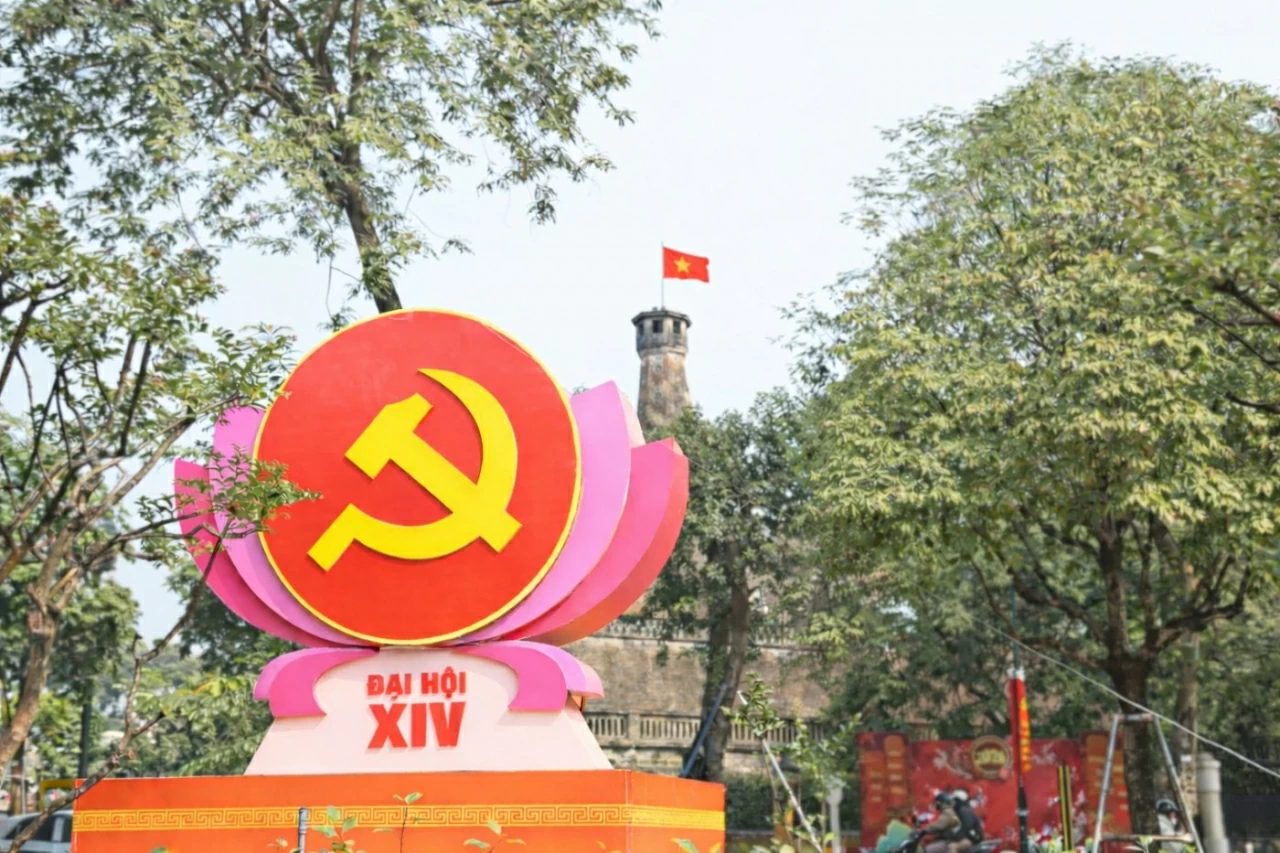 |
| The model welcoming the 14th National Party Congress is placed at the Lenin Monument on Dien Bien Phu Street. (Photo: Thanh Long) |
In the context of a world entering a new cycle of competition, where development space extends beyond land and sea to digital, underground, and even outer space, Resolution 79-NQ/TW by the Politburo on state economic development emerges as a “marching order” for the state economy – the backbone of the national economy – to embark on a new journey at the 14th National Party Congress.
The new mission of the state economy is not just to act as a “pillar”, but to become a pioneering force, guiding and creating growth to propel the nation into a new era.
Major shift in governance thinking
After 40 years of Renewal, the state economy has always been the “barometer” of the national economy, maintaining macroeconomic stability during the toughest times.
However, amid increasingly fierce strategic competition, rapid digital transformation, and continuous restructuring of global supply chains, merely acting as a “shield” is insufficient. Resolution 79 sets a higher requirement: the state economy must become a spearhead breaking through old growth limits.
A fundamental novelty of the Resolution is the expansion of the development space for the state economy. This is not just about capital and assets, but also about resources, strategic infrastructure, maritime space, underground space, digital space, and even future emerging spaces.
The state economy plays a decisive role because it creates foundational conditions for the development of other economic sectors. In other words, it is the strategic platform for the entire economy to leap forward.
However, this platform is only truly solid when built on a new governance foundation.
Resolution 79 directly addresses a core bottleneck that has existed for many years: the administrative management mindset towards enterprises. This time, the message is clear: shift from management to creation, from intervention to empowerment, from pre-inspection to post-inspection.
Clearly separating ownership functions from enterprise management functions is not just a technical adjustment, but a pivot in thinking. State enterprises cannot continue to be entangled in the “playing and refereeing” cycle, nor can they develop if every business decision requires a “beg-and-give” mechanism.
Notably, the mechanism allowing the formation of venture capital funds along with a framework protecting officials who dare to think and act for the common good is a strong political commitment to remove the fear of mistakes and responsibility – the “invisible barrier” that has hindered many development opportunities.
The introduction of concepts like “space economy”, “low-altitude economy”, and “underground space” into the strategic vision for the first time indicates that the Party has positioned the state economy on the future development axis, where competition is not only about scale but also about technology and the ability to create new development spaces.
The challenge of steering growth
Resolution 79 does not hide its ambition when setting the target: by 2030, there will be about 50 state enterprises among the 500 largest in Southeast Asia, with 1-3 enterprises in the Top 500 globally; 100% of state enterprises will be managed on a digital platform and according to OECD standards.
Behind these numbers is not just a desire for scale, but a desire for status.
OECD standards are not merely a set of governance rules. They are a passport for Vietnamese state enterprises to enter the global arena: more transparent, more professional, and more accessible to capital flows, technology, and strategic partners.
More importantly, it is a way for enterprises to shift from being reactive to proactive, from following the market to shaping the rules.
A well-governed state enterprise will not stand alone. Instead, it will become the hub of an entire production ecosystem, pulling along numerous domestic enterprises to participate in the supply chain, forming truly competitive industrial clusters.
Therefore, the “leading crane” mindset in Resolution 79 is not about spreading resources thinly, but about concentrating resources on key sectors: energy, digital infrastructure, telecommunications, manufacturing, and defense-security.
Pillars like Viettel, PVN, EVN, and major state-owned commercial banks are positioned not only to grow themselves but to lift the entire flock.
Action is the measure
A correct Resolution does not automatically become reality. The journey from thought to life is always challenging, where the organization’s implementation capability plays a decisive role.
To bring Resolution 79 to life, it must be quickly institutionalized through the legal system, especially regulations on state capital management in enterprises, aimed at reducing administrative intervention in business activities while increasing discipline through institutions and transparency.
The spirit of “local decision, local action, local responsibility” as emphasized by Prime Minister Pham Minh Chinh must be consistently implemented. For state enterprises, real autonomy must be granted to the board of members, while controlling power through mechanisms and transparency.
Above all, personnel must be considered the key of keys. State enterprises can only go far if they become a gathering place for talent, where the capable are given opportunities and rewarded commensurately with the results and value they create.
Resolution 79-NQ/TW is not just about state enterprises. More profoundly, it is about how Vietnam reorganizes its development drivers in a rapidly changing world.
When the “leading cranes” truly spread their wings, they carry not only economic responsibility but also the aspiration for self-reliance and the rise of the entire nation.
In his directive speech at the Government Conference with localities to implement the 2026 tasks, General Secretary To Lam stated that the country has gathered enough momentum, will, and determination to enter a new era.
And Resolution 79 is the launchpad for the state economy to truly become a solid foundation, enabling the country to confidently advance on the path of rapid and sustainable development.