







Promoting digital transformation while protecting human rights, ensuring digital security, and sustainable development of the nation
WVR - Opening remarks by Associate Professor Dr. Tuong Duy Kien, Director of the Institute of Human Rights, Ho Chi Minh National Academy of Politics at the scientific seminar titled "Human Rights in the Digital Age - Theory and Practice", in Lao Cai.on December 5, 2025.
Latest
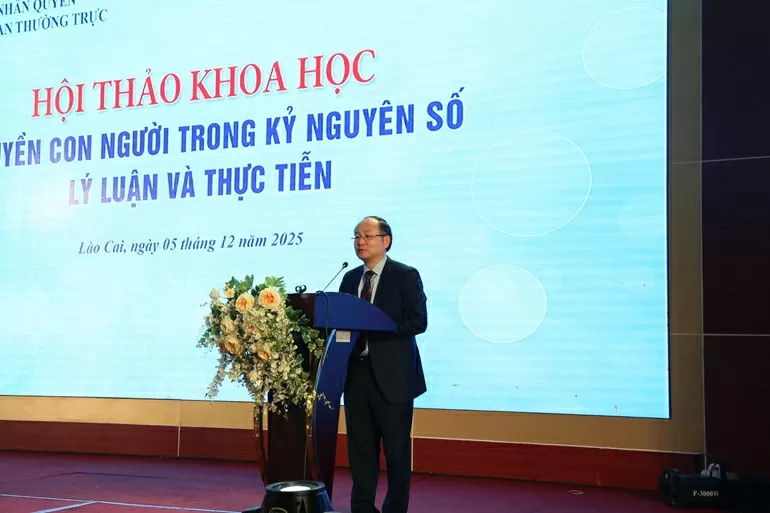 |
| Associate Professor Dr. Tuong Duy Kien, Director of the Institute of Human Rights, delivers the opening remarks at the seminar "Human Rights in the Digital Age - Theory and Practice". (Source: BTC) |
We are living in an unprecedented era of development in human history – the era of Artificial Intelligence (AI), Big Data, Cloud Computing, Blockchain, the Internet of Things (IoT), Virtual/Augmented Reality (VR/AR), and new-generation digital technologies. This revolution not only changes production methods but also reshapes the entire social structure, national governance, and human interaction.
Opportunities and challenges
On the opportunity side, advancements in digital technology bring unprecedented benefits, contributing to the realization of fundamental human rights:
Access to knowledge and education: Digital technology blurs geographical boundaries, offering lifelong learning opportunities and access to global knowledge for all citizens.
Economic development and the right to work: The digital economy and sharing economy create numerous new jobs, expand creative space, and increase labor productivity, thereby reinforcing the right to an adequate standard of living.
Improving governance and public services: Digital states and e-governments enhance governance capacity, increase transparency, reduce corruption, shorten administrative procedures, and strengthen citizens' rights to participate in public life.
However, alongside opportunities, the digital age also poses profound, multi-dimensional, and complex challenges to human rights. These are entirely new issues that traditional legal systems, social norms, and governance mechanisms have never faced before.
We would like to highlight three basic recognitions as the basis for the necessity of this seminar:
First, challenges in terms of human rights theory and concepts: Digital technology blurs the boundaries between personal and public spaces, requiring a reinterpretation of traditional human rights concepts:
Right to Privacy: Traditionally associated with personal physical space, it now extends to the entire digital footprint. The challenge is that personal data (from biometrics to consumer habits) can be collected, analyzed, shared, and used almost without limits by transnational private entities.
Freedom of Expression: No longer confined to journalism or assemblies, it occurs in the global online space where information spreads instantly, transcending national borders. The biggest challenge is balancing freedom of expression with social responsibility, protecting individual rights while combating fake news, misinformation, and hate speech – factors that can cause political and social instability.
Right to Equality: Technology can exacerbate the digital divide, creating a new form of inequality in access, use, and benefits from technology, especially for the poor, ethnic minorities, and the elderly.
Second, challenges in legal frameworks and governance: The technology-law asymmetry
Nations face an extremely challenging problem: how to build a strong legal corridor to regulate technology while maximizing conditions for innovation?
The lag of the law: The nature of technology is exponential speed, while the legislative process is linear and slow. If the law lags behind technology, regulatory vacuums will appear, leaving citizens vulnerable without appropriate protective mechanisms (e.g., AI liability, intellectual property rights for AI-generated works).
The cross-border nature of technology: Major tech corporations (Big Tech) operate transnationally, making a country's data and content management rules ineffective without global cooperation. The issue of national data sovereignty and the responsibility of transnational platforms in Vietnam is a significant legal and governance challenge.
Third, challenges in practical development in Vietnam: Accelerating alongside protection. Vietnam is one of the fastest digital transformation countries in the region.
With over 78% of the population using the Internet and over 70 million social media accounts, digital banking, digital education, digital healthcare, and digital government systems are thriving. Digital transformation is a national strategic goal, identified in resolutions and development strategies of the country.
However, the stronger the transformation, the more it is necessary to strengthen mechanisms to protect human rights in the digital environment. Issues such as online fraud, defamation, personal data leaks, and the risk of cyberattacks are increasing, requiring a proactive, comprehensive approach.
All the above analyses pose an urgent requirement: to proactively research, forecast, plan policies, perfect laws, and build mechanisms to enforce human rights suitable for the digital age. This is why today's scientific seminar is of particular importance, contributing scientific and practical arguments to guide legislative, executive, judicial activities, data governance, and technology development in Vietnam.
Based on the synthesis of nearly 40 high-quality scientific papers submitted to the Organizing Committee, we have categorized and proposed six key thematic groups. We hope these thematic groups will establish a multi-dimensional, in-depth, and practical forum for academic exchange, providing highly feasible recommendations.
Theoretical and legal foundations: Creating new frameworks
This research group aims to redefine basic principles and build a solid legal foundation to ensure human rights in the digital space.
Is the right to access the Internet a fundamental human right? Is it time to recognize the right to access the Internet as a fundamental right in Vietnam's Constitution or legal system, similar to the United Nations' recommendation, to ensure no citizen is left behind in the digital age?
Accountability of Transnational Tech Companies: Transnational tech corporations like Meta, Google, Apple, OpenAI are not governments but have global influence. How should they comply with human rights standards in Vietnam? What mechanisms are in place to hold them legally accountable when violating the rights of Vietnamese citizens, especially in content moderation or data usage?
The core of this thematic group is to identify the delicate balance between: individual rights and public interest; innovation and state management; national sovereignty and global connectivity.
Privacy and personal data protection: Data autonomy
This issue is considered the "currency" and "hottest front" in the data age. Vietnam has a Decree on Personal Data Protection (Decree 13/2023/ND-CP), followed by the Personal Data Protection Law, but implementation poses many challenges:
Voluntariness of consent: Is obtaining "consent" from users in current technology applications truly voluntary? Do users genuinely understand what they are allowing data collection and usage for, or is it merely a formal agreement to use the service (take-it-or-leave-it condition)?
Preventing mass surveillance: How to build legal and technological barriers to avoid mass surveillance through facial recognition, smart cameras, or online behavior analysis, ensuring technology use is limited to necessary and legal scopes?
The important discussion direction is: Building a data governance mechanism based on transparency, accountability, meaningful consent, and data self-determination. It is necessary to study the GDPR experience from Europe and apply it flexibly to Vietnam.
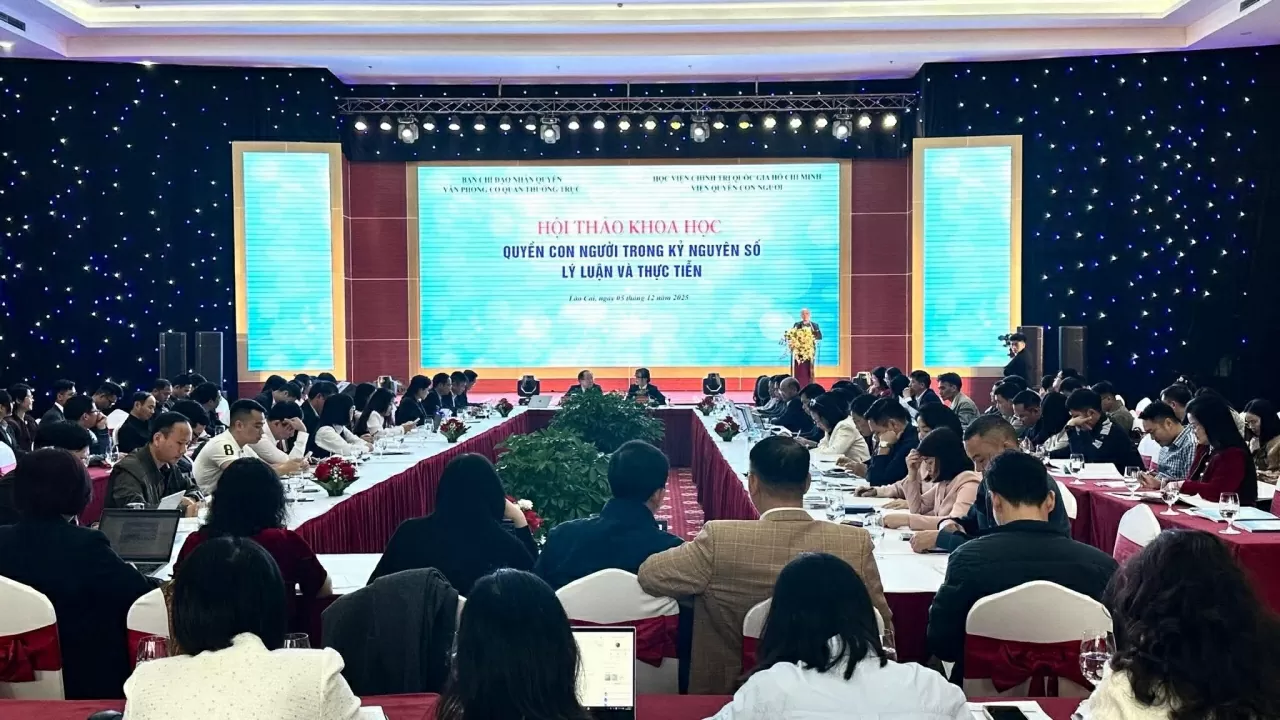 |
| Scientific seminar with the theme "Human Rights in the Digital Age - Theory and Practice", on December 5, in Lao Cai. (Source: BTC) |
Freedom of expression and right to information: Digital platform governance
This issue directly relates to freedom of speech, online child protection, national security, and combating fake news/disinformation.
Content moderation standards: Should content moderation follow national laws (e.g., prohibiting anti-state propaganda, fake news causing panic) or apply global standards (community standards of platforms)? What mechanisms are in place to compel platforms to quickly and effectively remove content violating Vietnamese laws?
Right to be Forgotten: Can the "right to be forgotten" mechanism (allowing individuals to request the removal of irrelevant or inaccurate information) be applied in Vietnam? This is an important right to protect honor and dignity in the context of permanently existing online information.
It is necessary to build a platform governance model suitable for Vietnam's characteristics, protecting freedom of expression while ensuring national security and public order.
Equality and protection of vulnerable groups: Technology for sustainable development goals
Technology must create social progress, not social division. This thematic group focuses on human rights issues for the most vulnerable groups.
Narrowing the digital divide: The central issue is narrowing the digital divide between urban and rural areas, between the rich and the poor, through policies to universalize the Internet, digital skills training, and inclusive digital public service development.
Preventing cyberviolence: Protecting women, children, and people with disabilities from cyberviolence, online bullying, and cyber-harassment. Legal and technical measures are needed to identify, handle violators, and provide psychological support for victims.
This is not only a human rights issue but also a key factor in achieving Sustainable Development Goals (SDGs) and ensuring social stability.
New challenges and contemporary issues: AI accountability
The rise of AI, especially Generative AI, poses entirely new philosophical, ethical, and legal issues, requiring proactive preparation from Vietnam.
AI ethics principles and algorithm accountability: When AI algorithms make decisions affecting human lives (e.g., lending, recruitment, medical prognosis), who is responsible for errors or biases? It is necessary to build national AI ethics principles and mechanisms for explainable and transparent algorithm systems.
Intellectual property in the generative AI environment: How to protect copyright for works created by AI? Is using copyrighted data to train AI legal?
Countries have begun enacting AI laws (such as the EU AI Act), but Vietnam needs to approach it in a way that suits domestic technology development and national goals.
Protecting the Party's ideological foundation and national digital sovereignty
This is a crucial highlight, reflecting the unique characteristics and core political requirements of Vietnam in the digital age.
AI application in protecting ideological security: Two key contents are: Applying AI and Big Data in detecting, preventing, and effectively handling false, distorted, and anti-state information in cyberspace; simultaneously, building positive digital communication mechanisms to guide public opinion.
Enhancing "Digital Ideological Immunity": Strengthening education, enhancing digital literacy, and digital ideological immunity for youth, students, and the entire society so they can proactively identify, analyze, and refute harmful information.
This is both an urgent task (addressing current cybersecurity situations) and a long-term one (protecting the younger generation), aiming to maintain political stability and protect national digital sovereignty.
Ensuring human rights in the digital age is no longer a choice but an objective requirement, a strategic task of the Party, State, and the entire society. This is not solely the work of the legal, technology, security, or state management sectors, but requires multi-sectoral, interdisciplinary coordination, and active participation from the business community, social organizations, scientists, and every citizen.
Today's seminar not only stops at identifying issues but, more importantly, serves as a bridge between knowledge and practice, to propose: A solid theoretical foundation for reinterpreting rights; A legal framework that predicts and regulates technology; An operational mechanism and policy model that is transparent and accountable; and Effective and inclusive implementation solutions.
We believe that with the presence of leading scientists, management experts, and dedicated delegates, the insights at the seminar will be profound and valuable. These practical recommendations will contribute to perfecting the legal system, enhancing state management quality, promoting digital transformation alongside protecting human rights, ensuring digital security, and sustainably developing the nation in the spirit of "Putting people and businesses at the center" of the National Digital Transformation Strategy.