






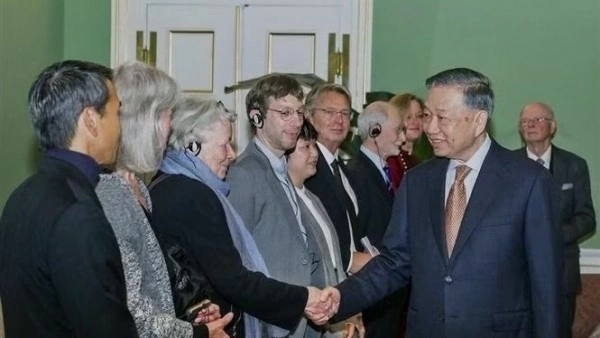

Passing on hope from Silicon Valley to an elementary school in Phu Quoc
One week has passed since returning from a 17-day journey to Vietnam, meticulously arranged - from itinerary to logistics - by a classmate from Stanford business school. The trip offered our group of 40-year-old friends abundant opportunities to reflect on Vietnam’s history and engage with local communities.
Latest
Along the way, I encountered moments and people that prompted me to reexamine my own outlook on life. Unexpectedly, it was those who had survived unimaginable hardship—broken families from the Vietnam War, young people in a new Vietnam speaking of their dreams, and children expressing pure and unguarded joy—who offered these profound insights.
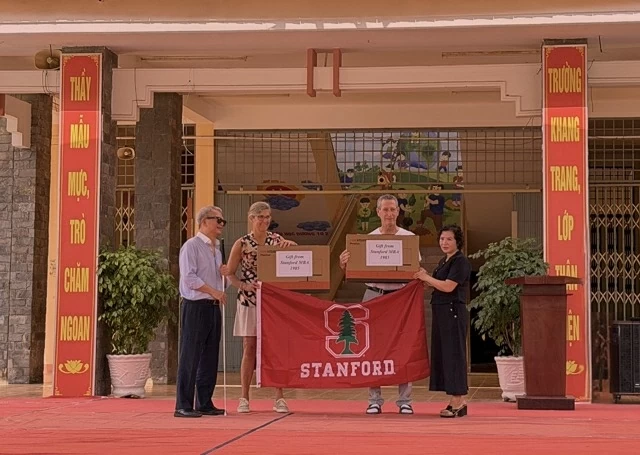 |
| Representatives from Stanford Business School donated computers to the school |
Even now, the impressions linger. As I recall the faces of those whom I met, I am gradually recording the stories that left a deep imprint on my heart. The leader of our tour was Pham Duc Trung Kien, a Vietnamese-American classmate who was honoured last October by Stanford Business School among its "100 Alumni Catalysts" for global impact is a business investor and social innovator. He founded the Vietnam Foundation and has sent hundreds of the best Vietnamese talents to top universities in the U.S. for doctoral degrees, and hundreds of them have returned to Vietnam during the last 20 years to help rebuild the country. In recent years, the Vietnam Foundation has brought the online education platform Khan Academy from Silicon Valley to big and small towns across Vietnam, benefiting millions of students and thousands of teachers in more than 11,000 public schools. Our tour combined visits to historical landmarks with an in-depth study of Vietnam’s complex past, as well as visits to major development projects that revealed the country’s rapid economic growth. At the same time, we were prompted to reflect on the social challenges accompanying that growth. Speakers included a former U.S. ambassador to Vietnam and leaders from the business and education communities, offering thoughtful perspectives on Vietnam’s future.
We also visited a local elementary school to observe vibrant classrooms in action, spoke with high school students aspiring to study abroad about their dreams, and met young people at a training institution supporting employment with Japanese companies, where they shared their hopes for their professional career path in Japan.
Tourism highlights included a visit to Sa Pa, a northern town in the mountains developed during the French colonial era. Travelling overnight from Hanoi by a train that first began operating in the early 1900s—its wooden-style carriage creaking along the way - I slept until being awakened by the conductor the next morning. At Mount Fansipan, a funicular broke through layers of clouds, delivering us into clear blue skies. The breathtaking panorama, atop what is known as the “Roof of Indochina,” along with the vivid embroidered textiles of the Hmong people living at its foothills, remains unforgettable.
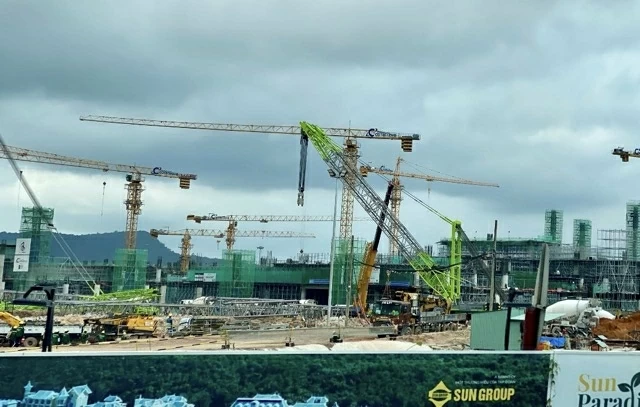 |
| Learning about major economic development projects and perspectives on Vietnam’s future |
Over more than two thousand years of history, Vietnam has repeatedly faced threats and invasions from powerful nations. Despite such a harsh history, the people we met across generations were strikingly cheerful, open, and forward-looking. Many conveyed a shared resolve: to leave past suffering behind and focus on building a brighter future.
Following reunification in 1975, Vietnam struggled under a centrally planned economy for about a decade. Severe poverty and food shortages led to a bold policy shift in 1986 toward a market-oriented system known as Renovation Cause (Doi Moi). Since then, Vietnam’s economy has steadily expanded, with GDP growth exceeding 6 per cent in recent years - among the highest in Southeast Asia. The government continues structural reforms aimed at achieving upper-middle-income status through infrastructure investment and income growth.
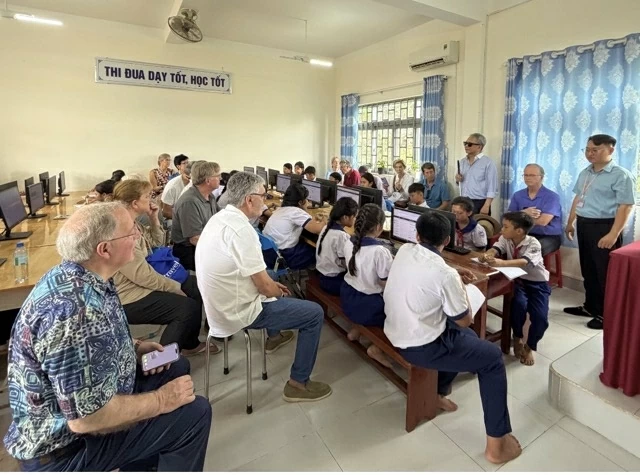 |
| Observing a Grade 4 Math class using the Khan Academy platform |
In Ho Chi Minh City, where we stayed near the Opera House, preparations for Tet filled the streets with young people dressed in traditional Ao Dai, posing cheerfully for photographs. With an average national age of 32, the country’s youthful dynamism is palpable. Of course, risks remain: environmental concerns from rapid development, infrastructure constraints, geopolitical uncertainties, inflationary concerns, shifting US trade policies, and ongoing regional tensions. Yet despite these challenges, Vietnam inspires optimism. Its difficult past makes me cheer all the more for its continued success and bright future.
On our fifth day in Vietnam, we visited Phu Quoc, Vietnam’s southernmost resort island. Once a quiet island of pearl farming and fish sauce production without even an airport 15 years ago, it now hosts luxury hotels and is undergoing rapid development ahead of the APEC 2027 summit. Construction cranes fill the skyline, transforming the island’s landscape. Expectations are high, recalling the economic impact of APEC in Da Nang in 2017.
While the resort stay was relaxing and much needed, I most enjoyed our visit to a local elementary school. About 40 minutes inland from the glittering resort coastline, we arrived at a modest village. The school fully utilises the Khan Academy online program, which was introduced to Vietnam a few years ago. Because the road was not passable by a large bus, we walked the unpaved final stretch. As we reached the gate, around 200 children gathered in front of a temporary stage, erupted in cheers, and waved energetically and jumped with excitement to welcome us. The scene was far removed from any rigid stereotype of a public school in a communist country - it was vibrant, joyful, and full of life.
After the principal's welcoming remarks, our classmates presented desktop computers donated by our Stanford class. Our group leader encouraged the children to study hard and “aspire to attend Stanford”, so I assume. The celebration concluded with lively dance and song performances by the students. In a fourth-grade classroom, we observed students working with a Khan Academy math program. The program has been localised by the Vietnam Foundation, particularly to strengthen mathematics education, reportedly to a level higher than that of American students. We heard Vietnam’s IT infrastructure and device access are sufficiently robust to allow students to continue learning at home without difficulty.
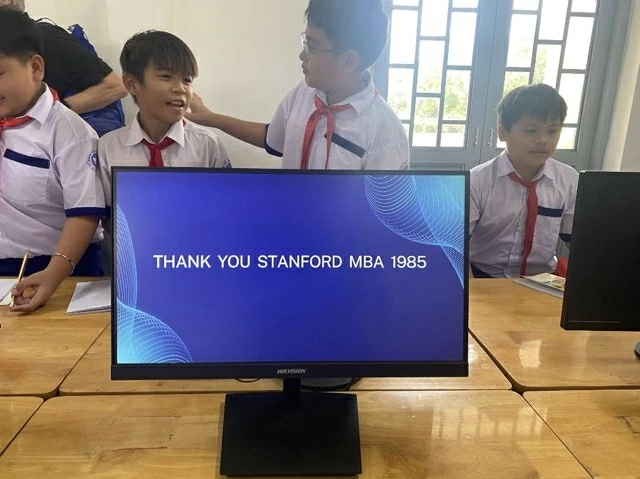 |
| “Let’s meet someday in California!” |
It was deeply moving to see an online program originating in Silicon Valley supporting learning at a small elementary school on a southern island 8,000 miles away. While silently cheering, “Go, you children of Vietnam!,” I felt that it was I who was being encouraged by their bright energy and optimism. The gift entrusted with hope from Silicon Valley was returned with radiant smiles from the children, who conveyed confidence in the future.
With heartfelt gratitude to the children of Vietnam who wrapped vitality and hope in their smiles, we departed after exchanging high-fives and saying, “Let’s meet someday in California!”
| About the author: Ms Atsuko Jenks is an expert consultant who has advised major Japanese corporations on global expansion during the last 40 years. Last month, she toured Vietnam with a group of 30 U.S. business and investment executives. She holds an MBA from Stanford University in the U.S. and a BA from Tsuda University in Japan. |

| Khan Academy Founder praises Vietnam's vision for digital transformation in education As part of a recent visit to Silicon Valley, Mr. Pham Duc Trung Kien, representative of The Vietnam Foundation (VNF), which implements the Khan Academy ... |

| Khan Academy Vietnam and Diplomatic Academy to promote AI integration in teaching On January 7, the Diplomatic Academy of Vietnam (DAV), in collaboration with The Vietnam Foundation and Khan Academy Vietnam (KAV), organised a seminar titled “Introduction ... |


