



Professor Furuta Motoo: Understanding Vietnam to understand the world
WVR - Choosing to study Vietnam as a key to understanding the world, for over 50 years, Professor Furuta Motoo has been a steadfast bridge in Vietnam-Japan educational cooperation.
Latest
| Editor's Note: There are bonds with Vietnam that begin with a page of a book, a lecture, a trip, a meeting, or years of living amidst historical upheavals. Over time, these touchpoints transcend geographical distances, language, and cultural differences to become understanding, sharing, and connection. From stories about people, one can see a multi-dimensional Vietnam rich in connectivity. These are scholars who have spent many years studying the country, its people, and its history, considering understanding Vietnam as a way to gain broader insights into the world and inter-nation relationships. These are also women who, at different times and circumstances, have contributed to bridging peace, bringing people closer after separations and losses. And these are individuals who carry memories of Vietnam, finding commonalities in emotions, culture, and people from personal nostalgia. The noteworthy aspect of these stories does not lie in the distance between “Vietnamese” and “foreigners,” but in the values that can transcend borders. A research project, a class, a meeting, an exchange activity, or a preserved memory can all become starting points for empathy and dialogue. In this flow, Vietnam is both the origin of stories and the convergence point of various journeys. Each character brings a unique perspective, but behind these differences is a common denominator: The appreciation for the country, its people, and the values that have created enduring bonds over time. The series “Vietnam - Where Hearts Meet” recounts encounters between people, between memory and the present, between lands once thought distant but now close. Through this, the series adds a perspective on the power of connection, where understanding and genuine affection can become bridges bringing Vietnam closer to international friends, while also allowing hearts from around the world to find a part of themselves in Vietnam. |
In a conversation with The World and Vietnam Report, he shared about his academic journey and the motivations behind creating an international education model in Vietnam.
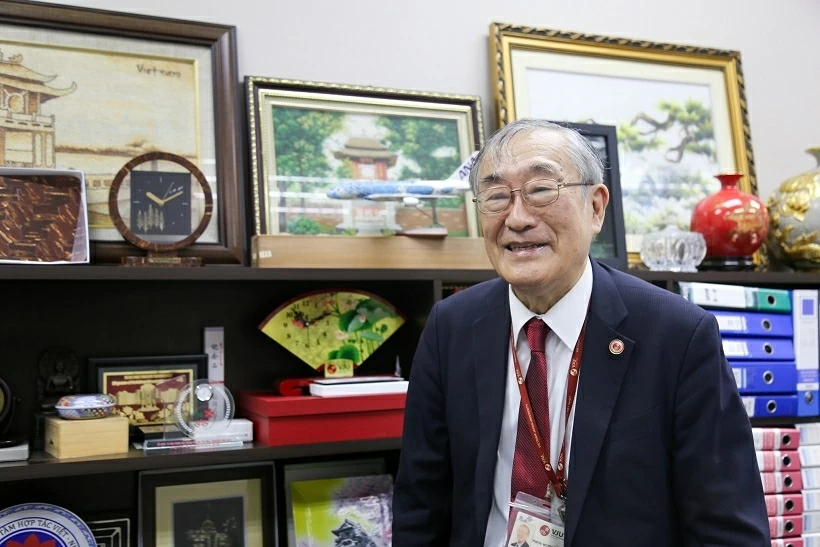 |
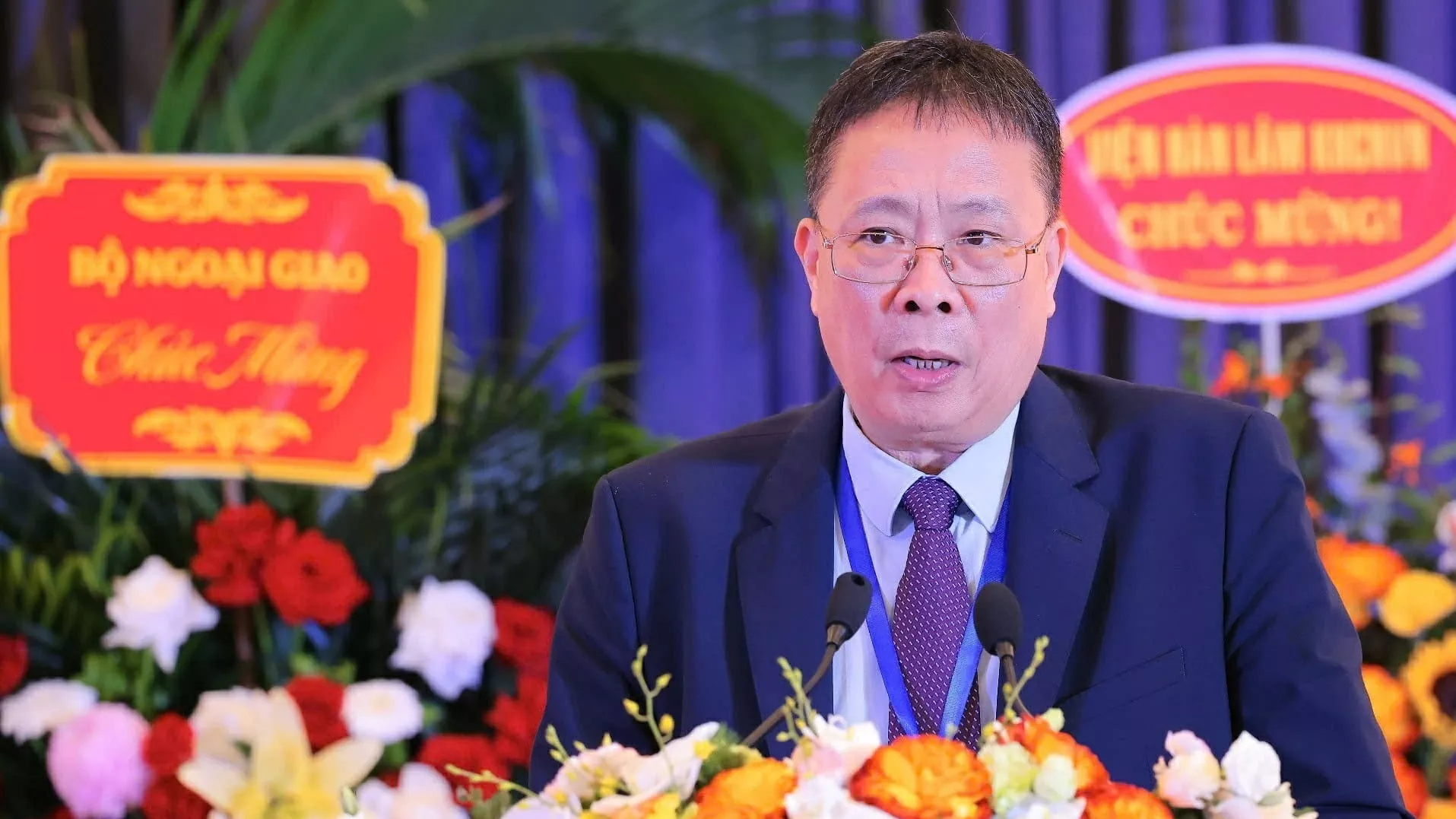
| Professor Furuta Motoo.(PhotoL: WVR) |
Professor, what brought you to Vietnamese studies and kept you deeply engaged for so many decades?
When I entered the University of Tokyo, the fierce resistance war against the U.S. by the Vietnamese people was at its peak. To me, it seemed as if the entire world was revolving around Vietnam as its centre.
I believed that if I could understand Vietnam with that “central” significance, I could easily understand the world. That was the biggest reason I chose Vietnam as my research subject.
Thus, one could say Vietnam was my first love on my scientific research path. Over more than half a century, I have remained very faithful to that first love.
The most important factor that kept me persistent with this first love is the people – my Vietnamese friends, including the teachers who guided me, colleagues, and students... Thanks to the invaluable support and deep affection from my Vietnamese friends, I have been able to persistently pursue my research on Vietnam.
As the first foreigner to hold the position of Rector at a member school of Vietnam National University, Hanoi, how do you perceive this responsibility after many years?
For me, the role of Rector at Vietnam Japan University (VJU) is a position where failure is not an option. This creates a great deal of pressure on me.
However, I have managed VJU for the past 10 years based on the invaluable cooperation of all participants from both Vietnam and Japan, and I am immensely grateful for that.
In your opinion, what makes VJU unique within the Vietnamese higher education system?
I have always believed that VJU should train talents who can contribute to promoting an equal partnership between Vietnam and Japan. To achieve this, we need a new perspective on both Japan and Vietnam.
When Vietnamese people want to understand Japan, they need a more multi-dimensional perspective and critical thinking, paying attention not only to Japan's successes but also to its failures. Through this, Vietnamese people can proactively apply Japan's thinking, methods, and experiences to their real lives.
With the expectation that VJU symbolizes Vietnam-Japan educational cooperation, how do you assess the effectiveness of this model after nearly a decade, especially in the context of globalization and digital transformation?
I hope VJU will play a significant role in changing the image of Japan in Vietnam, aiming for a multi-dimensional, unbiased, non-deified, and non-repudiated view of Japan.
Moreover, Vietnamese people can reflect on Japan's successes and failures, compare them with other countries worldwide to draw lessons suitable to Vietnam's situation and development aspirations. Such a new perspective on Japan will be called “Liberal Japanese Studies”.
The focus of VJU's training and research is in advanced technology fields where Japan excels. However, to promote technology transfer, we need the perspective on Japan as mentioned above.
Therefore, I believe VJU should develop advanced technology fields while maintaining and valuing “Liberal Japanese Studies” and “Liberal Vietnamese Studies” at a certain scale.
I find that such a model is worthy of the name VJU. With this orientation, VJU takes advanced technology fields as its focus while adopting liberal education as its educational philosophy.
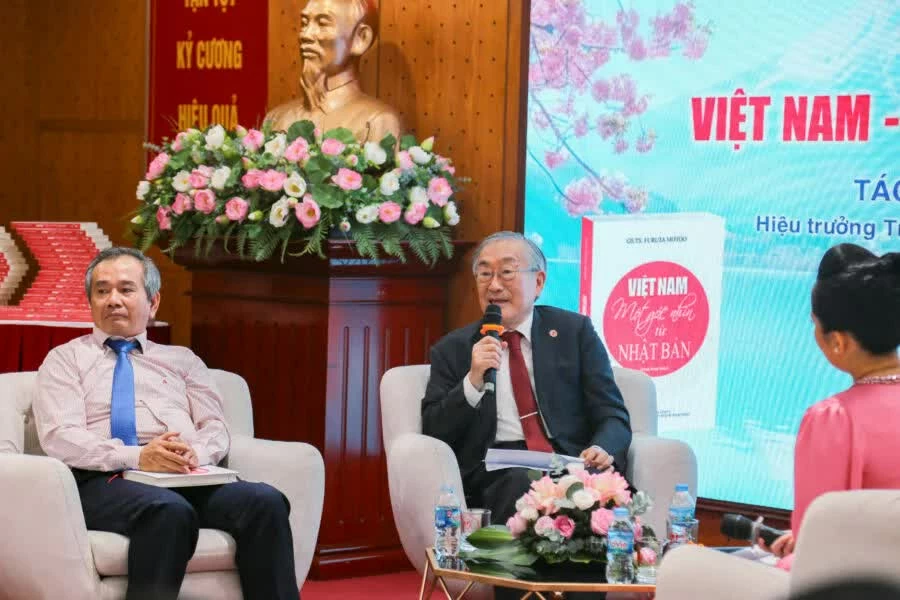 |
| Professor Furuta Motoo launched the book “Vietnam - A Perspective from Japan” in 2025. |
In your opinion, what is the biggest barrier to the internationalization of Vietnamese higher education today?
Vietnam has a culture of respecting foreign guests. As a foreigner living in Vietnam, I have benefited greatly from this culture. However, I believe that the culture of “respecting guests” is different from treating foreigners as colleagues.
I think that for universities to truly internationalize, there will be limitations if they do not establish a culture of welcoming foreign researchers and lecturers as “colleagues” rather than just “guests”.
Vietnamese universities have flexible academic calendars (including the start and end dates of semesters and academic years).
While this has advantages, such as the ability to effectively handle emergencies like COVID-19, the culture of not deciding the start date of the next semester until the last minute is a major obstacle to international exchanges at universities, such as the participation of foreign lecturers in classes, student exchange programs with foreign universities during breaks, and the reception of international students.
If this flexible academic calendar is viewed as part of university culture, I believe it is a culture that needs to change to welcome foreigners as “colleagues”.
From the practical training at VJU, how do you view the need for innovation in higher education, especially in linking training with practical needs and international cooperation?
VJU focuses on comparisons with Vietnam to help Vietnamese students gain a deeper understanding of Japan. The Japanese modules are taught by both Japanese and Vietnamese lecturers, aiming to help students understand Japan through comparisons with Vietnam.
We aim to provide high-quality human resources for both Japanese and Vietnamese enterprises.
Currently, many Japanese companies want to tap into the Vietnamese market, developing goods and products that suit Vietnamese tastes.
Therefore, they need Vietnamese personnel who truly understand Vietnam. Moreover, when Vietnamese students want to proactively apply Japanese experiences, they also need a solid understanding of Vietnam.
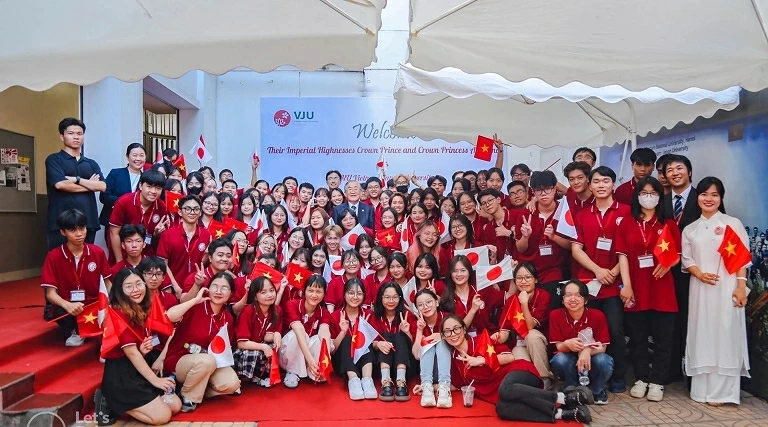 |
| Professor Furuta Motoo with VJU students. |
Resolution No. 71-NQ/TW of the Politburo emphasises the requirement to improve the quality of human resources in the context of international integration. In your opinion, what changes do Vietnamese universities need to make to meet this requirement?
I believe Vietnamese universities need to innovate their approach and perspective on foreign culture and technology. VJU will play a pioneering role in renewing the perspective on Japan in Vietnam.
Resolution 71 encourages Vietnamese educational institutions to establish branches abroad. I hope that among VJU graduates, there will be those who realize the establishment of a VJU branch in Japan.
Thank you very much, Professor!
| Professor Furuta Motoo is a leading Vietnamologist in Japan, specializing in the history and politics of Vietnam. He was formerly the Dean of the College of General Education, University of Tokyo (2001-2002); Vice President of the University of Tokyo (2004-2006); Director of the University of Tokyo Library (2009-2015). He is the first foreign Rector of Vietnam Japan University (under Vietnam National University, Hanoi) and completed a 10-year term from 2016-2026. |
Relate News