






International Conference on Development Economics: Finding new drivers for Vietnam's economic growth
Vietnam needs to innovate its growth model, relying more on productivity, knowledge, innovation, and institutions to overcome the middle-income trap.
Latest
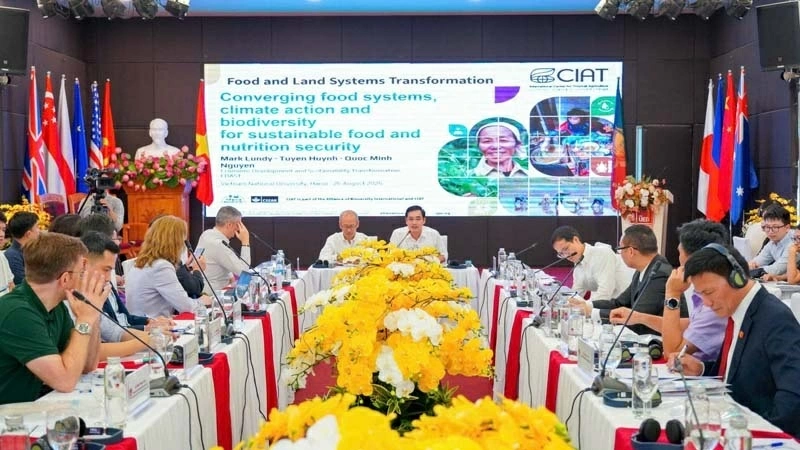 |
| The overview of the first International Conference on Development Economics with the theme “Economic Development and Sustainable Transformation”. (Photo: Thanh Mai) |
Climate, resources, energy, population, technology, geopolitics, and global value chain fluctuations are imposing new demands on the growth models of many countries. For Vietnam, the challenge is even more urgent as it aims to become a developed, high-income country by 2045 and achieve net-zero emissions by 2050.
This is also the focus of the first International Conference on Development Economics with the theme “Economic Development and Sustainable Transformation” (EDAST 2026), organized by the University of Economics - Vietnam National University, Hanoi (UEB) in collaboration with the International Centre for Tropical Agriculture (CIAT).
With 2 plenary sessions, 5 keynote reports, and 1 roundtable discussion, the conference provides an academic exchange space and policy dialogue on Vietnam's development choices in response to the need for rapid, sustainable, and adaptable growth.
Traditional growth drivers narrowing
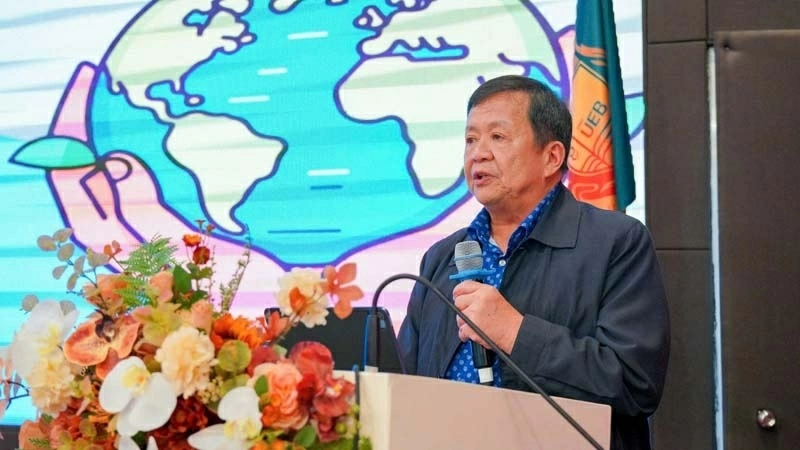 |
| Prof. Dr. Roberto F. Ranola, Jr., President of Cabuyao University, Philippines. (Photo: Thanh Mai) |
One of the prominent issues at EDAST 2026 is the risk that Vietnam may struggle to maintain high growth rates without structural transformations.
Drawing from South Korea's industrialization experience, Prof. Dr. Keunjae Lee from Pusan National University (South Korea) analyzed the process of transforming an economy with a per capita income of about 100 USD into a nation with an income over 33,000 USD. He highlighted a series of risks Vietnam needs to address promptly, including stagnating productivity, an aging population, a shortage of high-quality human resources, limited domestic enterprise capabilities, insufficient innovation, and institutional quality lagging behind development speed.
This indicates that the challenge is not only to maintain growth rates but to change the way growth is generated. As advantages in labor, resources, or investment expansion narrow, the economy must rely more on productivity, human resources, and innovation capabilities.
According to analyses at the conference, to overcome the middle-income trap, Vietnam needs comprehensive transformations in productivity, human resources, domestic industrial capacity, global value chain positioning, and institutional quality. This is also a condition for the private economic sector to truly play its role as a driver of the economy.
Growth must rely more on quality
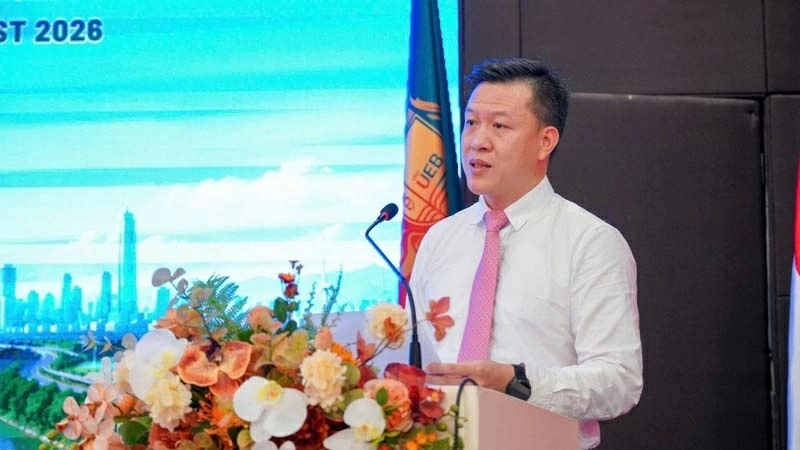 |
| Assoc. Prof. Dr. Hoang Khac Lich, Vice Rector of the University of Economics - Vietnam National University, Hanoi, speaking at the conference. (Photo: Thanh Mai) |
Assoc. Prof. Dr. Hoang Khac Lich, Vice Rector of the University of Economics - Vietnam National University, Hanoi, believes that economic research should not only explain development issues but also provide scientific evidence, propose solutions, and create policy dialogue spaces.
According to him, the value of research lies in its ability to connect various approaches, from economic transformation, resource management, food systems, climate action, biodiversity conservation to governance and implementation capacity.
This approach shows that growth cannot only be measured by the rate of economic expansion but must also be viewed through quality, efficiency, and long-term sustainability.
For Vietnam, this means shifting from a model heavily reliant on input increases to one that creates higher value from each unit of capital, labor, and resources. Productivity must become a central factor, while domestic enterprises need to gradually move up to stages with higher knowledge, technology, and added value in the value chain.
Green transition must be linked to resources
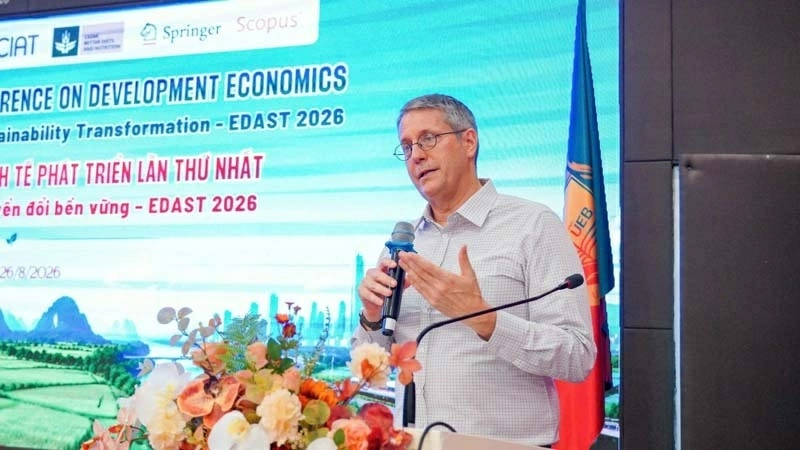 |
| Dr. Mark M. Lundy from CIAT. (Photo: Thanh Mai) |
Another important topic at the conference is the relationship between economic development and green transition. Dr. Mark M. Lundy (CIAT) argues that programs on food systems, climate change, and biodiversity are often implemented through separate pathways, while these issues are closely related and need to be addressed through an interdisciplinary approach.
According to him, for the transition process to create substantial change, three conditions must be simultaneously met: unified policy direction, implementation capacity, and financial resources. If any of these factors are lacking, the result may only be a better plan rather than real transformation.
This is particularly noteworthy for Vietnam. Green transition is not only an environmental requirement but also an economic issue directly related to capital allocation, technology, competitiveness, and institutions.
The presentations at the conference also emphasized that natural resources can only become a foundation for long-term development when they are transparently managed, fully accounted for, and placed within an appropriate institutional framework. Similarly, commitments on climate, food systems, or biodiversity will only be effective when linked to specific resources and implementation mechanisms.
Institutions determine policy transformation capability
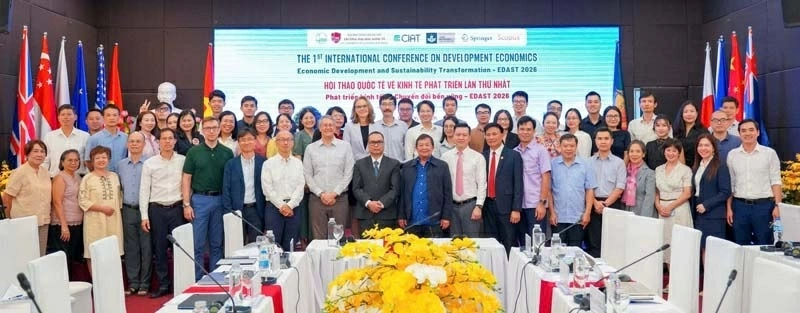 |
| Speakers participating in the EDAST 2026 conference. (Photo: Thanh Mai) |
At the roundtable discussion, opinions further clarified a consistent requirement: the gap between policy intentions and actual results can only be narrowed when policy, capacity, and finance are connected within a single action mechanism. The transformation process also requires the ability to coordinate across sectors, organize dialogues, and maintain cooperation long enough to create change.
If productivity, technology, and human resources are direct drivers of growth, then institutions determine the extent to which these drivers can be effectively utilized. A good policy lacking resources, implementation capability, or coordination is still unlikely to produce the desired results.
From the discussions at EDAST 2026, it is clear that the challenge for Vietnam's economy in the coming period is no longer just about growing faster, but on what foundation and with what quality.
To achieve the high-income goal, Vietnam needs to simultaneously enhance productivity, develop human resources, increase innovation capacity, strengthen domestic enterprises, manage resources efficiently, and continue to improve institutional quality.
The biggest challenge, therefore, is not just how much more capital, labor, or resources can be mobilized, but how effectively these resources are used. This is also the factor that will determine Vietnam's ability to move up to a higher development level.


