






Governing AI in an era of borderless technology
WVR - The World and Vietnam Report is pleased to present an article by Indonesian Ambassador to Vietnam Adam Mulawarman Tugio on the need to establish global rules for the inclusive and responsible governance of artificial intelligence (AI).
Latest
 |
| The rapid advancement of AI opens up new opportunities while posing growing challenges to global governance. (Source: Live Science) |
AI is no longer confined to research laboratories or technology companies. It is already shaping how public services are delivered, how students learn and how information circulates through society. AI and emerging technologies can be powerful drivers of development and social progress. The pace of AI adoption is remarkable. Yet equally striking is the lack of meaningful oversight.
 |
| Indonesian Ambassador to Vietnam Adam Mulawarman Tugio. (Photo: Chu Van) |
What should concern us is not the technology itself. Few would dispute that AI holds enormous potential. It can accelerate scientific discovery, enhance healthcare and boost productivity in ways that were difficult to imagine only a few years ago. The real challenge is that our ability to govern these systems is falling far behind our capacity to develop them.
The risks are no longer theoretical. Biased algorithms can reinforce discrimination while concealing it behind opaque decision-making processes. Generative AI has made misinformation cheaper and faster to produce, as well as more difficult to detect.
Meanwhile, training and operating large AI models require vast amounts of energy and water at a time when many countries are already grappling with the pressures of climate change.
There is also a deeper imbalance that receives far less attention. Advanced AI development, computing infrastructure and intellectual property remain largely concentrated in a handful of countries. Yet the consequences of AI are global. The societies most affected by these technologies are often not the ones shaping their development.
This is not simply a technological divide. It is a governance problem.
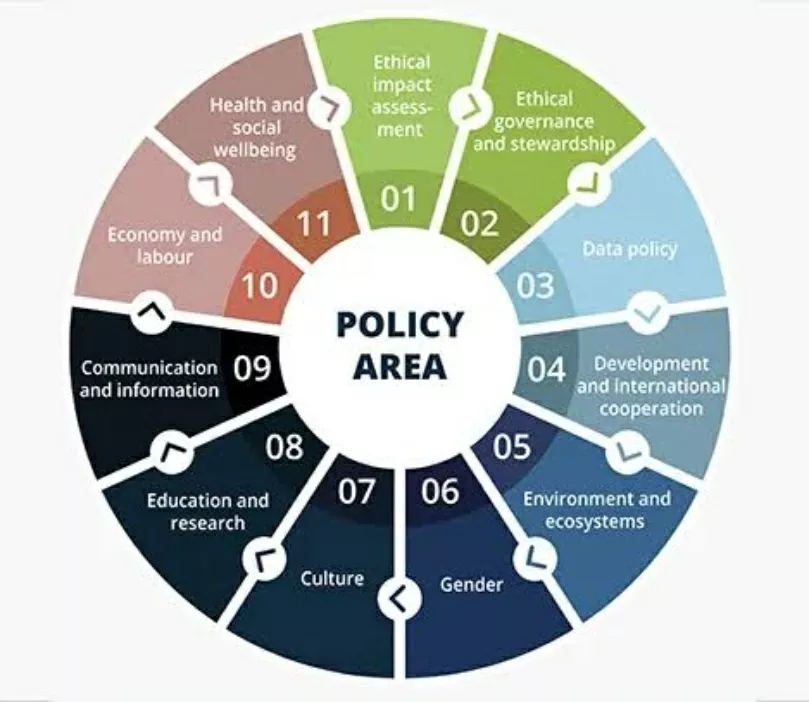 |
| UNESCO’s Recommendation on the Ethics of AI outlines 11 key policy action areas to promote responsible AI development. (Source: UNESCO) |
UNESCO recognised these challenges when it adopted its Recommendation on the Ethics of Artificial Intelligence in 2021. The Recommendation sets out shared values and principles, including transparency, fairness and non-discrimination, responsibility and accountability, human dignity, and sustainability.
Yet principles alone are not enough. Good intentions do not automatically translate into accountability. Without effective mechanisms for implementation, ethical principles are like a compass without a map: they tell us which direction to take, but not how to reach our destination.
That is why the debate can no longer be about whether AI should be governed. The question is how.
Recent assessments by the UN Independent International Scientific Panel on AI reinforce what many observers have long suspected: AI capabilities are advancing faster than existing safety and governance mechanisms can keep pace with them. There are, moreover, no proven guarantees that advanced AI systems will consistently comply with human-defined rules. This increasingly makes AI safety a challenge of containment. Ignoring this widening gap would be a mistake.
The most promising path forward, therefore, lies in the governance framework established under the auspices of the United Nations, which combines independent scientific assessment with broad international dialogue. Its value lies in distinguishing scientific evidence from political considerations while enabling governments to negotiate common rules.
Climate diplomacy has benefited from a similar model through the Intergovernmental Panel on Climate Change (IPCC). AI governance can draw valuable lessons from that experience.
Effective governance, however, must also be inclusive. Global rules cannot be drafted by a handful of technological powers and subsequently presented to the rest of the world as a finished product. Countries with different levels of development, resources and priorities deserve a meaningful voice in shaping the future of AI.
 |
| Representatives of 29 countries signed an agreement establishing the World Artificial Intelligence Cooperation Organization (WAICO) in China on 16 July. (Source: China-US Focus) |
This is why Indonesia has consistently advocated a people-centred and collaborative approach to AI governance, arguing that developing countries should not be relegated to the role of passive consumers of technologies developed elsewhere.
Indonesia’s participation in initiatives such as the World Artificial Intelligence Cooperation Organization (WAICO), alongside 28 countries from across the continents, reflects a broader concern shared across much of the Global South: countries must have a seat at the table when decisions are made about technologies that will shape their economies, societies and development pathways.
This perspective is not about slowing innovation. Rather, it is about ensuring that technological progress serves everyone and leaves no one behind.
Against this backdrop, the international community must take concrete steps to establish safeguards for the inclusive and responsible development of AI, while advancing the Sustainable Development Goals (SDGs). Several priorities stand out.
 |
| The inaugural Global Dialogue on AI Governance took place in Geneva, Switzerland, from 6 to 7 July, bringing together delegations from 163 countries. (Source: Tech Policy Press) |
First, AI safety standards must become genuinely global. These systems operate across borders in milliseconds, making it increasingly difficult for fragmented national regulations to keep pace.
Governments should therefore draw on the Panel’s independent scientific findings and deliberations within the Global Dialogue on AI Governance to develop common benchmarks for transparency, auditing, risk assessment and incident reporting. High-risk AI models should not be taken on trust. Their developers should be required to demonstrate their safety before deployment.
Second, global governance must address the widening divide between countries that develop AI and those that merely consume it. Governance without capacity becomes exclusion.
If developing nations lack access to computing resources, datasets, research infrastructure and technical expertise, they will remain dependent on systems developed elsewhere and shaped by priorities other than their own.
Wealthier nations, technology companies and international institutions should facilitate access to computing resources and open-source tools, while fostering research partnerships and providing technical training. Representation from the Global South must also be embedded in governance mechanisms from the outset, rather than added later as an afterthought.
Third, international frameworks must link digital governance with environmental accountability. The AI sector should be transparent about the energy and water consumption associated with training and operating large-scale models.
International standards negotiated under the auspices of the United Nations should encourage more sustainable computing practices while supporting technological innovation. Citizens also deserve a clearer understanding of AI’s environmental footprint so that public debate is informed by evidence rather than assumptions.
Such efforts should be complemented by a greater understanding of emerging technologies, including biological computing using living neurons, which represents a promising alternative with the potential to advance both technological innovation and environmental sustainability.
Critics often argue that global governance is too slow and excessively bureaucratic. Their concerns are not unfounded. International cooperation rarely moves swiftly. Yet the alternative is far worse: a patchwork of conflicting regulations, regulatory loopholes and a race to lower safety standards in pursuit of competitive advantage.
We have witnessed variations of this scenario before, notably in financial regulation and climate policy. Waiting for problems to escalate into crises is usually the most costly course of action.
For all its transformative potential, AI is no exception.
With the scientific evidence now squarely on the table and a universal diplomatic forum in place, the international community has a narrow but decisive window of opportunity to act.
By translating shared scientific understanding into binding global norms, we can ensure that artificial intelligence serves humanity as a whole, rather than becoming another force that divides it.