







Proactively shaping the rules in the digital era: Placing human rights at the center
Artificial Intelligence (AI) is increasingly intervening in every aspect of social life, posing challenges to legal sovereignty, social governance, and ensuring human rights.
Latest
In this context, the approval of the Law on AI by the Vietnamese National Assembly marks a shift from passive management to proactively shaping the rules in digital technology governance. This not only regulates AI research, development, and application but also serves as a tool to place human rights at the center of the nation's digitalization process.
Originating from practical requirements
AI opens up vast opportunities for socio-economic development but also presents urgent challenges in management, ethics, and safety, while Vietnam's current legal regulations do not fully cover these aspects.
The Law on Digital Technology Industry (DTI Law), enacted on June 14, 2025, with "Chapter IV: Artificial Intelligence", establishes an initial legal framework for AI development and application. However, these regulations do not provide a comprehensive legal corridor to facilitate AI research, development, deployment, and the comprehensive AI ecosystem.
Practical issues such as ethical risks, algorithmic bias, privacy invasion, and discrimination in AI applications; lack of mechanisms for classifying and controlling AI system risks; heavy reliance on foreign technology and models... are creating significant barriers to AI research, development, deployment, and usage in Vietnam.
Challenges include legal responsibility gaps when AI causes damage; threats to national security, social order, and ethical values when deepfake technology is abused to create misleading, defamatory, fraudulent, or politically destabilizing information; biased algorithms leading to AI systems that may inadvertently or intentionally learn and amplify existing biases in data, resulting in unfair and discriminatory decisions in society...
 |
| AI opens up vast opportunities for socio-economic development but also presents urgent challenges in management, ethics, and safety, while Vietnam's current legal regulations do not fully cover these aspects. (Photo: HUSTA) |
In fact, many countries have enacted and developed legal regulations for AI research, development, deployment, and application. The European Union (EU) has introduced the Artificial Intelligence Act (AI Act) - the world's first comprehensive AI law. The AI Act provides a unified, harmonized legal framework for AI system development, deployment, and usage in the EU, adopting a risk-based approach to ensure AI systems are used safely, reliably, transparently, and with respect for human rights.
South Korea has an Act on the Development of Artificial Intelligence and Establishment of Trust, balancing AI promotion and management. Japan has an Act on Promotion of Research and Development, and Utilization of Artificial Intelligence-related Technology. Thailand is developing a Law to Promote and Support AI Innovation based on five fundamental pillars: Risk-based regulation, innovation support, general legal principles, regulatory oversight, and law enforcement.
The U.S. and China are also swiftly developing and refining specific management institutions for the AI sector. China is implementing a strategy to become a leading AI powerhouse, emphasizing national security, mastering core technologies, and building massive datasets to develop sovereign foundational models. Meanwhile, the U.S. prioritizes AI innovation through substantial R&D investments.
Thus, Vietnam's enactment of the Law on AI meets practical demands, international integration needs, and aligns with global trends.
Placing humans at the center
The Law on AI, approved by the National Assembly on December 10, 2025, marks a significant milestone, positioning Vietnam among the few countries with a specialized legal framework for AI.
The Law on AI consists of 7 chapters with 56 articles, designed as a flexible framework law adaptable to technological developments, ensuring consistency with related legal documents. The content of the Law has been developed to align with international human rights treaties to which Vietnam is a party (ICCPR, CRC, ICESCR).
The fundamental principles of AI activities are stipulated in Article 4: (1) Centering on humans; ensuring human rights, privacy, national interests, public interests, and national security; complying with the Constitution and laws;
(2) AI serves humans, not replacing human authority and responsibility. Ensuring human control and intervention in all decisions and actions of AI systems; system safety, data security, and information confidentiality; the ability to inspect and monitor AI system development and operation;
(3) Ensuring fairness, transparency, non-bias, non-discrimination, and no harm to humans or society; adhering to Vietnamese ethical standards and cultural values; accountability for AI system decisions and consequences;
(4) Promoting green, inclusive, and sustainable AI development; encouraging AI technology development and application towards efficient energy use, resource conservation, and reducing negative environmental impacts.
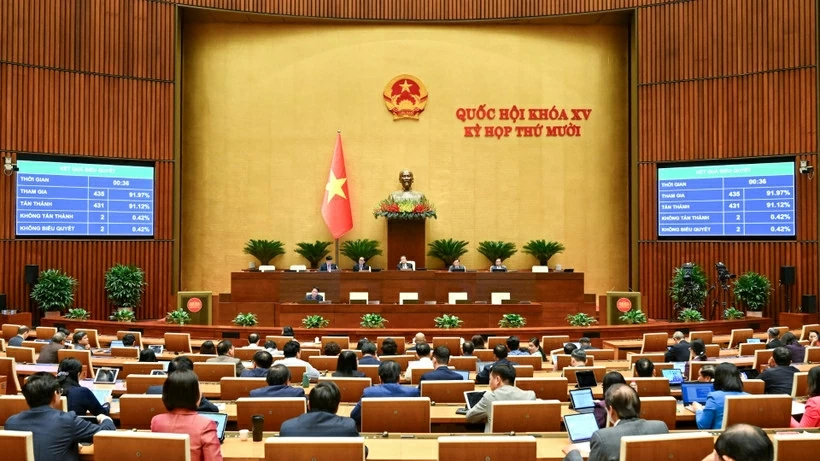 |
| The 10th Session of the 15th National Assembly on December 10, 2025, approved the Law on AI, making Vietnam one of the few countries with a specialized legal framework for AI. (Photo: Nhan dan Newspaper) |
Thus, the supreme principle of the Law is that AI serves humans, does not replace humans, and humans oversee AI in crucial decisions; AI must be transparent, accountable, and safe. According to Nguyen Thanh Hai, Chairman of the National Assembly's Committee on Science, Technology, and Environment, this is the foundation to ensure AI develops safely, humanely, and responsibly; no one is left behind in the digital era.
Additionally, the Law emphasizes fairness, transparency, objectivity, and non-discrimination, while requiring adherence to Vietnamese ethical standards and cultural values. In reality, AI is trained primarily from social data provided by humans, which can reproduce and amplify pre-existing biases, leading to bias in social life activities. The Law's requirement for risk assessment, bias control, and accountability is a crucial legal basis to prevent "algorithm-based discrimination".
Moreover, AI heavily relies on data, and without control, privacy can be severely violated. Associating AI with data governance and information security obligations helps strengthen the protection of individual rights in the digital environment. The Law on AI also establishes the right to know, to be explained, and to appeal when individuals are affected by automated systems, thereby promoting accountability for everyone participating in the AI arena.
The Law on AI also encourages AI applications serving social welfare (Clause 3, Article 5) targeting vulnerable groups: Supporting people with disabilities, the poor, and ethnic minorities to bridge the digital divide; preserving and promoting national cultural identity. Integrating AI education into the general education curriculum helps the younger generation access technology responsibly and humanely.
The human rights-based approach is further evident in the Law's high-risk level for AI systems that can significantly harm life, health, legal rights and interests of organizations, individuals, national interests, public interests, and national security (Clause a, Paragraph 1, Article 9).
Paragraph 2, Article 6 also emphasizes: For essential fields directly impacting life, health, legal rights, and interests of humans or social order and safety, AI application must be managed with stricter risk levels, suitable to each field's characteristics, ensuring patient safety in healthcare; reliability in practical use conditions; protecting health data as per legal regulations; ensuring suitability with age characteristics and learner development in education; preventing risks in assessment, classification, and impact on learners; ensuring data safety and privacy.
Furthermore, Article 7 of the Law on AI prohibits exploiting or appropriating AI systems in violation of the law, infringing on the legal rights and interests of organizations and individuals, and prohibits developing, providing, deploying, or using AI systems for the purpose of using fake or simulated elements to deliberately and systematically deceive or manipulate human perception and behavior, causing significant harm to human rights and interests; exploiting the weaknesses of vulnerable groups (children, the elderly, people with disabilities, ethnic minorities, or those lacking civil capacity, with limited civil capacity, or with cognitive and behavioral control difficulties) to harm themselves or others.
With the overarching principle "human rights at the center", the Law on AI has been developed based on compatibility with international AI and human rights standards, such as UNESCO's Recommendation on the Ethics of AI or OECD's AI Principles, which emphasize human dignity, fairness, transparency, and responsibility.
 |
| On December 5, 2025, the Government's Human Rights Steering Committee and the Institute of Human Rights (Ho Chi Minh National Academy of Politics) organized the scientific conference "Human rights in the digital Era - Theory and practice", commemorating the 77th International Human Rights Day (December 10, 1948 - December 10, 2025). (Photo: Government's Human Rights Steering Committee) |
Ensuring citizens benefit in the AI era
The enactment of the Law on AI is a significant step forward but also raises issues that need to be addressed for effective implementation, for the rights and interests of the people.
The Law on AI is based on a risk management mechanism. Therefore, to be effective, it must have specific criteria for classifying transparency levels, risk levels, and assessing the impact on human rights of high-risk AI systems. AI impacts many fields (healthcare, education, finance, labor...) directly related to human rights, so a clear inter-sectoral coordination mechanism is needed. Additionally, "controlled open data" is the right direction, but access rights need to be designed according to roles and a responsibility mechanism must be established.
Simultaneously, specific guidance on complaint - compensation - remediation mechanisms is needed for people to understand the process of protecting their rights. The rights of those affected by AI also need specific guidance. AI-caused damage is often difficult to prove. Without a mechanism for accountability and evidence support, the right to effective protection will be diminished.
The Law on AI opens up great opportunities for Vietnam to accelerate innovation while strengthening human rights protection in the digital environment. The important issue ahead will be the practical implementation of the Law with specific guidance documents to ensure human rights are truly guaranteed and protected as AI intervenes in life. Only then will the Law on AI truly be an institutional advancement, placing Vietnam among the countries shaping AI rules towards "responsible development" in the digital era.
| This is the first time Vietnam has developed and enacted a separate law on AI. The Law consists of 35 Articles, designed towards "management for development", ensuring a balance between risk control and innovation promotion, in line with international practices and supporting Vietnam's proactive integration with new technology standards. |
REFERENCES
1. UNESCO (2021), Recommendation on the Ethics of Artificial Intelligence.
2. OECD (2019), OECD Principles on Artificial Intelligence.
3. European Union (2024), Artificial Intelligence Act (AI Act).
4. United Nations (2023), Human Rights and Artificial Intelligence.
7. National Assembly of the Socialist Republic of Vietnam, Artificial Intelligence Law.