





Cham inscriptions at My Son move toward World Documentary Heritage recognition
WVR - Experts from the French School of Asian Studies (EFEO) will assist in translating the Cham inscription system at the My Son Sanctuary to support the preparation of a nomination dossier for World Documentary Heritage recognistion.
Latest
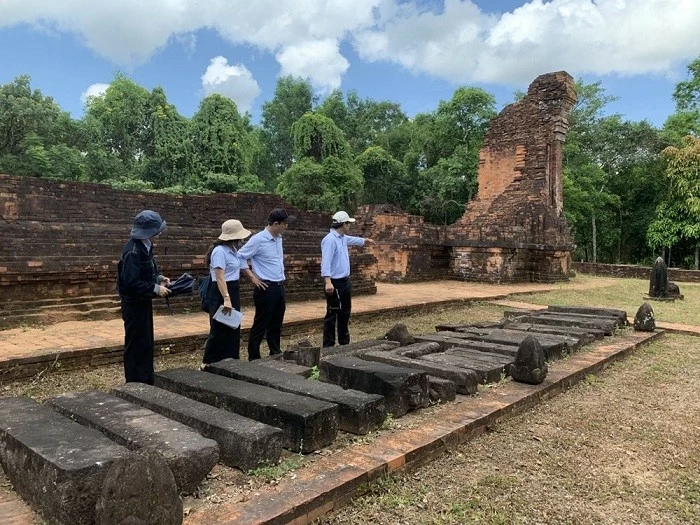 |
| Officials from the Museum Conservation Department under the Management Board of My Son World Cultural Heritage conduct a preliminary survey of the inscription and stele system at My Son. (Source: Van Hoa) |
The Management Board of My Son World Cultural Heritage has announced that EFEO experts recently worked at the My Son temple complex to finalize the details of collaborative research, conservation, and promotion of Cham cultural heritage values.
Accordingly, EFEO will assist in translating the Cham inscription system at My Son to support the preparation of a nomination dossier for Cham inscriptions and steles to become World Documentary Heritage.
Both parties also proposed signing a memorandum of understanding to enhance cooperation in scientific research, heritage conservation, and the implementation of professional activities in the future.
The Management Board of My Son World Cultural Heritage also requested EFEO to share additional historical documents related to the French research and restoration of the My Son temple complex in the past.
Previously, the management board conducted a preliminary survey of the inscription and stele system at My Son to facilitate inventory, digitization, and the creation of a scientific database for the documentary heritage nomination dossier.
The survey focused on reviewing the current status, location, materials, degree of intactness, and preservation condition of each artifact.
The Cham inscription system at the My Son Sanctuary includes numerous stone steles inscribed with Sanskrit and ancient Cham scripts, considered a vital source of historical documentation reflecting the history, culture, religion, and life of the Champa kingdom through various periods.
Since the late 19th century, many French scholars have conducted research, translations, and publications of these inscriptions.