



Globalisation is not a one-way street - a trip to Germany and back
WVR - Global mobility is rising, and Vietnam is part of this trend, with more Vietnamese building careers in Germany while an increasing number of well-trained returnees head home and contribute to economic growth, noted Vietnamese and German scholars and experts. The World and Vietnam Report is pleased to introduce their article on mobility of overseas Vietnamese in Germany.
Latest
International mobility is on the rise. Vietnam is no exception.
Many Vietnamese people now work in Germany and have integrated very well into the workforce here.
Starting a career abroad isn’t always as easy as some social media makes it out to be.
In any case, it is relevant for young Vietnamese to be well prepared for work, study or vocational training.
Another interesting trend is that more and more Vietnamese living abroad, having received an excellent education in Germany, are finding their way back to their homeland and making a significant contribution to Vietnam’s economic growth.
They act as a bridge between the two countries and are a great asset to the Vietnamese economy.
This article explores this fascinating aspect of cultural exchange.
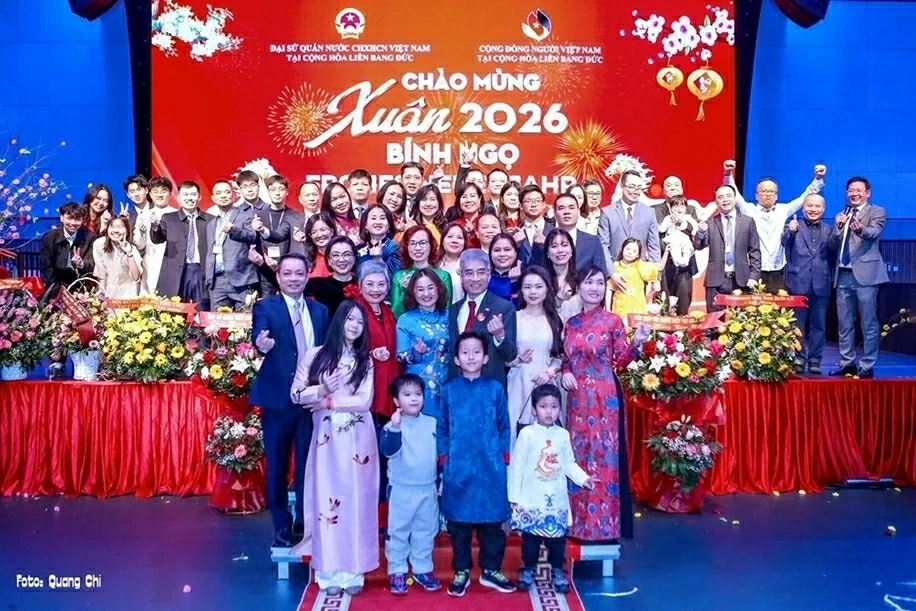 |
| Vietnamese attendees gather at the "Xuân Quê hương” program, immersed in a warm and festive atmosphere celebrating cultural roots. (Photo: Vietnamese Embassy in Germany) |
Vietnamese life in Germany
In some places, such as the Phuong Quang Pagoda near Munster, the atmosphere during the Tet Festival and other celebrations feels just like being in Vietnam.
The pagoda itself is located in an old country hotel in a small wooded area outside the city. Upon entering, visitors find themselves in another world.
It smells of incense sticks and, especially at Tet, everything is festively decorated.
The prayers of the faithful from the neighbouring room fill the air, whilst in the cellar, banh chung chay, banh tet chay, canh chay, che dau xanh, che ba mau and drinks are on offer.
Dialects from all regions of Vietnam can be heard. Guests, including some Germans, immediately feel at home here.
The pagoda is not only a place of spiritual exchange but also a hub for networking among Vietnamese people.
The wife of co-author Andreas Stoffers, Mrs Le Thi Mao, enjoys visiting here, as it gives her a sense of connection to her distant homeland. Vietnamese and Germans: a shared history that is now entering its second generation.
Facts and figures - The diverse Viet Kieu (overseas Vietnamese) community in Germany
Vietnamese people are among the best-integrated immigrant groups in Germany. Their numbers now exceed 200,000.
They are characterised by the fact that they can be found in high and top-level positions within German society, as well as in solid middle-class roles, for example in the care sector.
The science journalist Mai Thi Nguyen-Kim is known to a wide audience through her science communication.
A high percentage of staff at universities and hospitals are of Vietnamese origin. In addition, Vietnamese cuisine, in the form of countless Vietnamese restaurants, has won over the palates of the German public.
The standing of the Vietnamese community, which it has built up over recent decades, can be described as high.
Vietnamese people are over-represented among A-level graduates in Germany, a sign of these people’s strong drive for achievement and success.
| Xem thêm tin tức từ WVR |
 Cộng đồng người Việt tại Đức hân hoan chào đón Tết Nguyên đán Giáp Ngọ 2026. Cộng đồng người Việt tại Đức hân hoan chào đón Tết Nguyên đán Giáp Ngọ 2026. |
The Vietnamese community in Germany is as diverse as Vietnam itself.
Whilst many workers and students come to Germany today, the waves of immigration over the past decades were of a completely different nature.
The first Vietnamese arrived in Germany as early as the 1950s, following an agreement between the German Democratic Republic and what was then North Vietnam.
Many of them came as contract workers and remained in their new home after German reunification.
In what was then West Germany, there was a large wave of Vietnamese immigration, mostly from southern Vietnam, from 1975 onwards.
But just as today’s Vietnam presents itself as a unified nation, regardless of whether one comes from Ca Mau, Quang Ninh or Hue, so too has the Vietnamese community in Germany come together.
It is precisely those born in Germany and the young people now flocking to Germany who bear witness to a new, self-confident, united Vietnam.
And that is a good thing. Just as Germany has been reunified since 1989 after decades of forced division, so too has Vietnam.
It is these shared experiences of happy reunification that bind Germany and Vietnam together with a special understanding of one another.
Challenges for Vietnamese people in Germany
The challenges faced by Vietnamese people in Germany are manifold, depending on their generation and personal background.
Much depends on when and how people came to Germany. Families living here in the second generation know their way around Germany and know how to deal with the circumstances here.
This applies to dealing with the authorities as well as the rights and obligations they have as employees.
The generally good command of German, combined with their own Vietnamese networks, makes life noticeably easier. Yet even here, human nature rears its head.
There are the same interpersonal, and sometimes intra-family, problems as in Vietnam.
The many students, apprentices and skilled workers who have flocked to Germany in recent years represent an entirely new generation.
Fuelled by social media and perhaps the odd dodgy agent, some expect a good income and a wonderful new life abroad.
What is often forgotten is that they cannot simply bring their family and friends with them from Vietnam, and that the difficulty of learning the German language is underestimated.
Many new arrivals are also surprised by the high cost of living in Germany and struggle to find suitable accommodation.
Some employers also deliver less than they had previously promised. Added to this are the comparatively high social security contributions and income tax, as well as the many other taxes that exist in Germany.
| Xem thêm tin tức từ WVR |
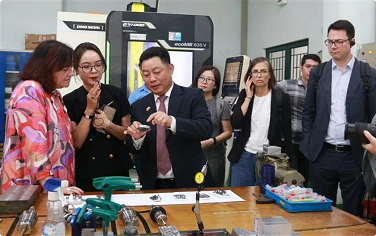 Hỗ trợ sinh viên Việt Nam tiếp cận thị trường lao động Đức Hỗ trợ sinh viên Việt Nam tiếp cận thị trường lao động Đức |
If one’s own family in Vietnam has had to take on debt to bring their son or daughter to Germany, this often means a hard life.
These negative aspects are also reported extensively on social media, including on Facebook pages such as Phap Luat Duc (German law) and similar platforms.
The multitude of Vietnamese restaurants, snack bars and supermarkets, which can be found almost everywhere in Germany, make settling in easier.
A particularly striking example is the huge Dong Xuan Market in Berlin, where you can get almost everything that is available in Vietnam, albeit at a slight mark-up.
Added to this are cultural centres such as the many pagodas and church communities scattered throughout Germany. In particular, people in need can find support here.
Officially, the Vietnamese Embassy (Berlin) and the Vietnamese Consulate General (Frankfurt) serve as points of contact.
However, it is always advisable to integrate into existing German structures, organisations and associations.
It is, however, essential to have German language skills at least at B2 level.
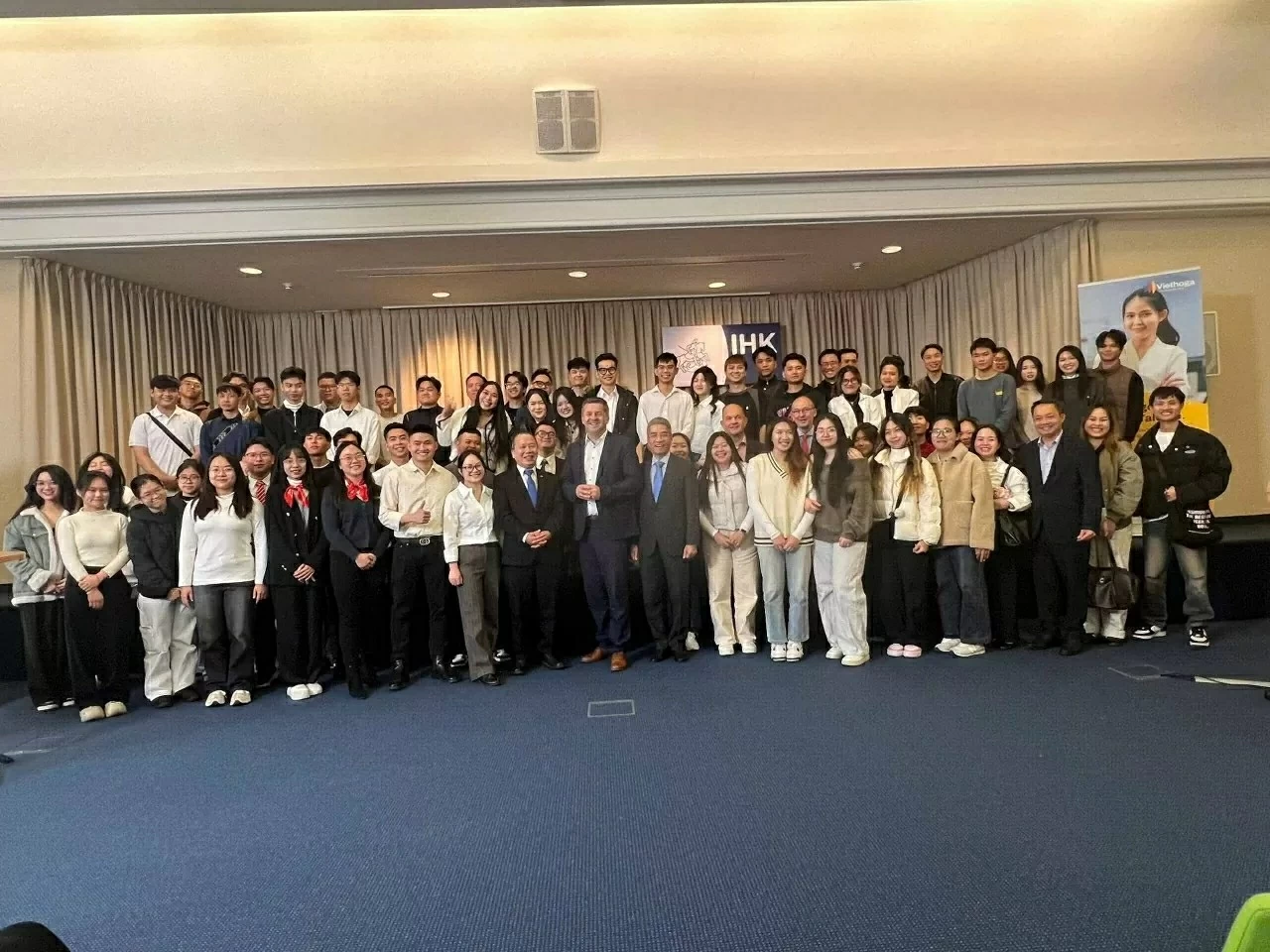 |
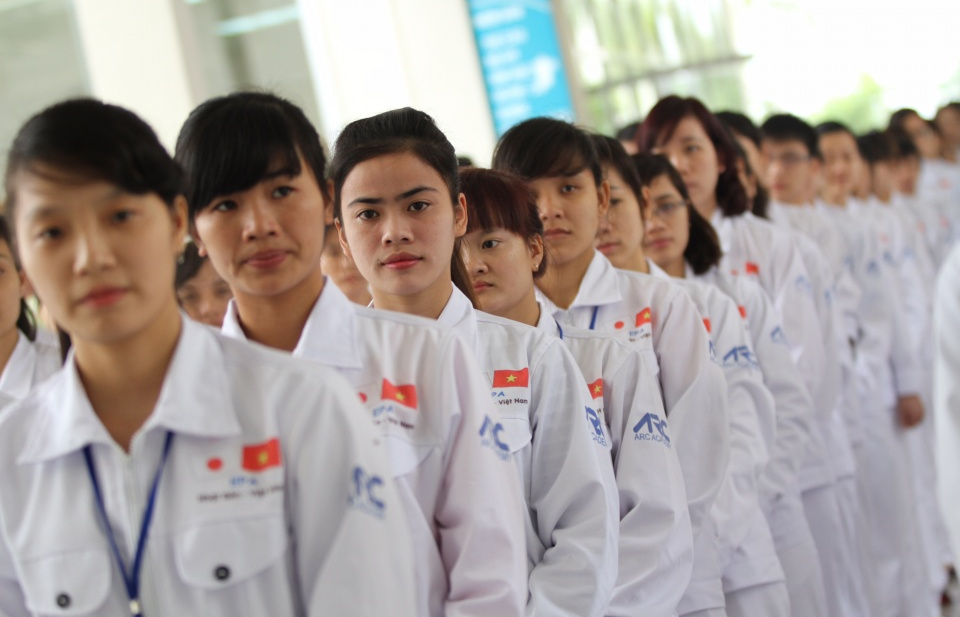
| Vietnamese trainees attend a welcome ceremony under the Viethoga program in Germany, highlighting both the opportunities and support networks essential for integration abroad. (Photo: Vietnamese Embassy in Germany) |
Support in Vietnam and Germany
It is essential not to be alone in a foreign country, but rather to prepare oneself as well as possible for the move to the new country and also to find the support one needs whilst abroad.
For hardly anything is more difficult than suffering culture shock. In such cases, Vietnamese expatriates may find themselves shipwrecked in a distant land.
This gap between what people are promised and what they actually encounter is one of the quieter tragedies of this migration.
It does not make the news, but it weighs heavily on many families.
This can also lead to health problems such as depression, as well as financial difficulties. Added to this, in the event of failure, is the stigma towards those left behind at home - that one has failed, that one has lost face.
| Xem thêm tin tức từ WVR |
 Trường đào tạo nghề và ngoại ngữ mới dành cho tình nguyện viên nước ngoài (OV) khai trương tại Đức. Trường đào tạo nghề và ngoại ngữ mới dành cho tình nguyện viên nước ngoài (OV) khai trương tại Đức. |
All too often, the dream of a high income abroad ends up in a shabby, tiny rented flat or a dubious nail salon.
The loneliness can also be overwhelming if, by chance, one ends up in a remote small town where there are no Vietnamese family or friends.
In Vietnam itself, there are countless agencies and schools offering their assistance.
Some of them also have branches and partnerships in Germany. However, it is advisable to look into this carefully.
All too often in the past, it has become apparent that not all of these providers are as reputable as they should be. In some cases, entire families find themselves plunged into debt, which weighs heavily on the emigrants.
The good news is that there are also reputable providers. In Vietnam itself, the AHK and the Goethe-Institut, as well as other organisations, offer assistance.
It is particularly important to speak to those who have successfully settled in Germany.
New trend - migration is no longer a one-way street
However, migration is no longer a one-way street. More and more Vietnamese are returning to the homeland of their ancestors, having received an excellent education in Germany.
There are many reasons for this. As authors who have spoken to countless returning Viet Kieu, we see a particular pattern here: Vietnam is one of the fastest-developing countries in the world.
In the first quarter of 2026 alone, economic growth stood at 7.8% y-o-y, and in the major cities it is likely to have been in double digits.
Participating in this economic growth, equipped with family contacts in the old Vietnamese homeland and knowledge of the Vietnamese language, offers excellent opportunities.
Co-author Pham Quang Long, for example, returned to Hanoi 10 years ago after completing his Master’s degree in economics in Freising/Bavaria, and is now successfully working in the logistics sector.
Like many other returning Vietnamese, he is using his solid German education to help support Vietnam on its path to becoming an industrialised nation by 2045.
| Xem thêm tin tức từ WVR |
 Trung tâm thương mại Đồng Xuân tại Đức là cầu nối giữa doanh nghiệp Việt Nam và doanh nghiệp địa phương. Trung tâm thương mại Đồng Xuân tại Đức là cầu nối giữa doanh nghiệp Việt Nam và doanh nghiệp địa phương. |
It is not always easy for returning Viet Kieu, as they have been strongly shaped by their time in Germany and must first find their feet again here in Vietnam. Not everyone succeeds in this, but most do. It can lead to a genuine ‘reverse culture shock’ that one must come to terms with.
The group of Vietnamese returnees is a key asset for Vietnam: in this way, Vietnam gains well-educated specialists and managers in a wide range of fields, from engineering and medicine to economics.
These are not only university graduates, but also Vietnamese who have benefited from Germany’s dual vocational training system and can work here, for example, as nurses, IT specialists or technicians.
Viet Kieu such as Nguyen Trong Luat, who successfully manages a factory in Binh Duong for the Swiss company CICOR, or the many returnees in the fields of technology and artificial intelligence, are just a few of many positive examples.
From an economic policy perspective, this “reverse migration” is significant. In this way, Vietnam not only gains well-trained skilled workers, but also people who bring with them international work cultures, management methods and technological expertise.
This combination represents an important competitive advantage for Vietnam.
Vietnam and Germany - Looking ahead
Relations between Germany and Vietnam show that globalisation is not a one-way street, but offers people from both countries many opportunities to get to know one another better and to develop personally and professionally.
Whilst in recent years it was primarily Vietnamese people who sought their fortune abroad, including in Germany, a new trend has emerged in recent years.
The reason for this is that Vietnam is becoming an increasingly attractive place to live.
This applies both to Viet Kieu, who often return with excellent qualifications, and to a growing number of Germans who are investing in Vietnam’s future.
Vietnam aims to become an industrialised nation by 2045. The prospects for this are good.
Germany remains an attractive and welcoming country for Vietnamese people, so it is good to give people from both nations the opportunity for exchange.
For Vietnam, this means that the country welcomes returning compatriots with open arms, but also extends a hand to German emigrants (whether temporarily or permanently). Generosity regarding citizenship, work permits and residence permits is an important prerequisite for this.
(*) FOM University of Applied Sciences, Essen/Germany
(**) Business Development Director, ALLIED INDOCHINE, Hanoi/Vietnam