





From small classrooms to learning opportunities for millions of Vietnamese students
At many schools in the mountainous regions of northern Vietnam, teachers once had to search for places with stable Internet signals just to download lessons and learning materials for their students. With limited devices and challenging learning conditions, access to digital learning tools was difficult for both teachers and students.
Latest
But slowly, classrooms began to change.
When Khan Academy Vietnam (KAV) was introduced, students gradually became more comfortable with self-learning, revisiting lessons, and practising at their own pace. Classrooms became more dynamic, while teachers gained better tools to monitor and support each student more effectively.
According to Ms. Giang Thi De, Vice Principal of Tung Vai Ethnic Minority Boarding Primary School in Tuyen Quang, what surprised teachers most was not simply students’ access to technology, but the transformation in their learning mindset.
She recalled a fourth-grade Dao ethnic student who initially struggled with math and frequently answered questions incorrectly. However, with the ability to rewatch instructional videos and practice multiple times on Khan Academy, the student gradually improved and maintained consistent learning habits month after month.
“That experience showed us that when students are guided properly and given opportunities to try again, they become more confident and persistent,” Ms. De shared.
Stories like this are becoming increasingly common across Vietnam, from mountainous schools and coastal communities to remote islands far from the mainland.
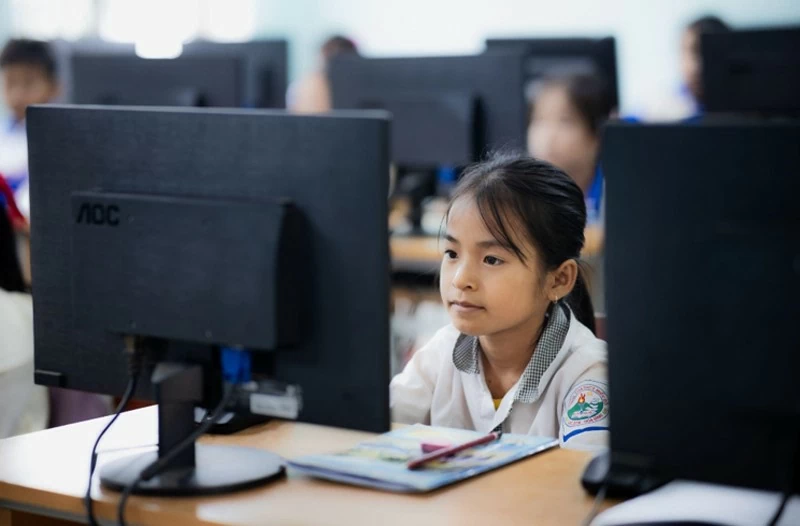 |
| Each classroom becomes more effective through the Khan Academy platform |
On Tho Chau Island in An Giang, where most students come from fishing families, and access to technology remains limited, the journey to bring digital transformation into classrooms also began with very practical challenges.
Ms. Ha Thi Oanh, Vice Principal of Tho Chau Primary and Secondary School, explained that when implementing the Khan Academy Vietnam Open School model, teachers faced many difficulties, ranging from students being unfamiliar with technology to older teachers struggling to use digital teaching platforms.
Yet step by step, teachers at the school learned to integrate technology into their classrooms.
“The most wonderful thing is seeing students become more engaged, learn at their own pace, and receive immediate feedback,” Ms. Oanh shared.
According to her, the biggest transformation is not simply about technology, but about how students see learning and their own future.
“We are not only teachers, but companions supporting our students on their journey of discovering knowledge. They are excited to step into a wider world of learning something they once only dreamed of,” Ms. Oanh said emotionally.
Beyond supporting students in remote and island communities, the program is also opening learning opportunities for students with special educational needs.
At Quang Tri School for Children with Disabilities, Ms. Hoang Duyen, a math teacher, explained that teaching requires tremendous patience and personalised approaches because every student has different learning abilities and challenges.
According to Ms. Duyen, however, Khan Academy’s math program has proven especially suitable for many students thanks to its visual, flexible, and repeatable learning experience.
“The students are always excited and look forward to their Khan Academy lessons,” she shared.
Truong Cong Huy, a sixth-grade student, communicated through sign language that he particularly enjoys learning on the platform.
“I really like learning on Khan Academy. The questions and exercises are interesting and challenging. When I make mistakes, I can try many times again. I also rewatch the videos to better understand the lessons.”
Teachers say that the ability to revisit lessons, practice repeatedly, and learn at an individual pace has become especially valuable for students who need more time and confidence to absorb new knowledge.
During periods of storms and flooding, many schools have also used online learning platforms to help students continue learning even when they could not attend school in person.
At Hong Thai Secondary School in Tuyen Quang, Ms. Le Hai Yen shared that assigning lessons through Khan Academy helped students maintain consistent learning during disruptions.
“Many students were already familiar with the platform, so even when they could not come to school, their learning progress continued steadily,” she explained.
For students themselves, learning has become a more positive and empowering experience.
“When I do not understand a lesson, I can learn again at my own pace. That makes me feel more confident,” one student from An Giang shared.
Another student, Nguyen Duc Anh, explained how instant feedback made learning more engaging:
“The system immediately shows whether my answers are right or wrong, so I can adjust by myself. I also receive badges for completing lessons consistently, which motivates me to keep learning.”
Whether in mountainous areas, remote islands, or specialised classrooms, students everywhere share the same need: the opportunity to learn in ways that fit their individual abilities and circumstances.
These stories reflect a growing demand in Vietnam for flexible, personalised, and scalable learning models.
In recent years, Vietnam has made significant progress in education and digital transformation. However, access to modern learning tools and high-quality learning experiences remains uneven across regions.
To help expand learning opportunities for Vietnamese students, Vietnam Foundation (VNF), in partnership with Khan Academy (USA), launched Khan Academy Vietnam - a free online learning platform serving students and teachers nationwide.
The platform provides high-quality educational content that has been localised into Vietnamese and adapted to align with Vietnam’s curriculum. Beyond self-learning, KAV is designed for direct classroom integration, allowing teachers to assign lessons, monitor progress, and better support students. The program is also expanding AI-powered educational support through Khanmigo - an AI teaching assistant that helps teachers save preparation time and explore innovative teaching approaches.
After several years of implementation, Khan Academy Vietnam has become one of the largest Khan Academy school implementations in the world. To date, the program has reached more than 3 million students, supported over 150,000 teachers, and expanded to more than 11,000 schools across Vietnam.
Not only has the model achieved impact at scale, but it has also been built with extraordinary cost efficiency. Just one US cent or 3,000 Vietnamese dong can help one student learn on Khan Academy and expand learning opportunities.
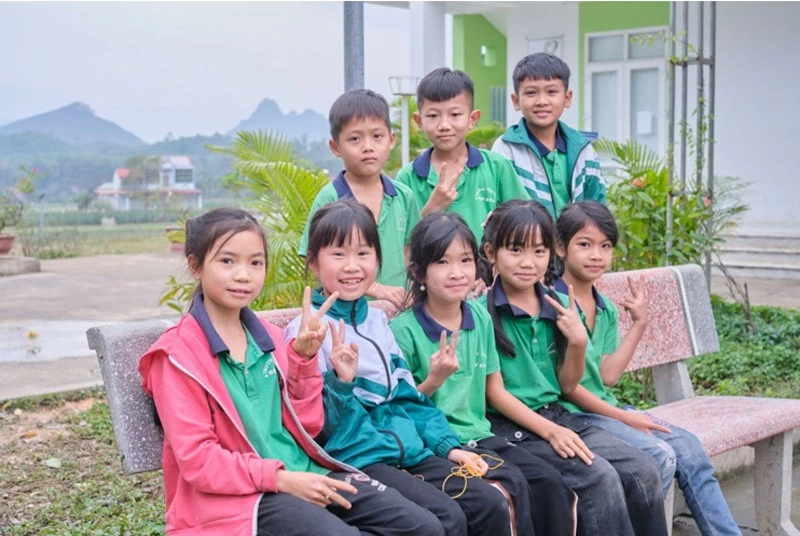 |
| Just one US cent can help one student learn on Khan Academy and expand learning opportunities |
Mr. Kien Pham, President of Vietnam Foundation, shared: “We believe that quality education should not be limited by geography or economic circumstances. When students are given access to the right tools and learning opportunities, they become more confident, more proactive, and better prepared for the future. What matters is building solutions that can scale and reach as many learners as possible.”
Beyond supporting students, the program is also helping teachers access technology and AI tools in education.
Mr. Huynh Ba Hieu, a teacher at Giong Rieng Ethnic Minority Boarding Secondary School in An Giang, said that gaining early access to AI-related training has created new opportunities for innovation in teaching.
“Teachers can learn how to apply technology in classrooms to create more engaging lessons, design assessments better suited for different groups of students, and explore new tools to improve teaching quality,” he shared.
Vietnam Foundation believes that expanding learning opportunities requires the collective support of educators, communities, organisations, and individuals worldwide.
Because sometimes, even a very small contribution can create meaningful change, helping a student become more confident in the classroom, helping a teacher gain better teaching tools, and helping more classrooms across Vietnam connect to wider learning opportunities for the future.
| About Vietnam Foundation Vietnam Foundation (VNF) is a US-based nonprofit organisation established in 2008 with the mission of improving lives through education. Through programs such as Khan Academy Vietnam, VNF works to expand access to quality education, promote open learning, and support innovation in teaching and learning across Vietnam. Learn more or support the program at: https://donate.vnfoundation.org/donate/ |
| Opening opportunities for young Vietnamese to study in Korea On May 9, Havina Global successfully organised the event “Korea Path 2026 - Smart Study Abroad & Global Career” at VNU Book Store, Vietnam National ... |
| Vietnamese youth and students in Europe foster connections, look towards hthe omeland WVR - On May 9, at the Vietnam Cultural Center in France, the Union of Vietnamese Youth and Students Associations in Europe successfully organized the ... |


