




When the youth seek the heritage of Old Hanoi memories
WVR - From field trips and spaces recreating past lifestyles to guiding activities at historical sites, many young people in Hanoi are turning to traditional culture through experiences, self-discovery, and retelling old stories in the language of their generation.
Latest
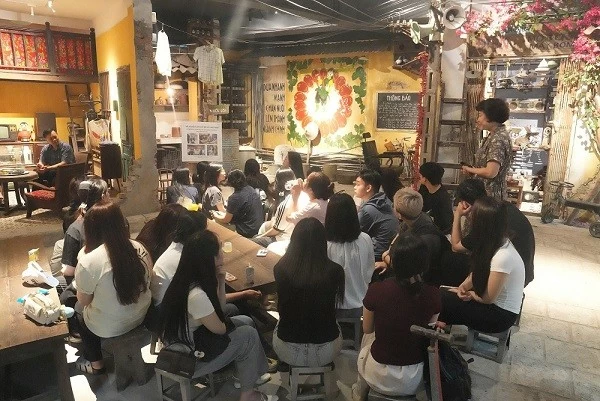 |
| Students experience the exhibition space, recreating the subsidized period at the cultural building No. 11 Ngu Xa, Hanoi. (Photo: Ngoc Duc) |
Touching Hanoi through experience
Recently, students of the 10th class of Cultural Management, Faculty of Cultural Heritage, Hanoi University of Culture, experienced a special class. Without lecture halls, textbooks, or purely theoretical lessons, their first lesson began with a hot bowl of pho in the space of “tram cars” arranged along the Ngoc Island - Ngu Xa area.
Here, the young people were directly told by Nguyen Dan Huy, Vice Chairman of Ba Dinh Ward People's Committee, about the origin, preparation, and art of enjoying Hanoi pho, the journey expanding to tea, coffee, rice culture, and traditional meals. Life slices arranged in each tram car create a space for the youth not only to see but also to hear, taste, and feel.
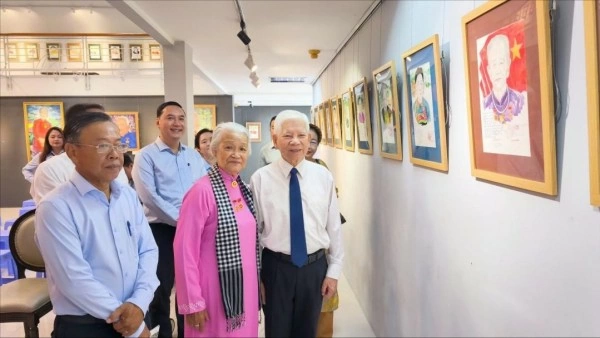
The journey continues at the space recreating the subsidized period at the cultural building No. 11 Ngu Xa. Old bookstores, attic apartments, propaganda paintings, Soviet-style gates, and professions that once existed like shirt collar flipping, ballpoint pen ink pumping, or boiling water... bring young people closer to a Hanoi many only know through the memories of their parents and grandparents.
Ms. Anh Thu, who has been a teacher for 34 years, guided the students through each space, recounting everyday stories of the subsidized period.
The narrative and seemingly simple artifacts created a “bridge” between two generations. For her, the most important thing is to convey old values to the younger generation, helping them better understand the history and social life of Vietnam during a special period.
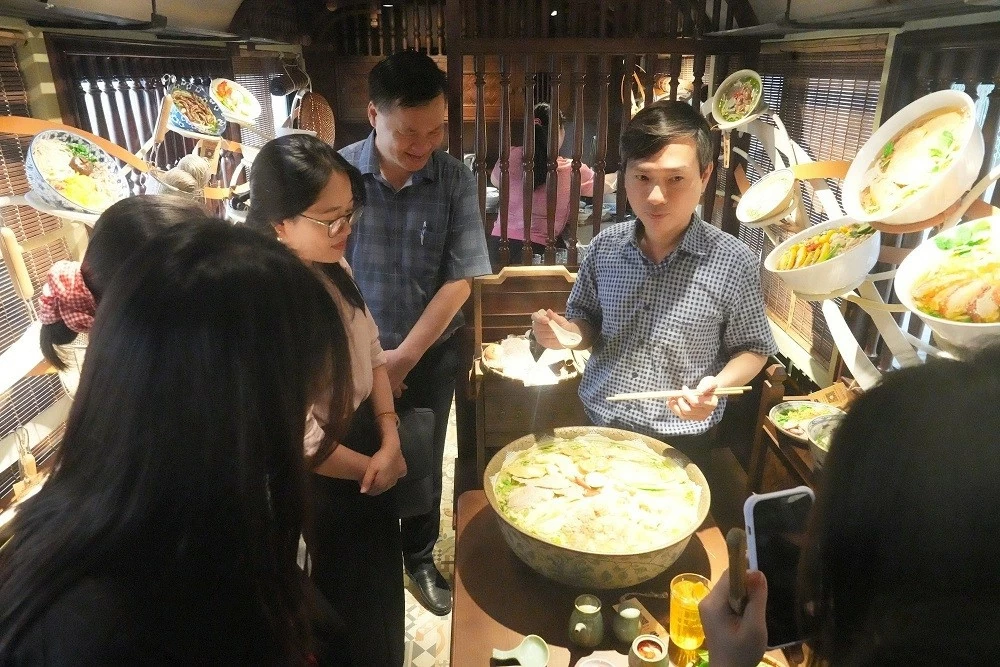 |
| Nguyen Dan Huy, Vice Chairman of Ba Dinh Ward People's Committee, explains the history and cultural value of Hanoi pho. (Photo: Ngoc Duc) |
From ancient villages to youth stories
Not only are spaces recreating past lifestyles attracting students, but many clubs at universities in Hanoi are also actively bringing young people back to the cultural addresses of the capital.
The History Club - HHE of the Faculty of Education, Hanoi Capital University, established in 2016, currently has nearly 100 members. With the motto “Evoking history authentically”, the club organizes research activities, practical experiences, and creative media, aiming to bring Hanoi's history and culture closer to the community.
A notable point in HHE's activities is that trips do not stop at sightseeing. Students are required to ask questions, take notes, collect documents, conduct interviews, and collaboratively build products after the trip. This learning method turns a heritage site into a lively “research topic”, where each young person must find their own answers and form their own perspective.
The study trip to the ancient village of Duong Lam is an example. Students explore relics associated with Phung Hung, Ngo Quyen, Chua Mia, Mong Phu Communal House, ancient houses, and community life. But besides knowledge about the relics, they also directly make traditional dishes like peanut candy and cassava cake.
Culture is perceived from multiple dimensions: architecture, history, beliefs, cuisine, and even the labor of the people. According to Nguyen Dao Quynh Trang, Head of the History Club - HHE, these experiences help students not only see history through relics but also feel history through everyday life, flavors, and the labor of the local community.
From such trips, young people also become more aware of their responsibility towards heritage. Quynh Trang believes that to preserve Hanoi's culture, young people must first understand the value of what they possess. Preservation does not necessarily mean keeping everything unchanged, but rather appreciating core values and making them continue to live in modern life with the spirit of today's generation.
This is also a noteworthy approach: Instead of placing young people in the position of “receivers” of heritage, they become the subjects exploring, interpreting, and continuing the heritage.
Retelling Hanoi in the language of the new generation
Another expression of love for heritage is the proactive participation in introducing culture to the community. The Cultural - Historical Propaganda Club, University of Social Sciences and Humanities, Vietnam National University, Hanoi, is one such model.
Established in 2014, inheriting from the Thang Long - Hanoi Cultural Historical Propaganda Team founded in 2009, the club maintains volunteer guide activities at many relics on weekends.
The Temple of Literature - Quoc Tu Giam, Thang Long Imperial Citadel, or the National Museum of History are not only places for members to learn knowledge but also become “stages” for them to retell historical stories to visitors.
Notably, they also seek to change the method of transmission. For children, interactive questions, legends, and folk tales are integrated into the tour. For visitors in general, instead of just providing information, members try to turn each destination into a story.
This approach shows a significant movement in Hanoi's cultural life: young people do not return to the past with a simple nostalgic mindset. They seek to understand, ask questions, experience, and then retell in their own language.
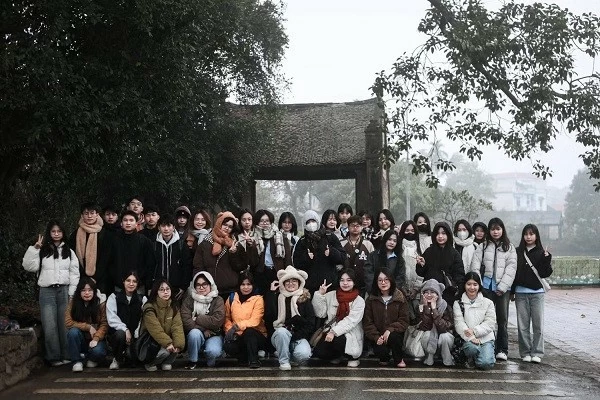 |
| Students participating in the History Club - HHE of the Faculty of Education, Hanoi Capital University at the ancient village of Duong Lam. |
Dr. Nguyen Viet Cuong, Deputy Director of the Department of Cultural Heritage (Ministry of Culture, Sports and Tourism), evaluates that this storytelling method helps participants see a broader picture of Thang Long - Hanoi, where besides palaces and citadels, there is also cuisine, customs, and the life of the people.
This reality opens up a promising direction for heritage education and promotion. When young people can “touch” culture with multiple senses, explore on their own, and create products, heritage will no longer be values confined in display cases or on book pages.
From a morning bowl of pho, an attic from the subsidized period, a trip to Duong Lam, or a guiding session at the Temple of Literature, young people are gradually rediscovering the fragments of Hanoi's memories. Because a thousand-year-old city can only truly retain its cultural vitality when its memories are embraced, cherished, and passed on by today's generation in a new way.