

Vietnamese diplomacy in the Ho Chi Minh era: An 80-year journey of shaping peace and development
WVR - The past eight decades have been a remarkable historical journey, marked by pivotal turning points in the nation’s destiny, from the struggle for independence to comprehensive international integration and the current era of dynamic development.
Latest
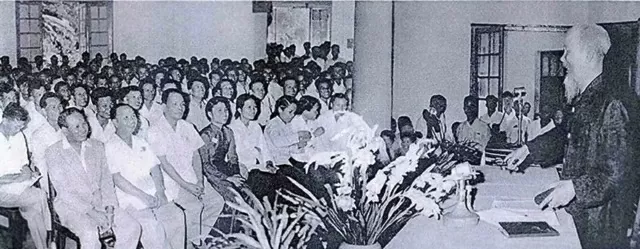 |
| Vietnamese diplomacy in the Ho Chi Minh era: President Ho Chi Minh speaking with officials and staff of the Ministry of Foreign Affairs at the First National Diplomatic Conference in March 1957. (Archive photo) |
Eighty years ago, on August 28, 1945, President Ho Chi Minh signed the decree establishing the Provisional Government of the Democratic Republic of Vietnam, thereby laying the foundation for modern Vietnamese diplomacy.
Throughout its journey, Vietnamese diplomacy has consistently aligned with and devoted itself to serving the national interest, playing a pivotal role in advancing the country’s revolutionary goals and realising the aspiration for peace and national development.
Peace and development are fundamental prerequisites for the survival of any nation. They are also the earnest desires of all peoples, including the Vietnamese, who have made immense sacrifices to safeguard their homeland.
Over the past 80 years, in steadfast companionship with the nation, Vietnamese diplomacy has embraced the philosophy of “defeating brutality with compassion, overcoming force with righteousness” and adhered to the resilient yet flexible, humane yet indomitable principle of “unchanging in the face of myriad changes” espoused by President Ho Chi Minh. It has remained a powerful tool in protecting and promoting revolutionary achievements, as well as an effective means of nation-building and development.
Strategic Missions
From the very first days of the nation’s founding, President Ho Chi Minh affirmed the vital role of diplomacy as a decisive front in the struggle for peace and development. He stated: “After national defence, diplomacy is a vital matter for an independent country” and consistently upheld the principle: “The Government’s foreign policy has only one objective, which is to be friendly with all democratic countries in the world to preserve peace”. Early on, he also recognised the close link between diplomacy and socio-economic development.
In November 1945, President Ho Chi Minh emphasised: “Diplomacy and economy influence each other. If we have an economic programme that benefits foreigners, they may be willing to help us”. He then announced an open-door and cooperative policy, inviting experts from France, the United States, the Soviet Union and China to support Vietnam in national reconstruction. Since then, his strategic thinking and visionary insights into the dialectical relationship between peace and development have continued to guide and inspire Vietnam’s diplomatic service across different eras.
In the perilous context of a nascent independent state, under the leadership of the Indochinese Communist Party and President Ho Chi Minh, who also served as the first Minister of Foreign Affairs, Vietnam’s diplomatic sector gradually forged a path to protect the fledgling revolutionary government and to confront threats both internal and external.
The signing of the Preliminary Agreement (6 March 1946) and the Provisional Accord (14 September 1946), along with diplomatic efforts at the Dalat Preliminaries and the Fontainebleau Conference, helped Vietnam avoid the danger of simultaneously facing multiple powerful enemies. These negotiations also played a crucial role in extending a fragile but essential period of peace, allowing the revolutionary government time to consolidate its forces in preparation for the protracted resistance war that would begin on 19 December 1946.
Throughout the two prolonged wars of national resistance, diplomatic struggle was closely coordinated with military and political efforts, enabling proactive international engagement and garnering global support for the Vietnamese people's just cause. At the same time, Vietnam’s external relations were significantly expanded. “Diplomacy became a vital front with strategic importance”, successfully mobilising an unprecedentedly broad international front in support of Vietnam’s struggle. The victories at the Geneva Conference and the Paris Peace Accords remain historic milestones and brilliant highlights of Vietnamese diplomacy in the fight for national liberation and the restoration of peace.
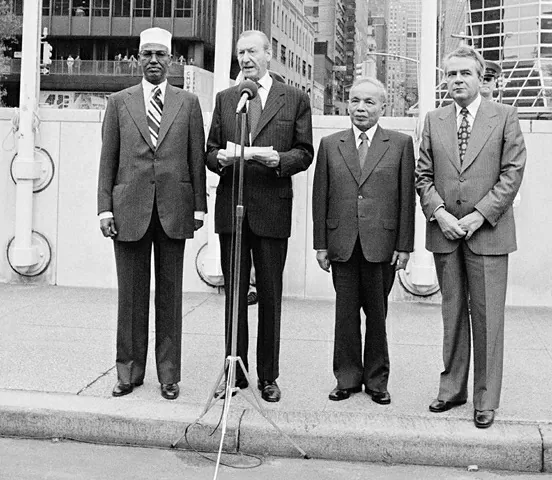 |
| Vietnamese diplomacy in the Ho Chi Minh era: On 20 September 1977, Vietnam officially joined the United Nations. In the photo: Deputy Prime Minister and Minister of Foreign Affairs Nguyen Duy Trinh (second from right) attends the flag-raising ceremony at the United Nations Headquarters. (Archive photo) |
Ensuring the “Dual objectives”
Although independence had been regained, the devastating consequences of two prolonged wars left Vietnam with immense challenges. Alongside the urgent task of healing the wounds of war, long-term and sustainable development became a national priority. The diplomatic service played an active role in post-war recovery, engaging in efforts to overcome economic embargoes and political isolation.
During the early stages of Vietnam’s economic renovation (Doi Moi), diplomatic officers, equipped with knowledge, multilingual capabilities and diverse perspectives, took the lead in researching international economic practices. Many were directly involved in advising on economic reform policies following the Sixth National Congress of the Communist Party in 1986.
Over the past eight decades, the country’s stature and role in the international arena have been steadily enhanced. Vietnam has officially established diplomatic relations with 194 countries, developed an extensive network of comprehensive, strategic and comprehensive strategic partnerships with 37 countries, including all five permanent members of the United Nations Security Council. The country has signed and effectively implemented nearly 20 free trade agreements, achieving an economic scale of nearly 500 billion USD, an almost 100-fold increase compared to 1986, ranking fourth in Southeast Asia and 34th globally. In 2024, Vietnam’s national brand value reached 507 billion USD, placing 32nd out of 193 nations worldwide. The country is also expanding cooperation in emerging fields such as digital transformation, semiconductors, artificial intelligence, green transition and innovation.
After four decades of Doi Moi, Vietnam’s comprehensive strength, especially in the areas of economy, security, defence, and foreign affairs, has undergone a qualitative transformation. This progress calls for a renewed, holistic and balanced approach to the nation’s dual objectives: safeguarding peace and promoting development in a new context.
On the one hand, diplomacy must ensure a peaceful and stable environment to maximise the mobilisation of resources for rapid and sustainable national development. On the other hand, progress across all fields, from politics, economy and society to science, technology, security and defence, forms a solid foundation for preserving that peaceful and stable environment. As President Ho Chi Minh once said: “National strength is the gong; diplomacy is the sound. Only with a large gong can the sound resonate far”.
Affirming the Vital and Enduring Role
To fulfil its noble mission, the 13th National Congress of the Communist Party of Vietnam (2021) reaffirmed the leading and guiding role of diplomacy in fostering peace and national development: “Continue to promote the pioneering role of foreign affairs in creating and maintaining a peaceful and stable environment, mobilising external resources for national development and enhancing the country’s position and reputation”.
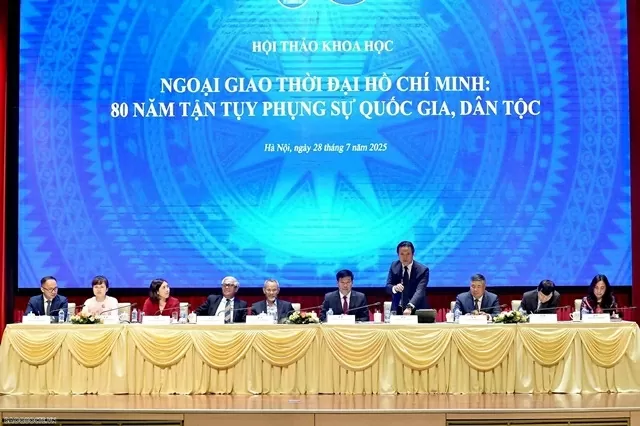 |
| Vietnamese diplomacy in the Ho Chi Minh era: An 80-year journey of shaping peace and development. (Photo: WVR) |
Accordingly, the Party has outlined the policy of “building a comprehensive and modern diplomacy based on three pillars: Party diplomacy, State diplomacy, and people-to-people diplomacy”, reflecting the maturity and depth of Vietnam’s revolutionary diplomatic tradition.
In his article “Reaching new heights in International Integration” (April 2025), General Secretary To Lam emphasised that, along with national defence and security, “promoting foreign affairs and international integration” constitutes a vital and regular task. This enduring strategic perspective on integration calls for leveraging external resources and favourable international conditions to safeguard the homeland and drive national development, early and proactively. It aims to ensure the utmost benefit for the nation and the best interests of the people.
To generate momentum for the country’s advancement into a new era, the Ministry of Foreign Affairs advised the Politburo to adopt Resolution No. 59-NQ/TW on international integration in the new context. This marks a breakthrough for integration, not only in achieving development goals but also in affirming Vietnam’s growing responsibility, influence and positive contributions to global politics, the world economy and human civilisation. The resolution forms part of the “four strategic pillars” shaping a unified mindset and strategic action framework for national development in the new era.
For every diplomatic officer in the Ho Chi Minh era, whether stationed at home or abroad, in central government or at the local level, creating and seizing every opportunity to contribute to peace and development through peaceful means remains the unwavering objective and consistent method to realise the collective aspiration of the diplomatic service: to elevate Vietnam to stand shoulder to shoulder with the great powers of the five continents.
That aspiration is also the unbreakable thread that connects generations of diplomats. It fosters a spirit of resilience and dedication in all circumstances in the service of the nation and its people, forming the enduring identity of Vietnamese diplomacy in the Ho Chi Minh era.