






Promoting the value of socialist human rights
WVR - The aspiration for a prosperous, happy, and powerful nation by the mid-21st century necessitates a strong renewal in theoretical thinking and practical development. Affirming and promoting the core values of socialist human rights (SHR) is of special importance, not only timely but also strategically significant in the long term.
Latest
Socialist human rights are not merely humanitarian and ethical goals of the regime but also foundational pillars and the strongest intrinsic motivation to mobilize and harness all social resources for the firm construction and defense of the nation in the new era.
The fourth foundational pillar of the socialist development model in Vietnam
During his lifetime, President Ho Chi Minh consistently emphasized that the highest goal of socialism is nothing other than for the people, for the happiness of the people. He succinctly and profoundly stated: “The purpose of socialism is to continuously improve the material and spiritual life of the people.” This viewpoint clearly reflects the humanistic and progressive nature of the socialist regime, laying the ideological foundation for the approach to human rights in Vietnam, an approach that closely links human rights with national independence, sovereignty, and sustainable development.
Entering the Doi Moi period, our Party has increasingly comprehended the dialectical relationship between humans, human rights, and national development. Not only considering humans as the ultimate goal, the Party also identifies humans as the subject and decisive driving force of all development processes: “Humans and human rights are the center, subject, goal, and driving force of national development.”
Practical development shows that the relationship between human rights and development is dialectical, evident in that respecting and ensuring human rights is a prerequisite for sustainable development; at the same time, only an independent, stable, and prosperous country has the resources and conditions to better ensure human rights. In this sense, human rights are most fully, substantially, and comprehensively ensured under the socialist regime, where humans and human rights are the center of all development strategies.
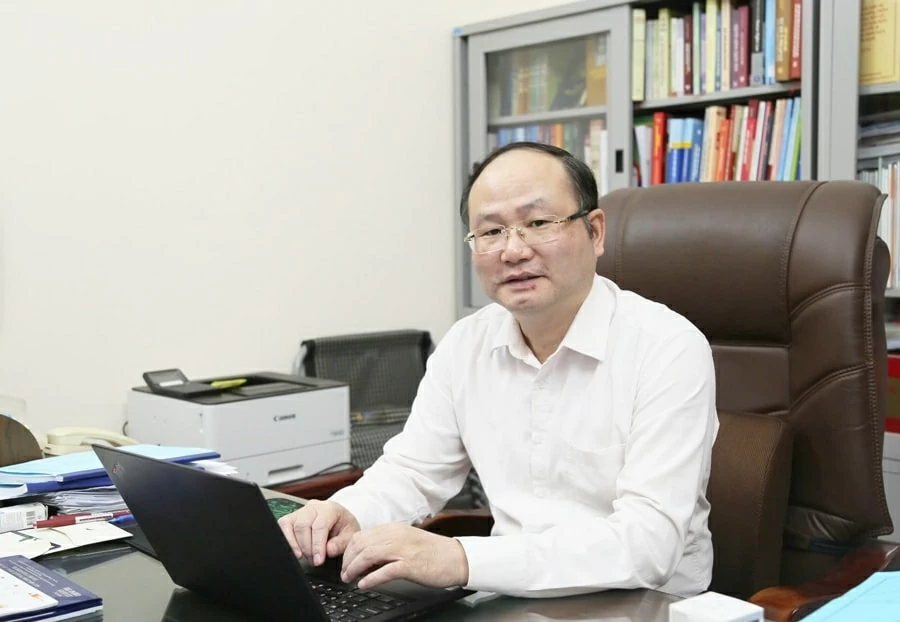 |
| Associate Professor Dr. Tuong Duy Kien, Director of the Institute of Human Rights (Ho Chi Minh National Academy of Politics). (Photo: Dinh Hiep) |
In the process of building and perfecting the socialist model in Vietnam, our Party has gradually formed and clarified three foundational pillars ensuring the stability and sustainable development of the country in the socialist orientation, including: (i) A socialist-oriented market economy, (ii) a socialist rule of law state, and (iii) socialist democracy.
However, the practical development of the country and the current need for theoretical renewal show that supplementing and affirming socialist human rights as an independent fourth foundational pillar is objectively necessary and of special importance.
Firstly, the socialist-oriented market economy is a means to develop productive forces and liberate all social resources, with the ultimate goal of improving people's lives. This pillar directly ensures basic economic rights such as the right to work, ownership, business, and legal enrichment; while providing a solid material foundation for the realization of social rights and human rights in general.
Secondly, the socialist rule of law state is a tool for organizing and managing society by the Constitution and law, ensuring all state power belongs to the people. This is the central mechanism to recognize, ensure, and protect civil and political rights, as well as the legitimate rights and interests of the people; while preventing and controlling abuse of power and protecting justice and reason in social life.
| More from WVR |
 Human rights efforts 2025: Transforming for breakthroughs Human rights efforts 2025: Transforming for breakthroughs |
Thirdly, socialist democracy is the essence of the regime, a form for the people to exercise their mastery in all fields of social life; ensuring the right to participate in state and social management, the right to know, discuss, act, and supervise.
On this foundation, socialist human rights need to be established as the ultimate goal and the “red thread” throughout, most concentratedly reflecting the superiority and humanism of the socialist regime. This is the synthesis of the values of the three aforementioned pillars, while playing a guiding role so that economic, political, and legal pillars operate in unison for humans, for the happiness of the people.
Establishing socialist human rights as an equal pillar is not only an important step forward in theoretical awareness but also contributes to enhancing the legitimacy and persuasiveness of the socialist path in Vietnam; while providing a solid foundation to proactively fight and refute false and distorted views on the human rights situation in Vietnam.
Unleashing developmental thinking
Entering the new era, the requirement for building and defending the nation goes beyond maintaining independence and sovereignty to creating a prosperous, happy nation with a worthy position on the international stage. In this context, the directives and orientations of General Secretary To Lam on the position and role of humans and human rights are of special importance. This is not only the inheritance of Ho Chi Minh's ideology but also a breakthrough development in thinking, elevating the issue of human rights to a key driving force. The comprehensive implementation of this viewpoint needs to be carried out synchronously in the following aspects:
Unified awareness and action: All policies and guidelines of the Party and State must originate from the legitimate rights, interests, and happiness of the people. This is the foundational viewpoint, an immutable principle emphasized by General Secretary To Lam. In the new era, the legitimacy and strength of the Party and State depend entirely on the people's support. Therefore, the process of formulating guidelines, policies, and law-making must undergo a fundamental shift in thinking.
(i) Clearly define the mindset: All policies and guidelines of the Party, laws of the State must truly originate from life, from the legitimate rights and interests of the people. (ii) Adhere to the goal: Respecting, ensuring, protecting human rights, happiness, and prosperity of the people is the ultimate goal. (iii) Implement the motto “People know, people discuss, people act, people inspect, people supervise, people benefit” in a substantive way. All policies before issuance must involve public opinion and after issuance must be subject to public supervision.
Institutional breakthrough: Removing “bottlenecks”, focusing on serving the people and businesses. General Secretary To Lam has clearly pointed out the need to focus on removing institutional “bottlenecks”, considering this a strategic breakthrough to liberate resources. In this mindset, perfecting the socialist human rights institution plays a core role.
Implementing this viewpoint requires the legal construction work to shift strongly from “management” thinking to “developmental creation” thinking. The legal system is not only a tool for the State to manage society but also a safe and open legal corridor to protect and promote the rights to creative freedom, property rights, and business rights of the people; decisively eliminating the “ask-give” mechanism, minimizing cumbersome administrative procedures that hinder access to development opportunities.
Ensuring human rights in institutional construction is creating a fair, transparent environment where every citizen has equal opportunities to contribute. When institutional “bottlenecks” are removed with progressive human rights thinking, the vast resources among the people will be unleashed, creating a synergistic strength for the nation-building endeavor.
Ensuring human rights in the digital space and national digital transformation. A significant highlight in the thinking of the General Secretary is the requirement to seize the opportunities of the Fourth Industrial Revolution and the digital transformation. In the new era, cyberspace is becoming a new survival space. Therefore, ensuring socialist human rights cannot be separated from ensuring the rights of “digital citizens”.
Implementing this viewpoint requires building a solid legal infrastructure to protect digital sovereignty and personal data; the State is responsible for ensuring equal access to digital technology, especially for people in remote and isolated areas, adhering to the principle of “leaving no one behind” in the digital revolution; national digital platforms and citizen data must be exploited to simplify procedures, make public authority activities transparent, helping people exercise their rights to supervise and participate in state management most conveniently. This is a vivid manifestation of the superiority of the socialist regime in the digital age.
Closely linking “human security” with “national security”. In the directive thinking of the Party leader, protecting national security fundamentally means protecting human security, security for the people. Human security is the foundation and goal of national security. The content of ensuring human rights in the new era needs to be expanded. It is not only civil and political rights but also social welfare rights, the right to live in a safe and healthy environment. Proactively responding to non-traditional security challenges such as climate change, natural disasters, epidemics... directly threatening people's livelihoods. Building a solid “people’s defense” in national defense must start from caring for and protecting the peaceful life of each citizen. When every citizen feels safe, respected, and protected by the regime, they will become the most resilient “living milestones” to protect national sovereignty.
Maximizing the human factor – the most important intrinsic resource. The era of national rise demands high-quality human resources. The viewpoint of the General Secretary affirms that humans are both the goal and the driving force. Therefore, respecting and protecting human rights is the optimal way to “nurture” and “promote” this resource.
The overarching thought that needs to be affirmed is: Humans and human rights are the center, subject, goal, and driving force of development; All policies and guidelines of the Party, laws of the State must truly originate from life, taking the legitimate rights and interests of the people; taking respect, ensuring, protecting human rights and happiness, prosperity of the people as the ultimate goal.
On this foundational awareness, officially establishing socialist human rights as the fourth foundational pillar of the development model, alongside the socialist-oriented market economy, socialist rule of law state, and socialist democracy will be a solid political-legal foundation to consolidate the great national unity bloc, build a solid “people’s defense” and unleash vast intrinsic resources for the nation-building and defense endeavor.
With steadfastness on the socialist path and breakthrough thinking placing humans at the center of all development strategies, Vietnam has complete theoretical and practical grounds to realize the aspiration of becoming a developed, high-income country by 2045, bringing true freedom, prosperity, and happiness to the people.
| A mechanism needs to be built to protect officials, party members, and citizens who dare to think, dare to act, and dare to break through for the common good. Freedom of thought, academic freedom, and creativity within the legal framework need to be strongly encouraged. Investing in human rights through education, healthcare, and culture is the most sustainable investment. At the same time, it is necessary to continue implementing the great national unity policy effectively, so that every Vietnamese, wherever they are, feels proud and wants to contribute to the country. |
| Vietnam ensures enjoyment of human rights for all citizens Vietnam’s human rights message is consistent: While universal, these rights must be practical and tied to daily life, prioritizing healthcare, education, and sustainable employment. |
| Enhancing the protection of human rights: Workshop on the International Convention for the Protection of All Persons from Enforced Disappearance WVR - On January 6, in Quang Ninh, the Ministry of Public Security of Vietnam, in collaboration with the United Nations Development Programme (UNDP), organized ... |

| 14th Party Congress: Ensuring social security from a human rights perspective WVR - One of the key tasks emphasized in the Draft Documents of the 14th Party Congress is the construction and development of the social ... |

| Human rights in cyberspace: Global and Vietnamese practices WVR - Ensuring and protecting human rights in cyberspace is an urgent requirement for the international community and individual nations in the current context. |
| Vietnam's expectations for its UN Human Rights Council membership term 2026-2028 WVR - Vietnam's outstanding completion of its term as a member of the United Nations Human Rights Council (UNHRC) for 2023-2025 and its re-election for ... |


