






Restructuring the nation, reaching out to the open sea: Article 4 - A streamlined national apparatus, a soaring Vietnam
WVR - With the strategic decision to “restructure the national aparatus,” both localities and businesses are poised to benefit. Merged or renamed localities now have stronger neighboring "companions" to support and prioritize regional development.
Latest
Vietnam’s current administrative reform, the most significant since 1986, is a strategic decision that enables the country to make a breakthrough and seize a new historic opportunity. Most importantly, this decision enjoys broad public support, consensus, and absolute trust. The streamlined two-tier government model is expected to operate efficiently in terms of time, resources, and cost.
 |
| A country can only develop sustainably when there is consensus among its people and coherence in its physical and geographical structure. (Source: Vietnamnet) |
A new era of development
A country can only develop sustainably when there is consensus among its people and coherence in its physical and geographical structure. In the years following the Doi Moi period, the old administrative model gradually became ineffective, revealing a bloated bureaucracy, overlapping functions, unnecessary intermediate mechanisms, and unclear decentralization. The legal and policy frameworks also remained inconsistent and outdated, unable to keep pace with the rapid development of the economy, society, and global trends.
To address these core challenges, the restructuring of provincial-level administrative units is a critical national decision, helping optimize resources and improve governance effectiveness. This marks the beginning of a new era of development, toward a sustainably growing Vietnam that creates new values while preserving long-standing cultural heritage and national identity.
| The efforts of localities to proactively identify their own advantages and propose specific policies and action programs aligned with larger administrative units for the sake of national interests are the key to accelerating implementation and ensuring smooth operation. |
Specifically, the merger of provincial administrative units - from 63 to 34 provinces and cities - stems from a fundamental desire to shift from fragmented, local development to coordinated, balanced growth. The merger of the administrative apparatus is based on the principle of leveraging each region’s strengths to create synergy within defined satellite zones.
For instance, the merger of Hai Duong and Hai Phong aims to establish a new growth hub in the Red River Delta. This integration optimizes resource utilization by combining the modern urban infrastructure with strengths in culture, agriculture, and local specialties. This results in harmonious, unified regional development with accelerated growth that goes beyond incremental gains.
A streamlined administrative system means a reduction in the workforce, a tightened and more effective use of the state budget, and reallocation of resources toward investment projects and improved public infrastructure.
At the macro level, reducing administrative layers minimizes overlaps and fragmentation in state management, especially in regional and interregional planning, thus fostering a more transparent and business-friendly environment for both domestic and foreign enterprises.
In terms of capital, an improved business climate enhances the efficiency of attracting foreign investment, which is one of the key pillars of national development. This drives growth in multiple areas, including job creation for local workers and the development of industrial zones and clusters.
Simultaneously, resources can be focused on developing transportation and synchronized infrastructure. When large economic zones are formed with stable, clear planning and standardized decentralization, domestic and international businesses will gain faster access to regional markets, and investment and trade will be carried out more efficiently and seamlessly.
The value chains serving investors will also grow. For example, agricultural value chains will benefit from large-scale, interregional production zones, while tourism value chains will gain from expanded interregional travel routes, promoting the development of local tourism products, no longer constrained by fragmented administrative boundaries. It is an inevitable step to resolve bottlenecks in regional economic development that the previous administrative model could not fully address.
Companion localities and regional synergy
At this critical moment, all efforts needs to be transformed into unified, coordinated, resolute, and determined action. With this decision on administrative merger, both localities and businesses will certainly benefit. The merged or renamed localities now have “companions” - stronger neighboring provinces - to prioritize regional development. They can leverage their existing advantages in geography, natural resources, and infrastructure to align with the strengths of core localities, thereby promoting the development of the entire area.
As a result, instead of small, fragmented local brands, we will now have larger regional brands that are more visible on the map of investment, business, culture, and tourism. For the business community, this presents an opportunity to expand geographically, reach broader markets, and reduce administrative burdens. Synchronized and developed infrastructure helps businesses cut transport and logistics costs, thereby reducing the costs of production and trade - and ultimately benefiting consumers directly.
Moreover, when regional linkages are established, preferential policies and mechanisms regarding taxation, land use, and access to capital will be proposed to facilitate enterprises aiming to invest, produce, and trade, as well as to foster inter-enterprise connectivity and enhance the competitiveness of specific goods and products.
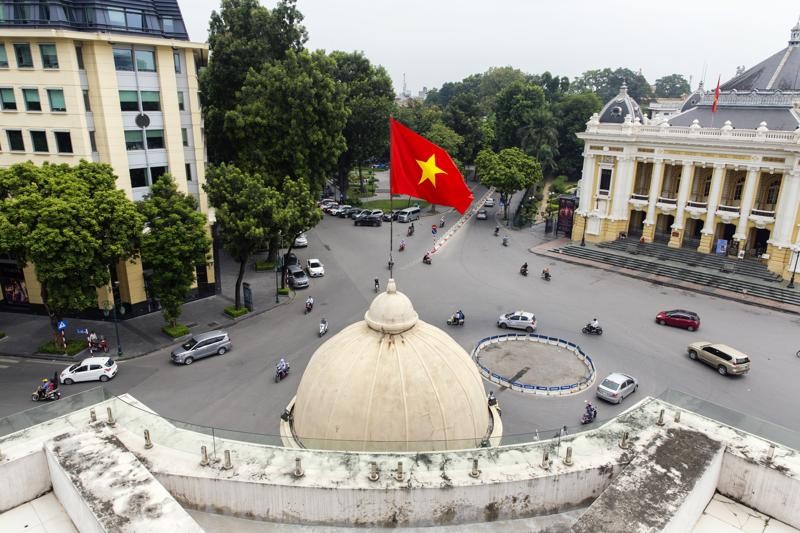 |
| This administrative restructuring is a historic milestone. (Source: Bloomberg) |
A Need for unified and focused thinking
The efforts of localities to proactively identify their own advantages and propose specific policies and action programs aligned with larger administrative units for the sake of national interests are the key to accelerating implementation and ensuring smooth operation.
To realize the goal of “restructuring the nation” for prosperity - as emphasized in the message from General Secretary To Lam to every locality, official, and citizen - we need synchronized solutions from the central to the local level and proactive engagement from the business community.
The State and Government play a pivotal role as the “locomotive” leading the way. Therefore, institutional and policy frameworks must be promptly completed, and regional and inter-regional planning must be issued with detailed, concrete guidelines, assigning responsibilities to localities under the new administrative model to ensure smooth, obstacle-free implementation.
In terms of administrative procedures, it is necessary to continue making processes more transparent and efficient, promoting digital government, and enhancing public services to reduce time and cost for both citizens and businesses. Infrastructure development should prioritize regional connectivity projects, industrial zone-port connections, and diversification of transportation modes along key routes.
For public officials, relocating entire provincial offices and staff to central areas is not always necessary. Instead, digital transformation should be promoted so that officials can work remotely. Facilities should be distributed evenly to better serve the public and businesses when needed. Additionally, officials must continue to receive training in both professional expertise and foreign languages to be fully prepared for practical challenges.
The localities need to proactively develop appropriate action plans that reflect their geography, local characteristics, and internal resources, in line with the strengths of the newly merged units.
The business community, in turn, must adapt proactively, explore investment opportunities, and prioritize neighboring areas, contributing to the balanced development of all aspects across localities. At the same time, they should strengthen partnerships with other enterprises in the region to enhance local value chains. Both businesses and localities should proactively create conditions, space, and environments for mutual growth. In particular, innovation and digital technology are essential.
It can be affirmed that this administrative restructuring is a historic milestone. This is a pivotal moment for all organizations to take collective action to turn the once-impossible into reality, and to transform potential into national strength. All for the ultimate goal of building a unified, strong, and prosperous Vietnam.
Stay tuned for Article 5: Businesses onboard "the train to prosperity"
| 6th Global Forum of Young Vietnamese Intellectuals: Soaring together on the journey of knowledge WVR - On the morning of July 19, the 6th Global Forum of Young Vietnamese Intellectuals 2025, themed "Global Young Vietnamese Intellectuals contributing to the ... |
| Party General Secretary To Lam writes article honouring fallen heroes, revolution contributors Party General Secretary To Lam has written an article honouring those who sacrificed for the country, heroic martyrs, wounded and sick soldiers. |
| Article 1 - Dr. Nguyen Si Dung: Merging administrative units for a prosperous nation WVR - The merging of provinces and cities is far more than a simple administrative adjustment - it represents a renewal of leadership thinking, a ... |

| Article 2 - A strategic move reflecting Vietnam’s reform vision and aspiration for national advancement WVR - The merging of provincial-level administrative units reflects the nation’s strong aspiration for progress and reform vision for a new era of national advancement. ... |

| Article 3 - National Assembly deputy Bui Hoai Son - Administrative restructuring is a historic step for the nation WVR - On June 30, Vietnam officially announced the Resolution on the merger of provincial- and commune-level administrative units and the appointment of key personnel. ... |