


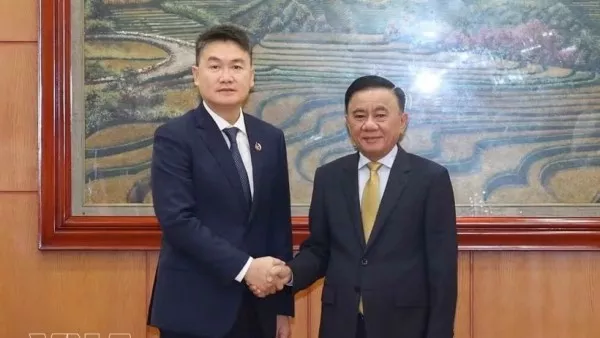

Restructuring the nation, reaching out to the open sea
Article 1 - Dr. Nguyen Si Dung: Merging administrative units for a prosperous nation
WVR - The merging of provinces and cities is far more than a simple administrative adjustment - it represents a renewal of leadership thinking, a reconstruction of public trust, and the beginning of a new era of national development.
Latest
As of July 1, provinces and cities across Vietnam officially operate under a two-tier local government system. The merger and reorganization of provincial-level administrative units is a “historic step,” marking a new phase in building a modern, streamlined, efficient, and effective public administration.
The World & Vietnam Report proudly presents a series titled “Restructuring the nation, reaching out to the open sea”, featuring perspectives from experts, National Assembly deputies, and intellectuals to offer a multidimensional view of the benefits of administrative mergers — a historic opportunity for national development and progress. It underscores that the merger of provinces and communes is not merely an administrative decision, but a profound spiritual transformation — a moment in which each citizen contributes to rewriting the name of their homeland in a new chapter of history, filled with aspiration and hope.
From his perspective, Dr. Nguyen Si Dung, a member of the Prime Minister’s Policy Advisory Council and former Deputy Head of the National Assembly Office, affirms that a country cannot become a developed nation while burdened by a bulky and sluggish bureaucracy. The state apparatus must be streamlined and effective—not merely for aesthetic reasons - but to become a true driver of development, a servant of the people, and a guiding force leading the nation into the future.
This is not just about reorganizing geographical boundaries; it involves the entire structure of power from the central to the local levels. If this system is not reorganized to be more streamlined, transparent, and effective, the nation will struggle to advance in the era of global competition.
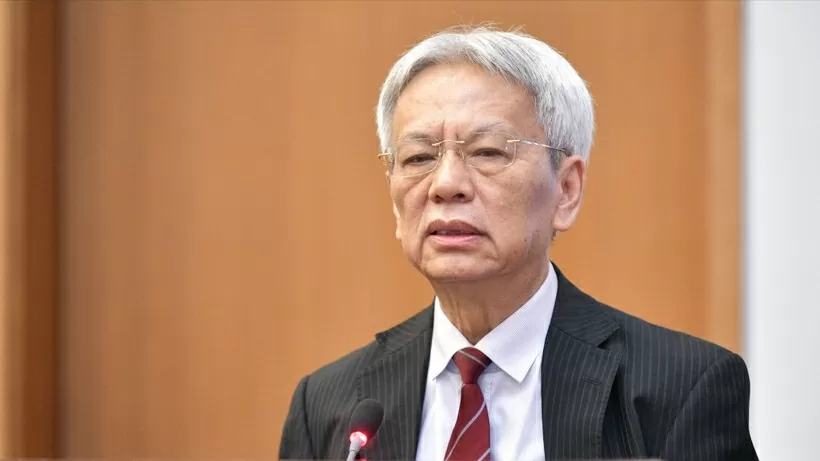 |
| Dr. Nguyen Si Dung believes that merging provinces and cities is essential for the nation to move forward into the future. (Photo: NVCC) |
A comprehensive and radical reform
The first reform is the streamlining of the central government, aiming for fewer agencies but greater efficiency. A modern national governance system cannot function effectively with numerous overlapping agencies. Too many authorities with duplicated responsibilities result in resource waste and reduced efficiency.
Therefore, merging ministries with closely related functions - such as the Ministry of Finance and the Ministry of Planning and Investment, the Ministry of Transport and the Ministry of Construction, the Ministry of Natural Resources and Environment and the Ministry of Agriculture and Rural Development - is not only reasonable, but essential.
At the central level, streamlining does not merely mean reducing the number of ministries, but also involves redesigning governance functions and strategies. It is important to clearly distinguish between agencies responsible for long-term strategic policymaking and those in charge of day-to-day administrative implementation. This distinction will help establish a clearly two-tiered system: a 'thinking brain' for strategy and an 'acting hand' for execution - each with its own role, avoiding overlap or interference.
The second vital reform lies in restructuring local government: larger but more simple administrative units. For the first time in nearly a century, Vietnam is boldly addressing the merging of provinces, eliminating the district level, and building a two-tier government model.
The traditional three-tier system (province – district – commune) has long been seen as cumbersome, inefficient, and prone to hierarchical "give-and-take" mentality. Transitioning to a two-tier system (province and commune/ward) reduces intermediate layers and shortens the distance between the government and the people.
| Vietnam cannot enter a prosperous 2045 with an administrative framework designed in the previous century. The system must be restructured, streamlined, and optimized - not merely through downsizing, but by rebuilding the entire national operating system - where technology, data, personnel, and processes are efficiently connected. |
The district level - originally meant to be an administrative bridge - has become a bottleneck. Eliminating this middle tier not only saves thousands of personnel but also marks a breakthrough in thinking about how to modernize the state apparatus.
Guiding principles of the two-tier local government model
First, the closer the government is to the people, the more effective it becomes. At the heart of any power structure must be the people—the ultimate bearers of public authority. The philosophy of “closeness to the people leads to effectiveness” stems from a fundamental principle of modern public governance: all public power must serve the public interest directly, rather than merely preserving bureaucratic structures.
The two-tier local government model - the provincial and commune/ward levels - helps reduce the distance between the governing authority and the policy beneficiaries. When communes are granted greater authority, clearer budgets, and stronger organizational capacity, they can address issues in a manner that is close to the people and responsive to real-life circumstances. Matters such as document issuance, complaint resolution, business registration, and construction permits will no longer need to pass through the intermediate district level, thereby reducing time, costs, and bureaucracy.
Furthermore, when power is closer to the people, it is subject to stronger social scrutiny. Commune officials cannot easily act improperly, as they are directly observed and known by the local population. This creates a built-in mechanism for preventing corruption and misconduct through transparency, accountability, and public oversight.
Second, reducing hierarchical layers increases the effectiveness and speed of governance. One dilemma of the administrative system lies in its intermediary levels - where power is often fragmented, overlapping, and prone to inertia. For years, the district level has functioned as a “transfer station”: lacking sufficient authority to make decisions, too far from the people to serve them effectively, and yet a source of bureaucracy, delays, and gatekeeping.
Eliminating this layer allows for a more streamlined and coherent design of authority. Decisions no longer have to pass through multiple layers of approval; responsibilities are no longer passed around; and policies can flow more quickly, accurately, and effectively. This not only enhances the government’s effectiveness but also clarifies personal accountability - a prerequisite for power control.
Instead of delays and unclear mandates, citizens and businesses will have quicker access to policies and receive timely government responses. Most importantly, public trust will be strengthened through clear, transparent, and consistent practices in public service.
Third, rearranging functions is essential to break away from fragmented governance thinking. A common mistake in administrative reform is to confuse "merging" with "substantive reform." Simply combining organizational units without redesigning internal functions and processes results in a “two-headed snake”—where responsibilities overlap, accountability becomes diffused, and productivity declines.
Therefore, reorganizing administrative units is not just about downsizing, but about redesigning the machinery based on function and output. Each agency must have distinct responsibilities and clearly defined deliverables, with no overlap. Only then can each part operate as an essential cog in a unified system—rather than working passively, managing vaguely, or shirking responsibility.
This marks a critical shift from a traditional administrative model to a modern governance model—where authority is accompanied by accountability, and organizations operate based on their assigned missions rather than outdated bureaucratic maps.
Fourth, national strength must come from a lean, strong, and intelligent apparatus. In the modern world, no powerful nation operates with a bloated and rigid bureaucracy. As technology and globalization compress time and space, a delayed decision can cost the country an opportunity.
Vietnam cannot enter a prosperous 2045 with an administrative framework designed in the previous century. The system must be restructured, streamlined, and optimized - not merely through downsizing, but by rebuilding the entire national operating system - where technology, data, personnel, and processes are efficiently connected.
More importantly, the two-tier local government model is a starting point for a digital government, digital administration, and digital society. A smart, interconnected, and responsive system will form the foundation for Vietnam not only to catch up, but to take the lead in emerging sectors such as artificial intelligence, industry 4.0, the green economy, and innovation.
 |
| The two-tier local government model - comprising provinces and communes - helps shorten the distance between the governing center and policy beneficiaries. (Photo: Thanh Long) |
A big challenge but inevitable necessity
No major reform ever comes easily, and the nationwide merger of administrative units will certainly face considerable resistance. The first barrier is local mentality: every province, district, and commune has its own history and identity, and it is not easy to let go of long-standing names or local authority. In many areas, administrative boundaries are viewed not merely as lines of governance but as symbols of honour and “local sovereignty".
Therefore, merging provinces or communes is not just a technical exercise - it touches deep emotional chords in communities, something that is always sensitive and difficult to resolve without genuine, empathetic dialogue.
Associated with this is the concern over individual interests and official positions - a common obstacle in all efforts to streamline government structures. Any merger of organizations, reduction of administrative levels, or consolidation of agencies inevitably entails personnel transfers, staff reshuffling, and even the elimination of certain positions. Although the ultimate goal is to enhance governance efficiency, the direct impact on people’s interests remains one of the greatest hurdles to building internal consensus.
| Vietnam now stands at a historic turning point. We cannot become a developed nation while burdened by a bulky and sluggish bureaucracy. The state apparatus must be streamlined and effective - not merely for aesthetic reasons - but to become a true drive of development, a servant of the people, and a guiding force leading the nation into the future. |
Besides, a structural barrier is the lack of uniformity in the current legal system. Many laws related to the organization of state apparatus, local government, budgeting, decentralization, and delegation of authority are still based on the traditional three-tier administrative model.
If institutions are not promptly revised, updated, and unified, reforms risk falling into a situation of “top-down directives with no grassroots implementation”. In such cases, grand policies can be eroded by shortcomings in law and implementation.
However, difficulty must not become an excuse for delay - it should instead be the reason for more resolute action. No matter how formidable the resistance, it cannot justify maintaining a cumbersome, overlapping, and inefficient bureaucracy. On the contrary, these very challenges underscore the urgency and critical importance of reform.
Reaching out to the open sea
The merging of provinces and cities is not just about redrawing administrative maps. It reflects wisdom, courage, and a deep aspiration to lead the nation into a new era—one in which every territorial unit is not merely a boundary, but an optimized design for development. And although this endeavor is a big challenge, it is an inevitable necessity - and must be done successfully.
Vietnam’s history has seen numerous administrative reforms, but most have been technical adjustments or piecemeal reforms. This time, the provincial merger is a comprehensive institutional revolution—restructuring not only organizational models, functions, and powers, but also rebuilding data infrastructure, reallocating resources, and redesigning inter-governmental relations.
This reform demands a bold and progressive mindset - one that breaks away from outdated administrative thinking and embraces innovation. It also requires political courage to confront parochialism and conservative resistance that may arise during the process. Furthermore, successful implementation depends on strong institutional and operational capacity, from enacting the necessary legal frameworks to executing concrete, practical steps. Most importantly, it calls for the trust and support of the people, for only with public unity can meaningful reform be truly achieved.
Vietnam now stands at a historic turning point. We cannot become a developed nation while burdened by a bulky and sluggish bureaucracy. The state apparatus must be streamlined and effective - not merely for aesthetic reasons - but to become a true drive of development, a servant of the people, and a guiding force leading the nation into the future.
The merging of provinces and cities is far more than a simple administrative adjustment—it represents a renewal of leadership thinking, a reconstruction of public trust, and the launching pad for a new era of national development.
Stay tuned for Article 2: A strategic move reflecting Vietnam’s reform vision and aspiration for national advancement
| Vietnam’s car sales jump 20% in June, topping 31,000 units The total number of cars sold by the Vietnam Automobile Manufacturers Association (VAMA)’s members in June 2025 reached 31,977 vehicles, up 9% over May and ... |

| Ambassador Nguyen Nguyet Nga: A lifetime of dedication to diplomacy and the nation WVR - The World and Vietnam Report respectfully introduces an article by Ambassador Nguyen Phuong Nga, former Deputy Minister of Foreign Affairs, former President of ... |

| Youth train journey back to the roots: Traveling to deepen the love for a heroic nation WVR - On the afternoon of July 17, at Hanoi Railway Station, the program “Youth Train Journey Back to the Roots: Vietnam, Travel to Love ... |

| External affairs Journalism: An elite force contributing to the building of a strong and prosperous Vietnam WVR - On the occasion of the 100th anniversary of Vietnam's Revolutionary Press, in her interview with the World and Vietnam Report, Deputy Minister of ... |
| Party General Secretary To Lam writes article honouring fallen heroes, revolution contributors Party General Secretary To Lam has written an article honouring those who sacrificed for the country, heroic martyrs, wounded and sick soldiers. |