





Pom Coong Village – A tranquil beauty amidst the Mai Chau valley
WVR - Pom Coong village, a prominent community tourism destination in Mai Chau, Phu Tho, stands out with its natural landscape and the traditional culture of the Thai people.
Latest
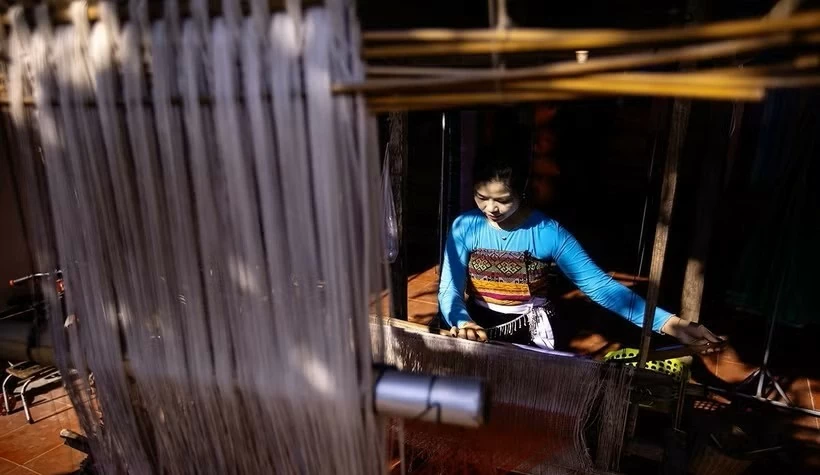 |
| Thai women weaving brocade in Pom Coong village. (Photo: Trong Dat) |
Nestled among the green fields of Mai Chau commune, Phu Tho province, Pom Coong village retains the rustic charm of a Thai village with traditional stilt houses and a slow-paced lifestyle centered around brocade weaving.
In the midst of the increasingly hectic modern life, many tourists visit Mai Chau not only to admire the mountains and forests but also to experience the serene atmosphere of villages nestled at the foot of the mountains.
Among these, Ban Pom village is considered one of the exemplary community tourism spots, where the cultural life of the Thai people is still preserved quite intact.
Pom Coong is located in the center of Mai Chau commune, Phu Tho province. The name "Pom Coong" in Thai means "the village of hills on a large drum", referring to the vast fields nestled among the hills. Currently, the village has over 70 households with more than 300 residents, primarily Thai people who have lived there for generations.
What first attracts visitors to Pom Coong is the distinctive landscape of the northern mountainous region. Traditional stilt houses, interspersed with rice fields, areca trees, and small paths, create a rare peaceful space. In the distance, green mountain ranges encircle the Mai Chau valley, creating a scene many visitors liken to a picturesque highland painting.
The stilt houses in Pom Coong are primarily constructed from bamboo, wood, or bương, elevated about 2 meters above the ground on sturdy wooden pillars. The roofs were traditionally thatched with palm leaves or gianh, though many families have now renovated them with new materials while retaining the traditional Thai architectural style.
Beyond its natural scenery, Pom Coong is also appealing due to its well-preserved community cultural life. Many families in the village continue the traditional craft of brocade weaving. Underneath the stilt houses, looms are often set up where Thai women weave scarves, bags, skirts, and other handicrafts for daily use and for sale to tourists.
One of the experiences many tourists cherish when visiting Pom Coong is staying at a stilt house homestay. Unlike modern resorts, these homestays maintain a living space close to the local lifestyle. Visitors can sleep in stilt houses, enjoy traditional dishes, and participate in cultural activities with residents.
Evenings in Pom Coong often feature cultural exchange programs with xoe dance, sap dance, and traditional musical performances. Many foreign tourists particularly enjoy the experience of "eating together, living together, and engaging together" with the local people in Pom Coong.
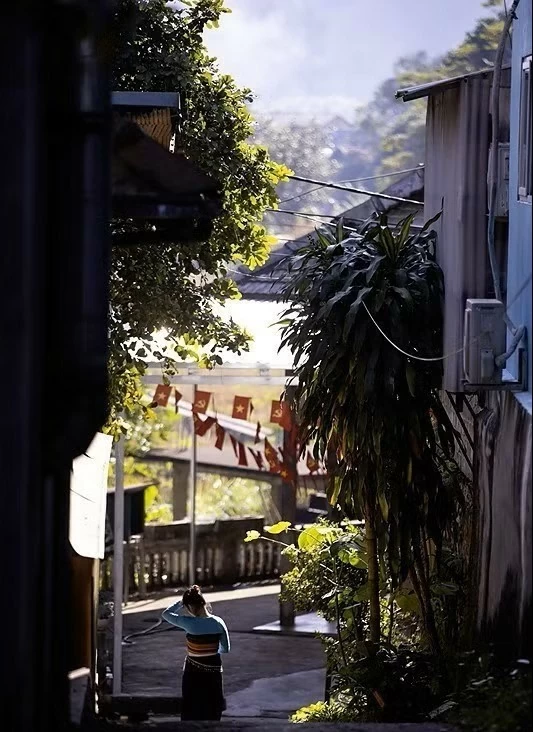 |
| The peaceful small alleys of Pom Coong. (Photo: Trong Dat) |
Cuisine is also a highlight of community tourism here. Dishes like com lam, grilled meat, stream fish, sticky rice, or ruou can, rich in highland flavors, are often prepared by families to serve guests. Many tourists believe that the most appealing aspect is not just the food but also the cozy atmosphere around the stilt house fire amidst the tranquil mountain and forest setting.
Pom Coong is beautiful year-round, with each season offering its own unique charm. Late May and early June mark the time when rice begins to ripen golden in the fields of the Mai Chau valley. By September and October, the cool weather combined with the golden hue of the rice fields creates a scene beloved by many photographers.
In recent years, with the development of community tourism, Pom Coong has gradually become a familiar stop for many domestic and international tour groups, yet the village still maintains a relatively peaceful atmosphere, not overly bustling.
Many opinions suggest that tourism development in Pom Coong should be linked with the preservation of indigenous culture to avoid excessive commercialization. The values that make this village attractive lie not only in its natural beauty but also in the lifestyle, architecture, and community life of the Thai people, preserved through many generations.