



Oc Eo-Ba The archaeological site aims for World Cultural Heritage recognition
WVR - On September 4, in Hanoi, a large number of managers, researchers and experts attended the scientific conference held to provide feedback and assessment on the draft nomination dossier and management plan for the Oc Eo - Ba The Archaeological Site, which is being proposed for inscription on the UNESCO World Cultural Heritage List.
Latest
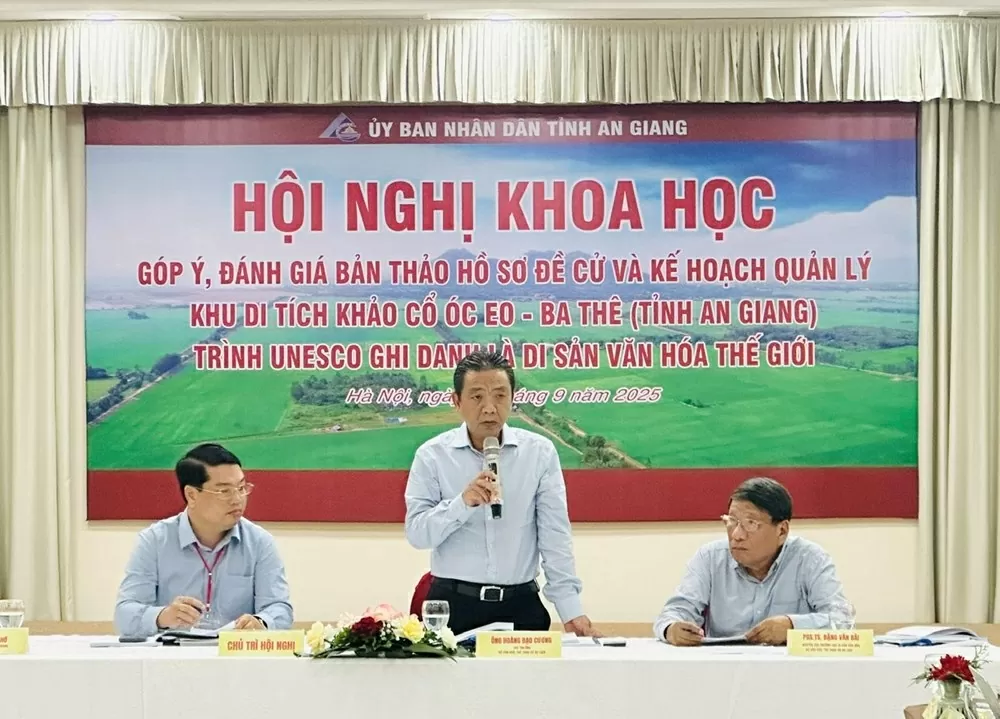 |
| Deputy Minister Hoang Dao Cuong chaired the conference on Oc Eo-Ba The archaeological site being proposed for inscription on the UNESCO World Cultural Heritage List. (Source: Van Hoa Newspaper) |
At the conference, Mr. Le Trung Ho, Vice Chairman of the People’s Committee of An Giang Province and Head of the Dossier Preparation Committee, announced that An Giang has completed the first phase of compiling the nomination dossier for the Oc Eo - Ba The Archaeological Site to be submitted to UNESCO for recognition as a World Cultural Heritage Site.
According to Mr. Ho, An Giang has always regarded the preservation and promotion of the Oc Eo - Ba The Archaeological Site as not only a responsibility to the past but also a practical action for the present and the future. The province is committed to close cooperation with specialised agencies, international organisations and scholars to develop a scientifically robust and persuasive dossier, thereby contributing to elevating the site to World Heritage status and enriching the cultural treasures of humanity.
Currently, An Giang is finalising the remaining procedures for the nomination dossier and the heritage management plan. The goal is to submit the draft nomination by 30 September 2025 and the official dossier to the World Heritage Centre by 1 February 2026.
Mr. Dang Van Bai, Vice Chairman of the National Heritage Council, observed that the site possesses tremendous potential to become a World Heritage Site. It represents an ancient Southeast Asian port city, providing evidence of East-West cultural exchanges and bearing distinct imprints of a fertile and creative delta civilisation.
The conference reached a consensus that, based on UNESCO’s criteria of Outstanding Universal Value, the Oc Eo - Ba The Archaeological Site may satisfy several conditions: demonstrating significant cultural interchange over a period or within a cultural area of the world; contributing to the development of architecture, technology, temple-building techniques, urban planning or landscape design; and bearing unique testimony to a cultural tradition or a civilisation that has disappeared or still exists.
Furthermore, the site also meets the criterion of being an outstanding example of traditional human settlement, land use, or sea exploitation, representing one or more cultures, or illustrating human interaction with the environment in contexts vulnerable to irreversible change.
To realise the goal of preparing the nomination dossier, the Ministry of Culture, Sports and Tourism has worked closely with the An Giang provincial authorities and consulting units to conduct research, supplement documentation, and clearly define the boundaries, scope, and Outstanding Universal Value of the heritage.
The workshop provided an important opportunity for experts and scholars, both domestic and international, to discuss and consult on the nomination criteria and the global significance of the site.
Deputy Minister of Culture, Sports and Tourism Hoang Dao Cuong affirmed that the dossier for the Oc Eo - Ba The Archaeological Site holds not only scholarly and cultural heritage value but also political significance. With the submission deadline approaching, he stressed the urgent need to complete the work without delay.
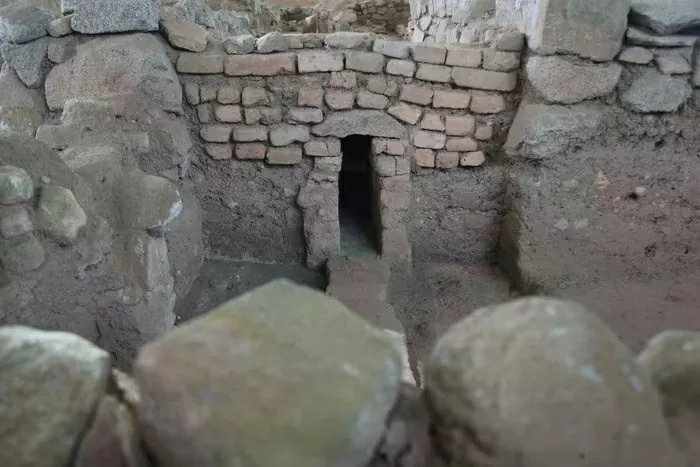 |
| )Linh Son Nam Relic, part of the Oc Eo - Ba The Site. (Source: Van Hoa Newspaper) |
| The Oc Eo-Ba The archaeological site is located in Oc Eo town, Thoai Son district, An Giang province, with a total conservation planning area of about 433.1 hectares. This includes the Ba The mountain slope and foothill area (zone A) of nearly 144 hectares, and the Oc Eo field (zone B) of over 289 hectares. Oc Eo-Ba The is a significant remnant of the Oc Eo civilization, which flourished in Southern Vietnam from the 1st to the 7th century. It was once a major trading center of the ancient kingdom of Funan, with a network of canals, architecture, and archaeological artifacts reflecting a high level of economic, cultural, and religious development. The site is a complex ensemble, including residential centers, religious architecture, craft workshops, ancient canal routes, and burial areas distributed from the Ba The mountain slope to the Oc Eo field. With over 1,000 years of history – spanning from the end of the last century BC to the 12th century AD, the site is a prominent testament to the formation and development of a complex ancient urban center, undergoing various phases of expansion, transformation, and adaptation. Notably, Oc Eo-Ba The showcases a unique urban-port model, formed and developed in the waterlogged coastal environment of the Mekong Delta. It is one of the earliest examples in Southeast Asia of a large-scale power-economic-religious center, planned with a geometric layout connected to an artificial canal system, flexibly adapting to the terrain and hydrology. With its outstanding values, in 2012, the Oc Eo-Ba The archaeological and architectural site was ranked as a special national relic. In January 2022, the World Heritage Centre included the site in the tentative list for a world cultural heritage nomination dossier. |