






Historical milestones in the 50-year journey of the National Boundary Commission
WVR - Reflecting on the past 50 years, the National Boundary Commission takes pride in the relentless, enduring, and silent contributions of generations in safeguarding Vietnam's national interests in territorial borders, seas, and islands, as per President Ho Chi Minh's advice over 70 years ago: “The Hung Kings founded the nation. We must together safeguard it.”
Latest
On September 19, 1954, beloved President Ho Chi Minh, during a meeting with officers and soldiers of the Pioneer Division at the Hung Temple on their way to take over the capital, advised: “Our meeting here is coincidental but very meaningful. The Hung Kings founded the nation; today we must together defend it... Through many eras of struggle, our ancestors preserved the capital, and for the past eight or nine years, due to our resolute resistance, we have achieved victory and returned to Hanoi. Therefore, you have been entrusted by the Central Committee and the Government with the task of taking over the capital, which is a great honor.”
The full quote from President Ho Chi Minh above encapsulates not only the millennia-long history of nation-building and defense but also serves as a reminder to all generations of officers, soldiers, citizens, and Vietnamese people at home and abroad about the responsibility to preserve the country's sovereignty, protect its political independence, and maintain the territorial integrity of Vietnam.
 |
| Ambassador Trinh Duc Hai, Chairman of the National Boundary Commission, Ministry of Foreign Affairs. (Photo: Thanh Long) |
After peace was restored in the North, the border issue between Vietnam and China began to emerge, and both sides started multiple exchanges. In November 1957, the Secretariat of the Central Committee of the Vietnam Workers' Party sent a letter to the Central Committee of the Communist Party of China emphasizing: “The national border issue is an important matter that needs to be resolved according to existing legal principles or redefined by the governments of the two countries; local authorities are strictly prohibited from negotiating with each other to replant markers or cede land to each other.” This view aligns with international law and practice, ensuring respect for the historical border delineated by the Sino-French Conventions of 1887 and 1895, which were demarcated by France and the Qing Dynasty. In April 1958, the Central Committee of the Communist Party of China agreed with the viewpoint of the Vietnam Workers' Party.
On February 20, 1959, the Secretariat of the Central Committee issued a resolution to establish the Border Committee to assist the Central Committee and the Government in monitoring and directing border work, researching, and recommending specific policies and measures to resolve border issues; organizing coordination among related sectors within the scope of border activities.
The period from October 1975 to May 1993
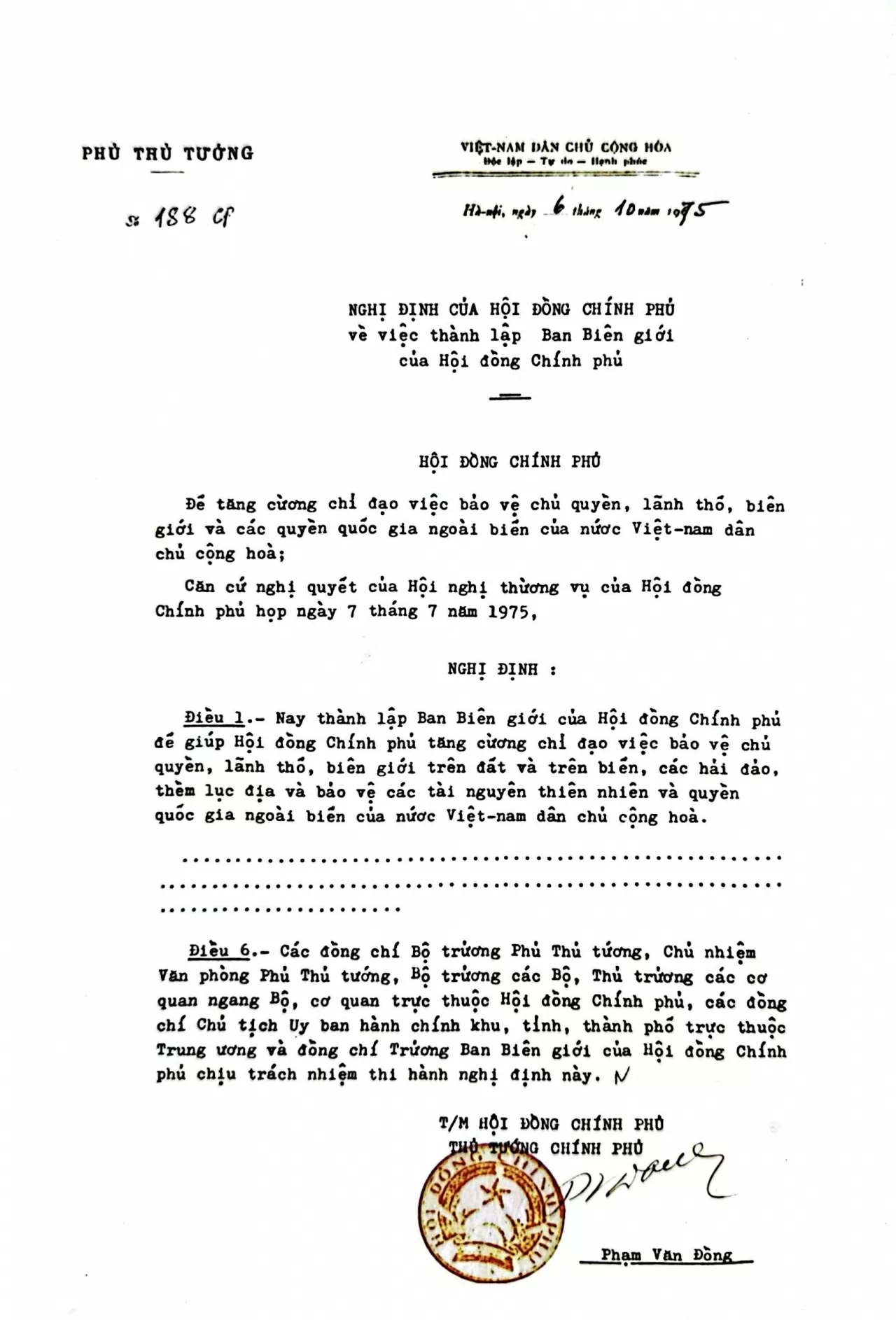
Recognizing the special importance of territorial border work, just six months after the country's complete reunification, with the land now united, on October 6, 1975, the Government of the Democratic Republic of Vietnam decided to establish the Border Committee of the Government Council.
The decree establishing the Border Committee, signed by Prime Minister Pham Van Dong, clearly emphasized the political mission and also the mission of the Border Committee of the Government Council: “To assist the Government Council in strengthening the direction of protecting sovereignty, territory, borders on land and at sea, islands, continental shelf, and protecting natural resources and national rights beyond the sea of the Democratic Republic of Vietnam.” To assist the Government Council in carrying out these particularly important tasks, the 1975 decree stipulated that the Border Committee of the Government Council included: a Minister-level Head, a Deputy Head at the Deputy Minister level, and several Deputy Minister-level members; several General-level officers from the Ministry of Interior, Ministry of Defense, and Assistant Ministers from the Ministry of Foreign Affairs.
 |
During the period from October 1975 to May 1993, the Border Committee of the Government Council operated as an inter-ministerial council and advised the Party and State leaders, the Government Council, to issue the Declaration on May 12, 1977, of the Government of the Socialist Republic of Vietnam on the seas under Vietnam's sovereignty, sovereign rights, and jurisdiction. With the issuance of the 1977 Declaration, Vietnam became one of the first countries in the region and the world to officially propose the concept of an exclusive economic zone while the Third United Nations Conference on the Law of the Sea was still ongoing, and the regime of the exclusive economic zone was still a new issue causing much debate and differing opinions at the Conference.
Additionally, the Border Committee directly chaired or participated in negotiations to resolve many major important territorial border issues between Vietnam and neighboring countries, notably:
With Laos: From 1975 to 1990, Vietnam and Laos endeavored to negotiate to sign the Treaty on the Delimitation of the Land Border between Vietnam and Laos (signed on July 18, 1977). The Supplementary Treaty to the Vietnam-Laos Border Delimitation Treaty (January 24, 1986); the Agreement on the National Border Regulations between Vietnam and Laos (signed on March 1, 1990).
The completion of the delimitation and demarcation of the land border between Vietnam and Laos is a highly significant achievement because the land border between Vietnam and Laos is not only the longest land border (approximately 2,337 km) between Vietnam and its three neighboring countries but also the most geographically and naturally complex border, with incomplete historical and legal data.
With Cambodia: From 1975 to 1993, Vietnam negotiated and signed several extremely important bilateral treaties with Cambodia on territorial borders, such as the Vietnam-Cambodia Historical Waters Agreement (signed on July 7, 1982); the Agreement on Principles for Resolving Vietnam-Cambodia Border Issues (signed on July 20, 1983); the Agreement on the Vietnam-Cambodia Border Regulations (signed on July 20, 1983); the Treaty on the National Border Delimitation between Vietnam and Cambodia signed on December 27, 1985. These legal documents hold significant political, diplomatic, and legal importance, helping to fundamentally resolve some long-standing sovereignty disputes from the colonial-protectorate period.
With Malaysia: Vietnam and Malaysia are neighboring countries at sea and have overlapping maritime areas in the Gulf of Thailand and overlapping continental shelf claims beyond 200 nautical miles from the baseline in the South China Sea. Additionally, Vietnam and Malaysia have sovereignty disputes over some features in the Spratly Islands. In the Gulf of Thailand, the overlapping maritime area between the two sides was formed from the 1971 continental shelf claim by the Saigon government and our 1977 declaration and the 1979 continental shelf claim by Malaysia.
The two sides began negotiations on the delimitation of the continental shelf in the Gulf of Thailand in the early 1990s. However, after realizing that continuing negotiations would likely not soon lead to a fair result acceptable to both sides, the two sides decided to temporarily halt delimitation negotiations and negotiate a cooperation agreement on joint oil and gas exploration and exploitation between Vietnam and Malaysia in the overlapping area.
The joint exploitation agreement between the two sides was signed on June 5, 1992, and remains in effect to this day. This is the first joint exploitation agreement that Vietnam signed with a Southeast Asian country before joining ASEAN and is also the only joint exploitation agreement to date between Vietnam and a neighboring country at sea.
On May 8, 1993, the Border Committee of the Government Council became the Government's Border Committee after Prime Minister Vo Van Kiet signed Decree No. 21/CP, stating: “The Government's Border Committee is an agency under the Government, with the function of state management and directing national border and territorial work, determining sovereignty and the rights of the Socialist Republic of Vietnam on land, at sea, in the air, on islands, and the continental shelf of Vietnam.” The organizational structure of the Government's Border Committee includes: the Vietnam-China Border Department; the Western Border Department; the Sea Department; the Information - Documentation Center; the Office.
The Government's Border Committee was also assigned the task of being the standing agency and assisting the Steering Committee on issues related to the East Sea and the Spratly Islands (now the State Steering Committee on the East Sea - Islands).
During the period from May 1993 to October 2001, the Government's Border Committee chaired or directly participated in negotiating and signing many important international treaties and agreements on territorial borders, notably:
With Thailand: The two sides negotiated from 1992 to 1997 and signed the Agreement on the Delimitation of the Maritime Boundary between the two countries in the Gulf of Thailand on August 9, 1997. This is the first maritime delimitation agreement that Vietnam signed with a country, ending a quarter-century of disputes between the two countries over the interpretation and application of international maritime law in delimitation, and is also the first maritime delimitation agreement signed between ASEAN member states after Vietnam joined ASEAN in 1995 and after UNCLOS 1982 came into effect (both Vietnam and Thailand signed and ratified UNCLOS 1982).
According to the Agreement, Vietnam receives 1/3 and Thailand receives 2/3 of the area of the overlapping continental shelf claim, which covers an area of approximately 6,074 km2 (this overlapping area was formed from the 1971 continental shelf claim by the Saigon government and the 1973 continental shelf claim by Thailand).
The two sides also agreed that the continental shelf delimitation line is also the exclusive economic zone delimitation line. After the agreement was signed, maritime management activities, fishing operations became orderly, the situation at sea stabilized, oil and gas exploration between the two sides was conducted vigorously and achieved positive results. The two sides also implemented joint patrols of functional forces at sea, expanded cooperation in areas such as combating illegal fishing, armed robbery at sea...
With China: After the two countries normalized relations (1991), the two sides exchanged views to promote bilateral negotiations towards a long-term solution to the territorial border issue. On November 7, 1991, during an official visit to China, General Secretary Do Muoi and Chairman of the Council of Ministers Vo Van Kiet agreed with General Secretary and President of China Jiang Zemin: “The two sides agree to resolve the existing territorial border issues between the two countries through peaceful negotiations.”
In November 1991, the two countries signed a Temporary Agreement on resolving work on the border between the two countries. In 1993, the two sides signed the Agreement on Basic Principles Guiding the Resolution of Territorial Border Issues between Vietnam and China (signed on October 19, 1993), which particularly related to the land border issue, the two sides agreed to base on the Convention on the Delimitation of the Border between China and France signed on June 26, 1887, and the Supplementary Convention to this Convention signed on June 20, 1895, along with the documents and maps of delimitation and demarcation attached to these two Conventions, as well as the border markers planted according to the regulations to compare and redefine the entire border between Vietnam and China.
Regarding the delimitation of the Gulf of Tonkin, the two sides agreed to apply international maritime law and refer to international practice to negotiate the delimitation of the Gulf of Tonkin. The agreement also stipulated the principle of negotiation based on the principle of equity “To reach an agreement on the delimitation of the Gulf of Tonkin, the two sides need to follow the principle of equity and consider all relevant circumstances in the Gulf of Tonkin to reach a fair solution.”
Based on the 1993 Agreement on Basic Principles, the two sides conducted simultaneous negotiations on land border delimitation and the delimitation of the Gulf of Tonkin. On December 30, 1999, the two countries signed the Land Border Treaty between Vietnam and China (effective from July 6, 2000). Regarding the Gulf of Tonkin, the two countries signed the Gulf of Tonkin Delimitation Agreement on December 25, 2000 (the two sides began negotiations in 1974).
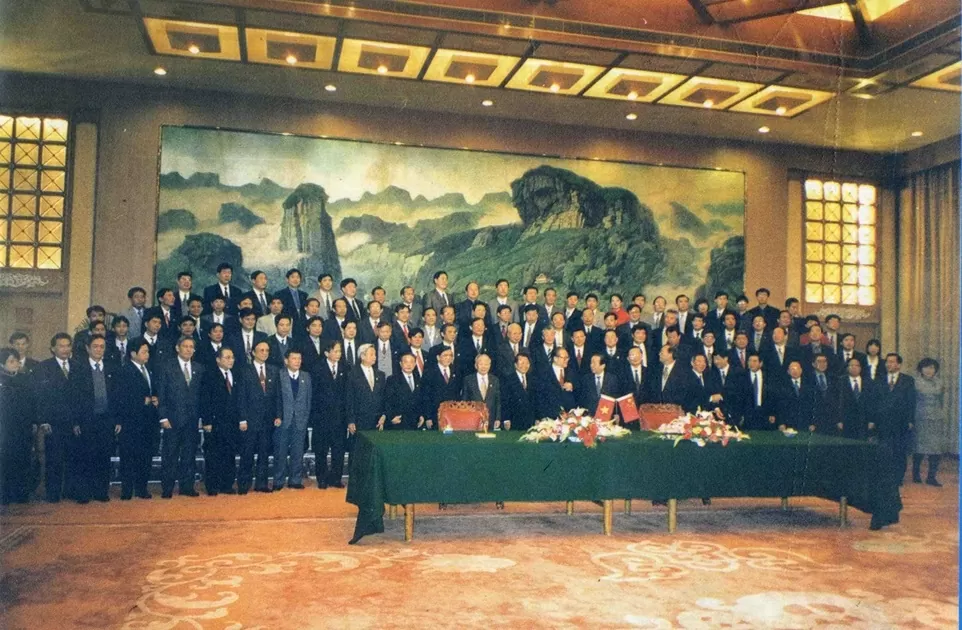 |
| The signing ceremony of the Agreement between the Socialist Republic of Vietnam and the People's Republic of China on the delimitation of territorial waters, exclusive economic zones, and continental shelves of the two countries in the Gulf of Tonkin, December 25, 2000. (Photo: Archive) |
A turning point in the 50-year history of the National Border Committee was the merger of the Government's Border Committee into the Ministry of Foreign Affairs according to Decision No. 157 dated October 17, 2001, by the Prime Minister, stating: “The National Border Committee is a general department-level agency under the Ministry of Foreign Affairs, assisting the Minister of Foreign Affairs in performing state management functions on national borders and territories.”
On August 1, 2007, the Prime Minister signed Decision No. 126/2007/QĐ-TTg on defining the functions, tasks, powers, and organizational structure of the National Boundary Commission under the Ministry of Foreign Affairs. Thus, the name “National Boundary Commission” replaced the name “National Border Committee” used since August 1, 2007.
Implementing Plan No. 141/KH-BCĐTKNQ18 dated December 6, 2024, on the orientation to streamline the organizational structure of the Government of the Government Steering Committee on summarizing the implementation of Resolution No. 18-NQ/TW, the National Boundary Commission continued to be reorganized and became a department-level unit under the Ministry of Foreign Affairs. Currently, performing state management functions on borders and territories, the National Boundary Commission has nearly 100 officers, civil servants, and employees, operating in a structure consisting of 08 department-level units: Department of Maritime Delimitation and Cooperation; Department of Sovereignty and Paracel, Spratly Islands; Vietnam-China Land Border Department; Western Land Border Department; Policy - Legal Department; Information - Data Department; Finance - Administration Department and Office.
During the period since the merger into the Ministry of Foreign Affairs (October 2001 to present), the National Boundary Commission has directly chaired the drafting of many important documents on territorial borders, directly chaired negotiations on land border demarcation, maritime delimitation, and cooperation with relevant countries, chaired negotiations on multilateral documents on the South China Sea (Code of Conduct in the South China Sea from 2018 to present)...
Compared to the previous 25-year period (October 1975 - October 2001), we can proudly say that in the subsequent 25-year period, when the National Boundary Commission became a unit of the Ministry of Foreign Affairs, the Commission continued to build on the achievements of previous generations, continuing to reap and achieve many significant and important achievements no less than the previous generations.
Outstanding achievements from October 2001 to October 2025
Regarding land border work
Vietnam-China land border
The development history of the National Boundary Commission over the past 50 years has always been closely linked to the process of resolving the Vietnam-China land border issue. After the two countries signed the Land Border Delimitation Treaty in December 1999, it took seven years of persistent struggle both on the ground and at the negotiating table to create a legal basis for demarcation and marker planting to transform the legal border into a real one on the ground. Negotiations on demarcation and marker planting lasted for eight years from December 2001 to December 31, 2008, beginning with the planting of marker 1369 (2) at Mong Cai (Quang Ninh) - Dongxing (Guangxi).
On November 18, 2009, representatives of the governments of the two countries signed three legal documents on the Vietnam-China land border: the Protocol on Border Demarcation and Marker Planting, the Agreement on Border Management Regulations, and the Agreement on Border Gates and Border Gate Management Regulations. These three historic documents marked the first time in the bilateral relationship between Vietnam and China that the two countries clearly defined both legally and on the ground a land border with a modern marker system consisting of 1,971 markers (including one tri-border marker between Vietnam, Laos, and China) with 1,548 main markers, 422 auxiliary markers, laying a solid foundation for building a peaceful, friendly, stable, long-term, cooperative, and developmental border, opening up new opportunities for the economic development of each country, enhancing friendly exchanges.
The Vietnam-Laos land border is the longest land border of Vietnam with a neighboring country, with extremely complex and rugged terrain. In 2008, the two sides agreed to carry out the work of increasing density and renovating border markers, which lasted for eight years (2008 - 2016). The two sides completed the identification of border marker positions and completed the dossier of 1,002 border markers and boundary markers, creating a premise for border protection, trade cooperation, investment, and economic, cultural, and tourism exchanges of border residents, contributing to strengthening political security, maintaining security and defense in the border area, promoting the friendly, stable, cooperative, and developmental relationship of the two countries.
Vietnam-Cambodia land border
After signing the National Border Delimitation Treaty in 1985, the two sides carried out demarcation and marker planting on the ground. In 2005, the two countries signed a Supplementary Treaty to the 1985 Border Delimitation Treaty. From 2005 to 2018, the two sides made efforts to negotiate demarcation and marker planting on the ground, and by 2018, they completed demarcation and marker planting for 84% of the border length, and in 2019, the two sides signed a Protocol legalizing the 84% demarcation and marker planting results. From 2021 to present, the two sides are actively negotiating demarcation and marker planting for the remaining 16%, initially focusing on completing the 6% group.
The ceremony for exchanging the ratification documents of the 2019 Supplementary Treaty and the Land Border Demarcation and Marker Planting Protocol between the Socialist Republic of Vietnam and the Kingdom of Cambodia, December 2020.
Regarding the Protection of Sovereignty over Vietnam's Islands and Archipelagos and the Seas under Vietnam's Sovereignty, Sovereign Rights, and Jurisdiction:
During this period, the National Boundary Commission chaired research and implementation and completed many important tasks related to protecting Vietnam's territorial sovereignty over Vietnam's islands and archipelagos (especially the Paracel and Spratly Islands), as well as the seas under Vietnam's sovereignty, sovereign rights, and jurisdiction in the East Sea and the Gulf of Thailand, notably:
With China
The National Boundary Commission is the lead agency for three Vietnam-China maritime working groups (Working Group on Less Sensitive Issues; Working Group on the Waters Outside the Gulf of Tonkin; Working Group on Maritime Cooperation and Development).
With Indonesia
After transferring to the Ministry of Foreign Affairs, the National Border Committee continued to assert itself as the leading agency in research, policy proposals, and direct negotiations on maritime delimitation and cooperation between Vietnam and relevant neighboring countries. In 2003, the National Border Committee coordinated with the Department of Law and International Treaties to complete negotiations on the delimitation of the continental shelf between Vietnam and Indonesia. From 2010 to 2022, the National Border Committee was the lead agency and directly negotiated the delimitation of the exclusive economic zone between Vietnam and Indonesia. In December 2022, Vietnam and Indonesia completed negotiations on the delimitation of the exclusive economic zone between the two countries in accordance with international law, UNCLOS 1982.
With Malaysia
In May 2009, Vietnam and Malaysia submitted a Joint Submission on the outer limits of the extended continental shelf beyond 200 nautical miles of the two countries in the southern East Sea (internationally known as South China Sea). The two sides established a Joint Technical Committee on the outer limits of the extended continental shelf beyond 200 nautical miles (JTEC) to promote the United Nations Commission on the Limits of the Continental Shelf (CLCS) to soon review and make recommendations on the Joint Submission of the two countries.
The two sides also continue to maintain cooperation on joint oil and gas exploitation in the overlapping continental shelf area of the two countries in the Gulf of Thailand.
With the Philippines
Vietnam and the Philippines have territorial sovereignty disputes over some features in the Spratly Islands and overlapping extended continental shelf issues beyond 200 nautical miles in the East Sea. In 2024, both Vietnam and the Philippines submitted separate Submissions to the CLCS. This event will create opportunities for the two sides to explore the possibility of cooperation in the overlapping extended continental shelf area in the East Sea.
In 2024, the two countries signed an Agreement between the two Ministries of Foreign Affairs on the prevention and management of maritime disputes and a Cooperation Agreement between maritime law enforcement forces.
At international and regional forums:
The National Boundary Commission is the lead agency in researching, implementing, and submitting three Submissions of Vietnam on the outer limits of the extended continental shelf beyond 200 nautical miles in the South China Sea (Vietnam submitted two submissions in May 2009, including one joint submission with Malaysia, and in 2024, Vietnam submitted the third submission); chaired negotiations on the Code of Conduct in the East Sea (COC) between ASEAN countries and China from 2018 to present.
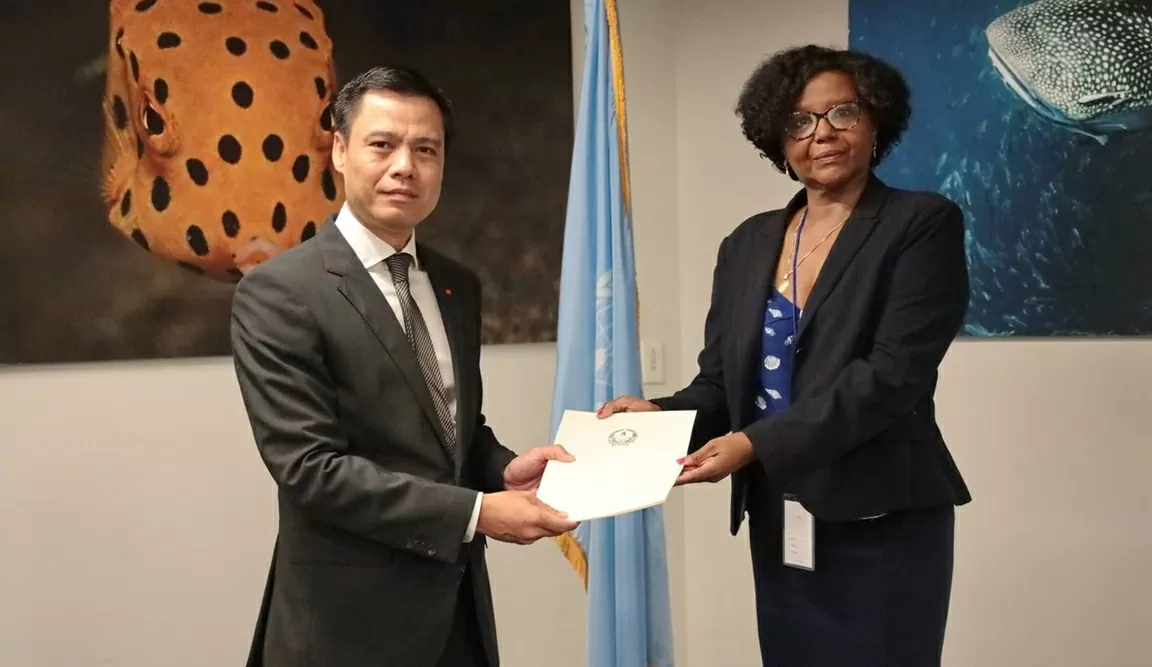 |
| Ambassador Dang Hoang Giang, Head of the Permanent Mission of Vietnam to the United Nations, submits Vietnam's Submission on the Outer Limits of the Extended Continental Shelf beyond 200 nautical miles in the Central East Sea to the representative of the United Nations Commission on the Limits of the Continental Shelf. (Photo: Archive) |
Bilateral maritime consultation and dialogue mechanisms:
Maritime and ocean cooperation is becoming an increasingly important task in the context of increasingly complex and unpredictable international and regional situations, especially the South China Sea disputes. Since 2012, the National Boundary Commission has begun establishing bilateral maritime and ocean dialogue mechanisms with important strategic partner countries. To date, the National Border Committee has established and maintained maritime dialogue mechanisms with the United States, the United Kingdom, France, Japan, Australia, New Zealand, South Korea, India, and Canada.
Regarding policy and legal development work
The most important legal document that the National Boundary Commission had the honour of being the lead drafting agency is the Vietnam Maritime Law, passed by the National Assembly in 2012. The National Boundary Commission is also the lead agency in researching, implementing, and presenting to competent authorities for consideration the Government's Declaration on February 21, 2025, on the baseline for measuring the width of territorial waters in the Gulf of Tonkin.
Additionally, the National Boundary Commission has coordinated with relevant ministries and agencies to develop a series of legal documents, including: the 2003 National Border Law, the 2015 Law on Marine and Island Resources and Environment, the 2017 Fisheries Law, the 2018 Coast Guard Law, the 2020 Border Guard Law, the 2022 Petroleum Law, Decree 34/2014/ND-CP dated April 29, 2014, on the regulation of the land border area of Vietnam, the 2024 National Marine Spatial Planning, the Strategy for Exploiting and Protecting the Marine and Island Environment until 2030, with a vision to 2050; the Circular dated December 15, 2024, of the Ministry of Natural Resources and Environment issuing place names for islands, rocks, shoals, and other geographical features in Vietnam's seas.
Regarding State Management of Islands and Seas: The National Boundary Commission is the lead agency for several inter-ministerial and inter-local coordination mechanisms in island and sea work, notably the Standing Office of the State Steering Committee on the East Sea - Islands chaired by the Prime Minister. Through the mechanism of the State Steering Committees on the East Sea - Islands in coastal provinces and cities, the National Border Committee regularly shares information, guides, and advises coastal localities to grasp the major policies of the Party and State, while also providing the necessary support to help localities implement marine economic activities and social, cultural, and marine activities.
The road ahead
Reflecting on the past 50 years, the National Boundary Commission takes pride in the relentless, enduring, and silent contributions of generations of officers, civil servants, and employees of the Committee through various periods in safeguarding Vietnam's national interests in territorial borders, seas, and islands, as per President Ho Chi Minh's advice over 70 years ago: “The Hung Kings founded the nation. We must together safeguard it.”
However, the road ahead for the National Boundary Commission still holds many tasks that today's generation and future generations will continue to undertake. In short, the mission of protecting territorial sovereignty, resolving territorial border and island disputes, and disagreements will be a long-term endeavor that will always accompany the nation and people in the journey ahead.
Towards the centennial goal (1945 - 2045), the National Boundary Commission will strive to resolutely and persistently resolve maritime delimitation issues, land border demarcation and marker planting issues, and better control and manage maritime disputes with relevant neighboring countries through peaceful measures based on international law and practice, contributing significantly to building Vietnam's increasingly important international position as a responsible member with a substantive and respected voice in the international community.


