



Former Vice President Nguyen Thi Binh receives American writer: Women bridging peace
WVR - In the early days of May, under the sweet golden sunlight filtering through the trees and the blooming clusters of purple crape myrtle lining the streets of the capital, we followed a nearly 90-year-old foreign woman to meet former Vice President Nguyen Thi Binh.
Latest
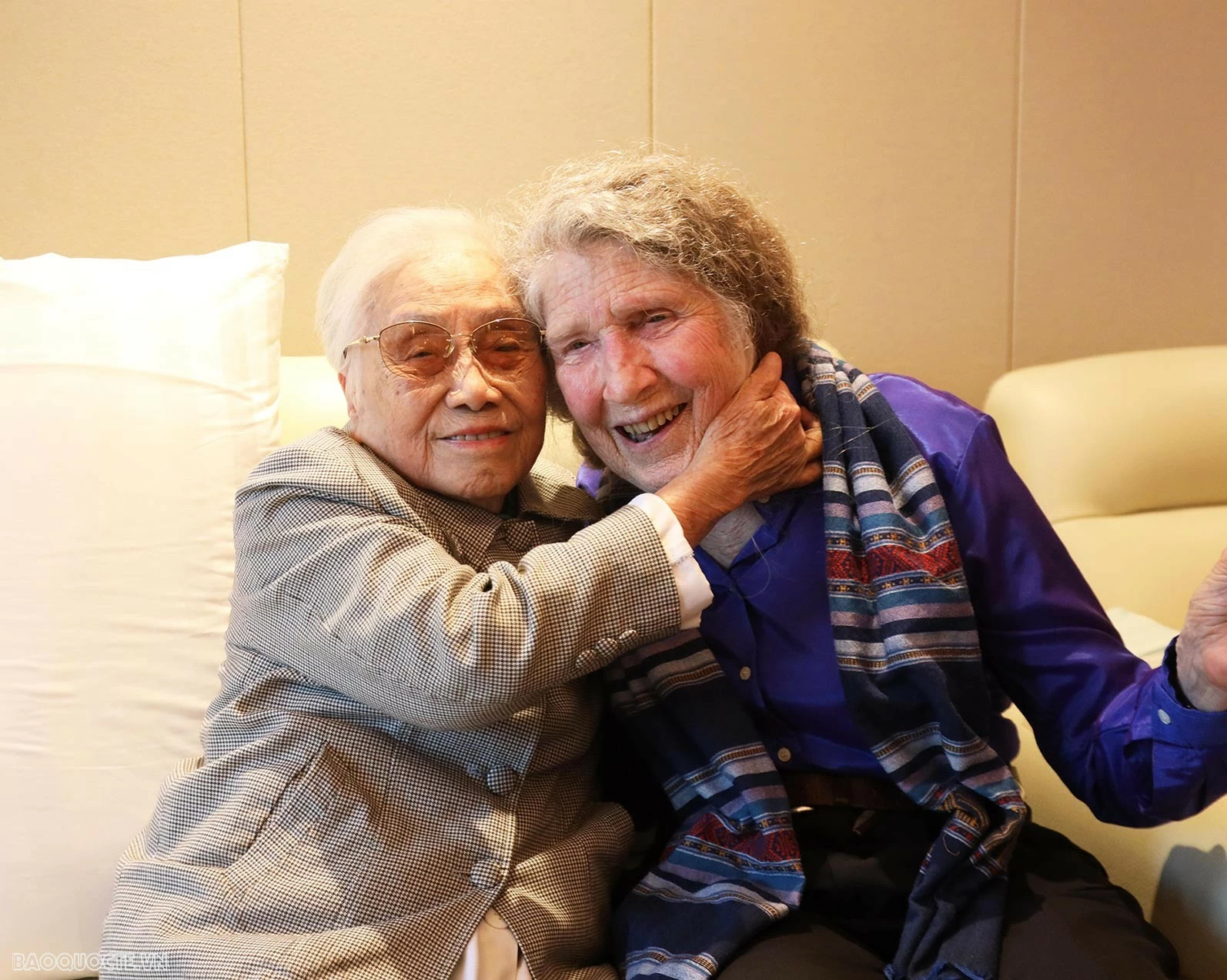 |
| Former Vice President Nguyen Thi Binh and American writer and translator Lady Borton. (Photo: Thanh Long) |
She walked slowly, her soft silver hair gleaming in the sun, her voice gentle, yet her eyes reflected the emotion of someone about to reunite with a close friend after many years apart. This woman is Lady Borton, or Ut Ly, an American writer and translator who has spent more than half a century connected to Vietnam, its people, and the poignant memories of war, peace, and reconciliation.
For those present that day, it was a meeting of two historical witnesses, two women who had lived through the tumultuous years of the 20th century, witnessing war, peace, division, and reunification; a reunion of great friends who had journeyed together through numerous diplomatic, reconciliation, and healing efforts.
The reunion of extraordinary women
The small room at the 108 Central Military Hospital that day lacked elaborate formalities. There was only laughter, firm handshakes, and the sparkling eyes of two old friends meeting again after many years.
As soon as she entered, Lady Borton could not hide her emotion. She recalled her first meeting with Nguyen Thi Binh in 1973, when the war had not yet fully ended, and Vietnam was still facing immense difficulties. “At that time, Vietnam was very poor. Ms. Binh was the Foreign Minister. I had the opportunity to work with her very early on,” Lady Borton reminisced.
Sharing with us, the old memories flooded back intact in the story of the American woman who had spent most of her life accompanying Vietnam through its greatest upheavals. She mentioned the difficult subsidy period, the journeys, the educational projects, and the early years of opening up when Vietnam began to reconnect with the world after the war.
In Lady Borton's narrative, former Vice President Nguyen Thi Binh appeared not only as a distinguished diplomat but also as a particularly compassionate, open, and progressive woman. “Ms. Binh helped me a lot to understand Vietnam. As a foreigner, how could I fully grasp the relationships, history, and people?” Borton said.
Perhaps that's why, for over 50 years, their relationship has transcended mere professional ties. It is a friendship, a shared empathy, and trust built through years of significant change.
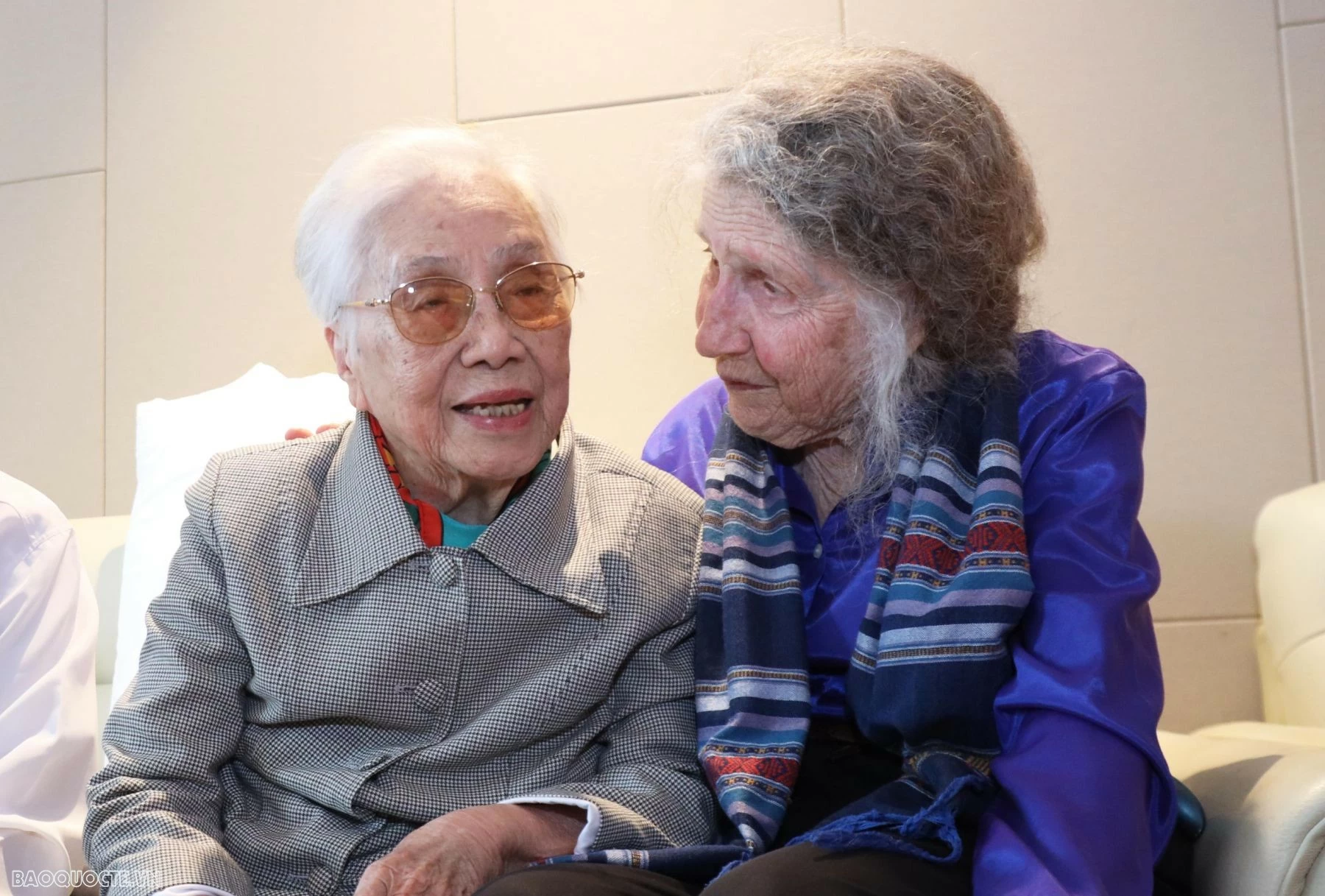 |
| Former Vice President Nguyen Thi Binh and Lady Borton reminiscing about the memories of the resistance against the U.S. (Photo: Thanh Long) |
Many times, they mentioned the issue of Agent Orange – one of the greatest war pains that both she and former Vice President Nguyen Thi Binh had pursued for years to raise awareness globally. She recounted that there was a time when neither Vietnam nor the U.S. was ready to discuss this issue extensively. Vietnam prioritized normalizing relations with Washington, fearing that too much emphasis on the war's aftermath might hinder reconciliation efforts.
“But Ms. Binh stood up,” said writer Ut Ly slowly. Together with General Vo Nguyen Giap and Dr. Le Cao Dai, Nguyen Thi Binh persistently spoke out about the effects of Agent Orange on both Vietnamese soldiers and civilians.
It was a struggle for justice for war victims, a journey to compel the world to face the truth. And from the efforts of many such individuals, the story of healing between Vietnam and the U.S. began to be written with understanding rather than confrontation.
Speaking of Nguyen Thi Binh, the female writer's eyes shone with natural admiration. She recounted that from the beginning, President Ho Chi Minh saw in Nguyen Thi Binh the special qualities of a diplomat. During the Paris negotiations and international events, the image of a female Vietnamese Foreign Minister amidst a sea of male politicians made a strong impression on the world, and as Borton humorously noted: “Ms. Binh led the way, and the world was astounded.”
It was a time when there were very few female Foreign Ministers globally. A Vietnamese woman, from a country engulfed in war, confidently stepping onto international platforms, speaking fluent English and French, handling situations skillfully and with poise, left many astonished.
But what Lady Borton remembers most is not just her diplomatic talent: “She was very approachable. She knew how to converse with representatives from each country.”
Perhaps it was this gentle yet steadfast nature that created a unique Nguyen Thi Binh – a woman who, with her calm demeanor, conveyed a powerful message of independence, peace, and reconciliation.
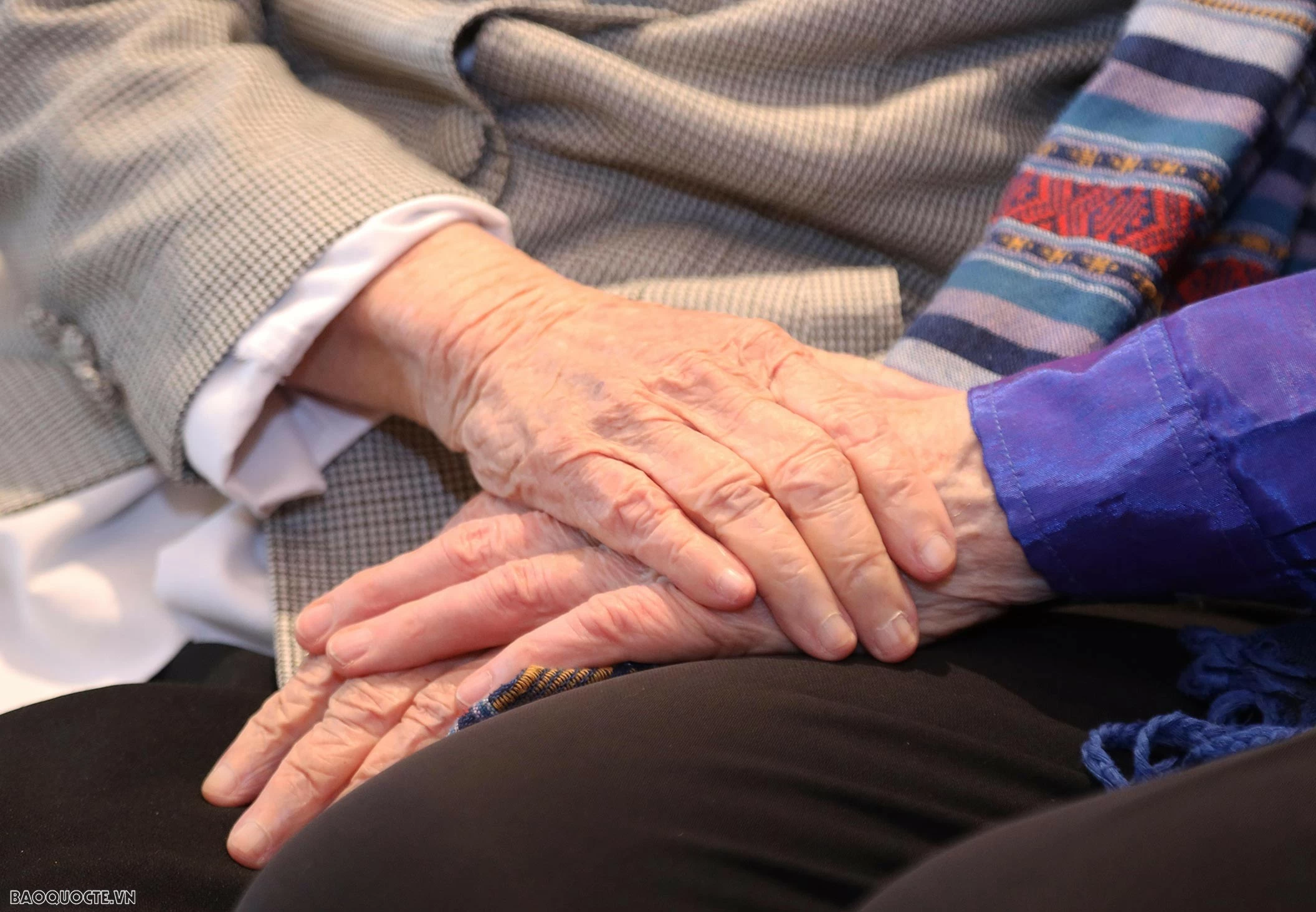 |
| Throughout the meeting, the two women held each other's hands tightly. (Photo: Thanh Long) |
Returning to memories
The conversation that day was frequently interrupted by laughter, as they recalled the name of an old friend, a meeting years ago in Algeria, or the days of writing books about the Paris negotiations.
Lady Borton reminisced that her team took five years to complete a bilingual book series on the Paris Conference, compiling hundreds of archival photos and verifying each person appearing in them. “Many have passed away,” she said softly.
Perhaps that is why today's meeting was so special. It was a return to memories, where those who remain together remember a generation that lived fully for ideals and peace.
At nearly 100 years old, former President Nguyen Thi Binh still amazed Ut Ly with her sharp memory: “She remembers everything. About General Giap, about meetings in Algeria decades ago.”
But what impressed the American writer most was the simplicity of the female politician who had traveled the world. “She lives very simply. Despite her status, she is very approachable,” Lady Borton said emotionally.
Lady Borton moved those present at the meeting when she shared about drawing a large map recording all the countries Nguyen Thi Binh had visited in her diplomatic journey. According to her, a Vietnamese woman born in colonial times, growing up amidst war, and becoming one of the faces representing the peace aspirations of an entire nation, that journey itself is a historical story.
For the American writer, the greatest contribution of former Vice President Nguyen Thi Binh lies not only in diplomacy but also in being “one of those who opened a new chapter in Vietnam's relations with the world.” Recalling the early 1990s, when the S-shaped land was no longer filled with gunfire, Vietnam began to open up, and international and non-governmental organizations gradually appeared in Vietnam, Lady Borton recounted that in this process, Binh was one of those who helped build the first bridges between Vietnam and the international community.
And Lady Borton was one of those who crossed those bridges with all her love for Vietnam.
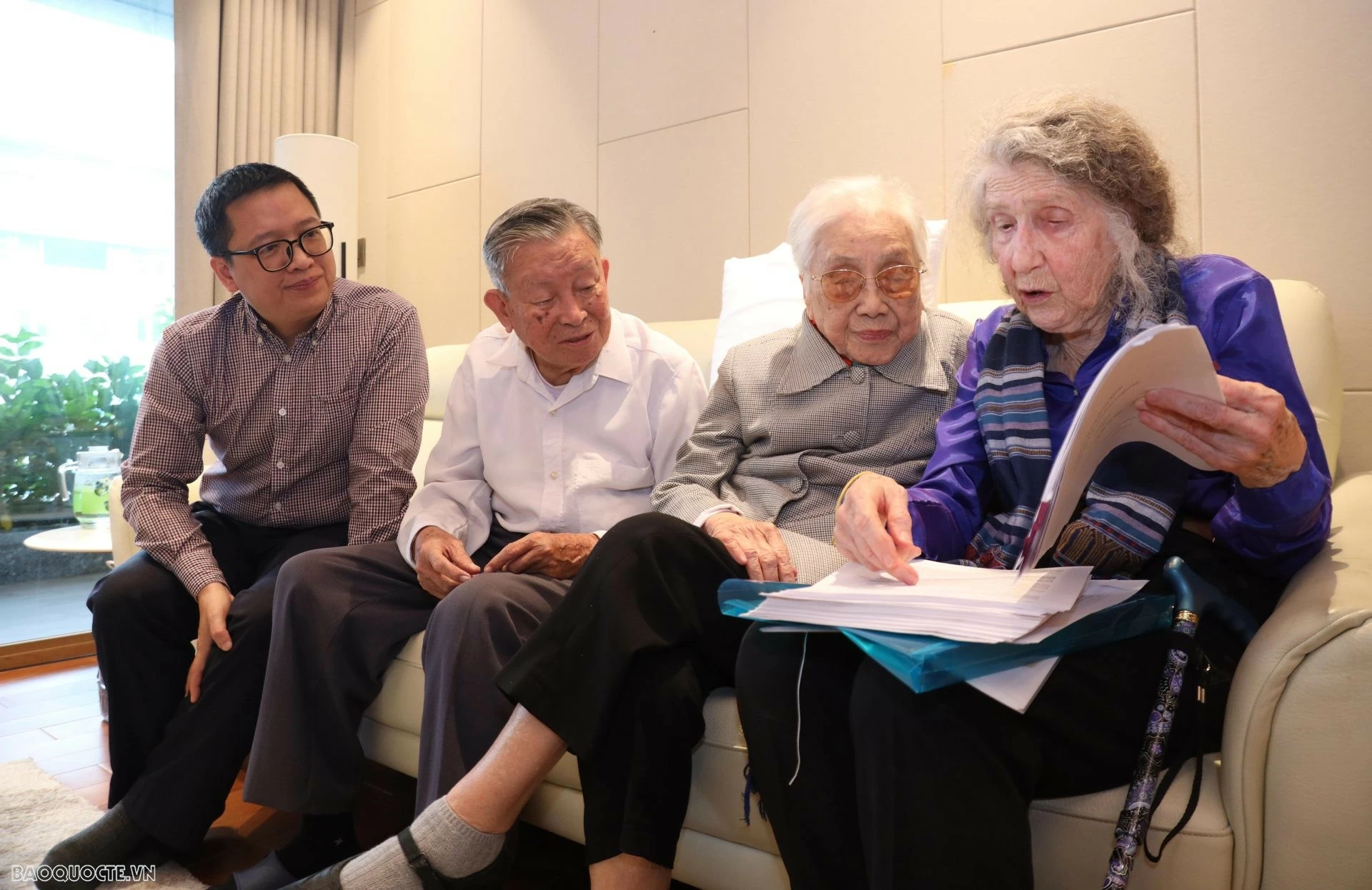 |
| Lady Borton moved those present at the meeting when she shared about drawing a large map recording all the countries Nguyen Thi Binh had visited in her diplomatic journey. (Photo: Thanh Long) |
Throughout the meeting, the two women held each other's hands tightly. One is a renowned female diplomat of Vietnam. The other is an American writer who spent more than half a century telling stories about Vietnam to the world. They come from two countries once on opposite sides of the battlefield, but what they preserve is not hatred, but understanding between people.
They exchanged heartfelt hugs as rare friends reunited, comrades holding hands through a time of fire and flowers. Even in those emotional moments, they – two famous and strong women, also very ordinary – tearfully inquired about each other's lives, congratulated the upcoming birthday (former Vice President Nguyen Thi Binh will turn 100 on May 26, 2027), and promised to sit together again.
When asked about the difference between “Madam Binh” of the past and present, writer Ut Ly smiled gently: “I see she is still the same, always cheerful.”
After all the upheavals of the era, friendship and understanding remain the most precious things.
| In late 1968, Lady Borton came to Vietnam to participate in volunteer activities, assisting civilians affected by the war in the Quang Da area under the Quaker humanitarian organization. Since 1970, she became a freelance writer and photojournalist. Thanks to her wide scope of work, she had more opportunities to interact with both civilians and members of the National Liberation Front of South Vietnam. Her real experiences on the battlefield helped her understand more about the war that the U.S. waged against the Vietnamese people. Self-taught in Vietnamese and having spent more than half a century connected to Vietnam, the female writer has devoted much effort to studying the history of a country half a world away from her homeland. She has made significant contributions to Vietnamese journalism and publishing with her writings, compilations, and translations, thereby helping to bring the image, history, and culture of Vietnam closer to international readers. |