




Ensuring fertiliser market stability against external shocks
Rising tensions in the Middle East are pushing up global fertiliser prices and raising concerns about input costs for farmers, as disruptions to key shipping routes threaten the supply of critical raw materials.
Latest
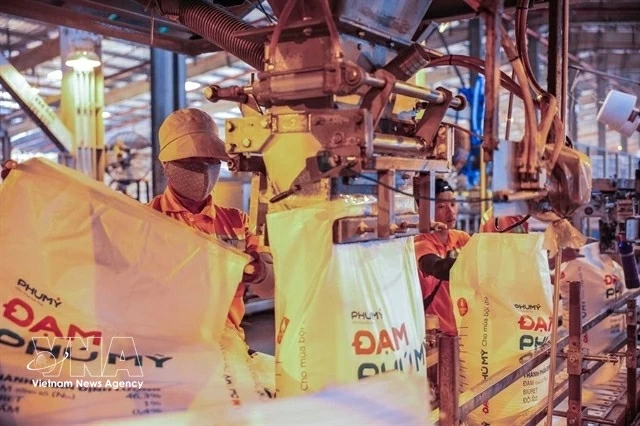 |
| A packaging line at the PetroVietnam Fertiliser and Chemicals Corporation (Phu My). (Photo: VNA) |
For an agriculture-based economy such as Vietnam, the volatility highlights the need to secure fertiliser supply and contain input costs to protect farm production from external shocks.
Domestic fertiliser prices often move in tandem with international trends. When global prices surge, local producers tend to adjust their selling prices to align with market levels and take advantage of export opportunities.
Market observations have shown that several wholesale warehouses and distributors have announced new price increases.
At the retail level, urea prices in many areas range between 610,000-650,000 VND per 50-kilogram bag for products from the PetroVietnam Ca Mau Fertiliser Joint Stock Company, while urea from the PetroVietnam Fertiliser and Chemicals Corporation (Phú Mỹ) is priced at around 610,000-660,000 VND per bag.
Other fertilisers also remain at relatively high levels. DAP Hong Ha is sold at around 1.25-1.3 million VND per bag, granular potassium fertiliser at about 500,000-530,000 VND and NPK 16-16-8 at roughly 600,000-750,000 VND depending on region and distributor.
Compared with late February, several common fertilisers, including urea from Ca Mau and Phu My, NPK 16-16-8 and powdered potassium, have increased by about 10,000 VND per 50kg bag, indicating that the domestic market has begun reacting to the global price rally.
Shipping risks
According to Phung Ha, Chairman of the Vietnam Fertiliser Association, disruptions around the Strait of Hormuz are a major factor behind the surge in fertiliser prices, as the waterway is a critical route for global fertiliser shipments.
Different fertilisers rely on different raw materials. Urea production depends largely on natural gas or coal, while phosphate-based fertilisers such as DAP require apatite ore. If the strait were disrupted, shipments of sulphur, urea and ammonia, key inputs for nitrogen fertilisers, could be significantly affected.
Each month, around 1.2-1.5 million tonnes of urea, 1.5-1.8 million tonnes of sulphur and 400,000-500,000 tonnes of ammonia are transported through the route. Ammonia is a key input for nitrogen fertilisers such as urea, MAP, DAP and SA, while sulphur is used to produce sulphuric acid, an essential material for fertilisers including DAP, SSP and SOP.
Logistics costs could also surge if shipping routes are disrupted, as most ammonia carriers and bulk vessels transporting sulphur cannot easily reroute. Without an alternative maritime route out of the Gulf that bypasses the strait, shipping expenses such as container rates, insurance premiums, fuel and labour costs may rise sharply.
In addition, geopolitical tensions have forced some fertiliser plants in Iran to suspend production of urea and ammonia. Facilities in Egypt and Jordan have also been affected due to disruptions in natural gas supplies from Israel.
Domestic cushion
These global factors could influence fertiliser prices in Vietnam in the coming period, particularly as the country remains a major importer.
Data from the General Department of Customs show that in 2025 Vietnam imported about 6.2 million tonnes of fertilisers worth roughly 2.2 billion USD. Potassium fertiliser accounted for the largest share at around 1.2 million tonnes, valued at 437 million USD. Imports of SA fertiliser reached about 1.2 million tonnes worth 193 million USD.
Despite having domestic production facilities, Vietnam still imported around 576,000 tonnes of urea worth 226.4 million USD in 2025. Imports of NPK fertiliser reached about 867,000 tonnes, while DAP imports totalled roughly 575,000 tonnes, valued at 414.6 million USD and 415.1 million USD respectively.
However, experts believe the situation remains manageable thanks to Vietnam’s relatively strong domestic fertiliser industry. Major plants such as those operated by the PetroVietnam Fertiliser and Chemicals Corporation, the PetroVietnam Ca Mau Fertiliser Joint Stock Company, the Ha Bac Nitrogenous Fertiliser and Chemicals Company and the Ninh Binh Nitrogenous Fertiliser Company help ensure stable urea supply for the domestic market.
According to the Vietnam Fertiliser Association, the country consumes around 10-10.5 million tonnes of inorganic fertiliser annually through a combination of domestic production and imports.
Vietnam is capable of producing most major fertiliser types, including urea, DAP, SSP, FMP, SOP and various NPK blends and even exports moderate volumes of some products such as SSP, DAP and NPK.
According to Nguyen Thi Hien, Deputy General Director of the PetroVietnam Ca Mau Fertiliser Joint Stock Company, the company’s plant continues to operate steadily, producing its two core products: urea and NPK fertilisers.
She noted that global urea prices had been rising sharply, largely due to higher freight costs and that domestic prices could follow suit as the farming season approaches. Whether the increase would be sustained would depend on further developments in the global market.
Meanwhile, representatives from the PetroVietnam Fertiliser and Chemicals Corporation have said international urea prices are currently influenced by market sentiment amid geopolitical risks, though domestic plants are operating normally and local supply remains secure.
Managing volatility
Despite relatively stable supply conditions, experts warn that Vietnam’s fertiliser market is not immune to global volatility. As global commodity markets become increasingly interconnected, geopolitical tensions in distant regions can still ripple through supply chains and affect prices.
Closely monitoring developments in global energy and logistics markets will therefore be crucial for both businesses and regulators in responding to potential price fluctuations.
Vietnamese fertiliser producers have already developed strategies to cope with such shocks. These include diversifying supply sources, maintaining stable production, cutting intermediate costs, developing substitute products and investing in advanced technologies to improve efficiency and reduce production costs.
Industry experts also recommend that producers prioritise domestic supply, reduce energy and raw material consumption and accelerate research into enhanced efficiency fertilisers.
For farmers, applying fertilisers according to the four rights principle, using the right type, right quantity, at the right time and in the right way, can help optimise fertiliser use and mitigate the impact of price fluctuations.
| Workshop: Enhancing capacity and ensuring safety for military women for peace and security in the digital era WVR - On February 7, an international workshop on “Enhancing capacity and ensuring safety for military women for peace and security in the digital era” ... |
| Elections of 16th National Assembly and People’s Councils: Political stability as the foundation of international trust WVR - The March 15 election of the 16th National Assembly and People’s Councils at all levels for the 2026–2031 term carries significance beyond a ... |

| Cooperation is key for peace and stability in the East Sea Whether the Code of Conduct in the East Sea (COC) becomes true sooner or later, the spirit of cooperation and de-escalation must always be promoted ... |

| National Assembly and People's Council Elections 2026: Proactively preventing fake news, ensuring safe and transparent elections WVR - Amidst the risk of misleading and distorted information on social media, the National Election Council and relevant authorities have developed various plans to ... |
| Amid Middle East tensions, Vietnam’s agriculture sector maintains stability Beyond being a collective hurdle, the ongoing instability in the Middle East functions as a critical assessment of how Vietnam's agriculture and environment can withstand ... |
(Source: VNA)