





Combating IUU Fishing: Government issues decree detailing implementation of Fisheries Law
WVR - The Government has just issued a decree detailing certain provisions and measures for implementing the Fisheries Law. This aims to complete the legal framework, enhance state management, protect and sustainably develop aquatic resources, while also meeting international integration requirements and combating illegal, unreported, and unregulated (IUU) fishing.
Latest
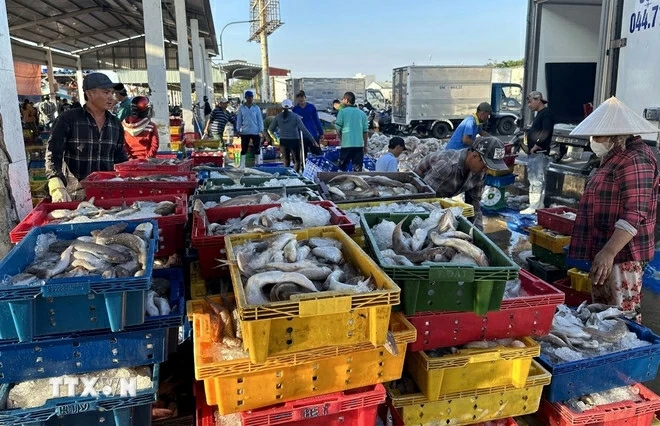 |
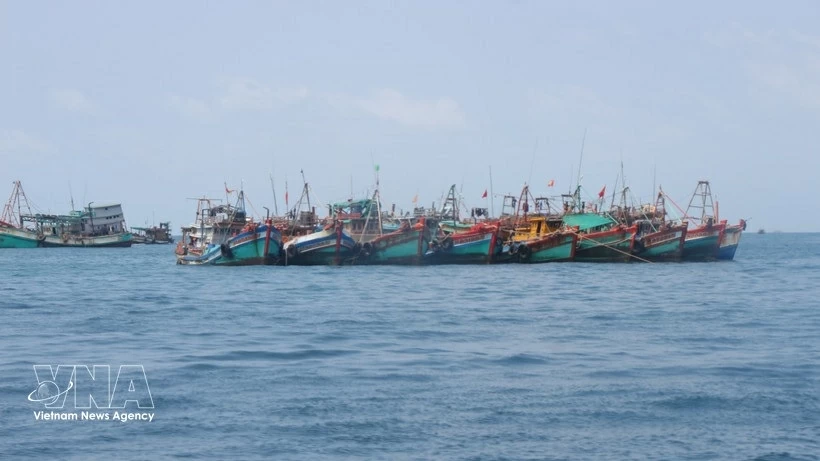
| Fishing vessels dock to unload fish at Tac Cau Fishing Port, Chau Thanh District in the early months of 2025. (Source: VNA) |
The decree is issued based on the 2025 Law on Government Organization and the 2017 Fisheries Law, amended and supplemented by the 2024 and 2025 Laws.
This important document concretizes many new regulations of the Fisheries Law, ensuring uniform implementation from central to local levels.
According to the decree, the scope of regulation includes detailing contents under the government's authority as assigned in various articles and clauses of the Fisheries Law, related to exploitation, aquaculture, protection of aquatic resources, management of fishing vessels, and control of fishing activities within and beyond Vietnam's waters.
Additionally, the decree specifies regulations on observers on Vietnamese fishing vessels operating in Vietnam's waters; licensing the export of aquatic species on the prohibited or conditional export list that do not yet meet conditions, in cases serving scientific research and international cooperation.
Notably, the decree adds regulations on controlling foreign vessels fishing, transporting, and transshipping aquatic products to Vietnamese ports; controlling aquatic products and products derived from fishing transported by container ships imported into Vietnam. This strengthens the enforcement of international commitments, especially as Vietnam strives to lift the European Commission's "yellow card" on IUU.
The decree applies to Vietnamese and foreign organizations and individuals engaged in or related to fisheries activities within Vietnam's mainland, islands, archipelagos, and waters; it also applies to Vietnamese organizations and individuals fishing outside Vietnam's waters.
The decree dedicates an article to explaining terminology, clarifying many important specialized concepts, contributing to a unified understanding and application in practice. Concepts such as intensive and semi-intensive aquaculture; substrates in aquaculture; shorelines, inshore lines; vessel tracking systems and equipment; transshipment of aquatic products; and fishery logistics vessels are specifically defined.
Particularly, the decree clearly explains illegal, unreported, and unregulated (IUU) fishing activities, in line with international law and recommendations from regional fisheries management organizations.
This provides an important legal basis for authorities to enhance inspection, monitoring, and handling of violations in fishing activities.
The decree also specifies regulations on storm shelter anchorage areas for fishing vessels, major fishery centers, and vessels serving aquaculture, contributing to the completion of fishery infrastructure, ensuring safety for fishermen, and enhancing production efficiency and fishery logistics services.
A highlight of the decree is the general regulation on simplifying administrative procedures, making it convenient for organizations and individuals. Accordingly, applications can be submitted directly at the One-Stop Service Department, through public postal services, or online via the National Public Service Portal and National Identification Application.
The decree allows the use of electronic documents and valid scans, reducing the requirement for certified copies, while clearly outlining the responsibilities of organizations and individuals regarding the legality of documents. In cases of natural disasters or epidemics, authorities are permitted to conduct online evaluations, temporarily postpone, or extend permits and certificates, ensuring both flexibility and strict management.
The decree dedicates Chapter II to regulations on the Fund for Protection and Development of Aquatic Resources, clearly defining the functions, tasks, organizational structure, and operational mechanisms of the Fund at the central and provincial levels.
Accordingly, the Fund supports programs, projects, and non-project activities for the protection and development of aquatic resources not included in the state budget plan. The Fund's financial resources are formed from voluntary contributions, sponsorships, and entrusted funds from domestic and foreign organizations and individuals, managed according to regulations on off-budget financial funds.
The Fund is used for propaganda, education, ecosystem restoration, aquatic resource regeneration, supporting occupational transitions, creating sustainable livelihoods for fishermen, and supporting the activities of provincial and community funds.
The management and use of the Fund's finances must comply with legal regulations on budgeting and accounting, and are subject to inspection, examination, and auditing by competent authorities.
The issuance of the decree detailing the implementation of the Fisheries Law is considered a necessary and timely step, contributing to the completion of the legal corridor, enhancing the effectiveness and efficiency of state management in the fisheries sector.
The decree not only provides a legal basis for the protection and regeneration of aquatic resources but also promotes the sustainable and responsible development of the fisheries economy, meeting international integration requirements.
The new regulations on exploitation control, vessel tracking, IUU management, and administrative procedure reform are expected to enhance the legal compliance awareness of fishermen and businesses, while affirming Vietnam's strong commitment to protecting aquatic resources and developing a modern, sustainable fisheries sector.