





Ca tru in Hanoi: A journey of preservation and dissemination
WVR - The Hanoi Ca tru Festival 2025 has just concluded, leaving a lasting impression on the audience of the capital. This was not only an opportunity for the public to enjoy a form of heritage recognized by UNESCO, but also a chance to reflect on the journey of preserving and promoting the values of ca tru in the land of a thousand years of civilization.
Latest
Just a few decades ago, Ca tru (a traditional singing) faced the risk of fading away as the number of veteran artists dwindled, audiences were indifferent, and theaters were empty. Thanks to the persistent efforts of researchers, artists, and the attention of the authorities, ca tru has gradually returned to the artistic life of the capital.
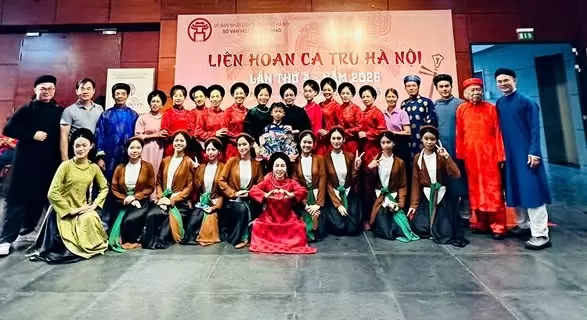 |
| The Lo Khe Ca tru Club participates in the Hanoi Ca tru Festival 2025. (Photo: Khanh Huy) |
Bringing heritage back to life
Since 2009, when ca tru was recognized by UNESCO as an Intangible Cultural Heritage in Need of Urgent Safeguarding, Hanoi has launched numerous preservation programs.
Ca tru clubs have been established, associated with familiar places such as Thai Ha, Lo Khe, Kim Duc, Ngai Cau, with the aim of teaching and nurturing a love for ca tru among the younger generation.
Special performance spaces, such as village communal houses and temples, have also been restored to allow the music and singing to reconnect with their roots.
The Hanoi Ca tru Festival 2025 brought together nearly 20 clubs with hundreds of artists, singers, and musicians participating, marking the largest festival to date.
According to People's Artist Tran Quoc Chiem, Chairman of this year's Festival Evaluation Council, the presence of many young musicians with good techniques is a positive sign.
“Previously, we were worried about the lack of musicians, but now there has been a significant change, with many contestants performing with single and polyphonic notes, harmonizing with the singing and drumming,” he shared.
Not only limited to recreating traditional forms such as hat noi, muou, ngam, and cheo do, many clubs have also composed new lyrics for songs, praising the homeland, country, leaders, and the beauty of the era. This demonstrates the creative efforts to renew the heritage and make it more relatable to today's audience.
Ms. Le Thi Anh Mai – Deputy Director of the Hanoi Department of Culture and Sports, emphasized: “The festival has contributed to preserving and promoting the value of ca tru, encouraging teaching activities at the grassroots level, and discovering and nurturing young talents. Hanoi is also implementing Resolution 23/2022/HĐND to create incentives for artists and support intangible heritage clubs, including ca tru.”
Artists persistently keeping the craft alive
Born into a family with a ca tru tradition in Kham Thien Street, Hanoi, and starting to sing ca tru at the age of 12, artist Nguyen Thi Chuc, when she was alive, hoped for someone to continue the craft, as ca tru cannot be mastered in just a few months; it requires artists who are dedicated for life.
Sharing this aspiration, artists have quietly kept the flame of ca tru alive for many years by offering free classes, encouraging young students, and even funding performances themselves. In traditional ca tru villages like Lo Khe (Dong Anh) and Ngai Cau (Hoai Duc), elderly artists are still diligently teaching the younger generation.
As the cradle of ca tru art in the country, Lo Khe ca tru has been preserved and developed in modern life. According to Mr. Nguyen The Dam, Head of the Lo Khe Ca tru Club, since the 15th century, this place had a teaching guild that performed across the provinces and the capital Thang Long. During the two national defense wars, Lo Khe residents opened ca tru venues in the central streets of the capital.
The first half of the 20th century is considered the heyday of Lo Khe ca tru art. Many famous singers and musicians were born here, such as Ms. Pham Thi Mui, Nguyen Thi Diem, Nguyen Thi Tinh; renowned singers and musicians Nguyen Thi Van, Nguyen Thi Nam, Nguyen The Bam, Nguyen Van Tieu...
Established in 1995, the Lo Khe Ca tru Club currently has 58 members and about 15 collaborators who are students participating in performances.
Mr. Nguyen The Dam hopes that the Ca tru Festival will be held biennially to provide clubs with more opportunities to preserve and promote the value of ca tru.
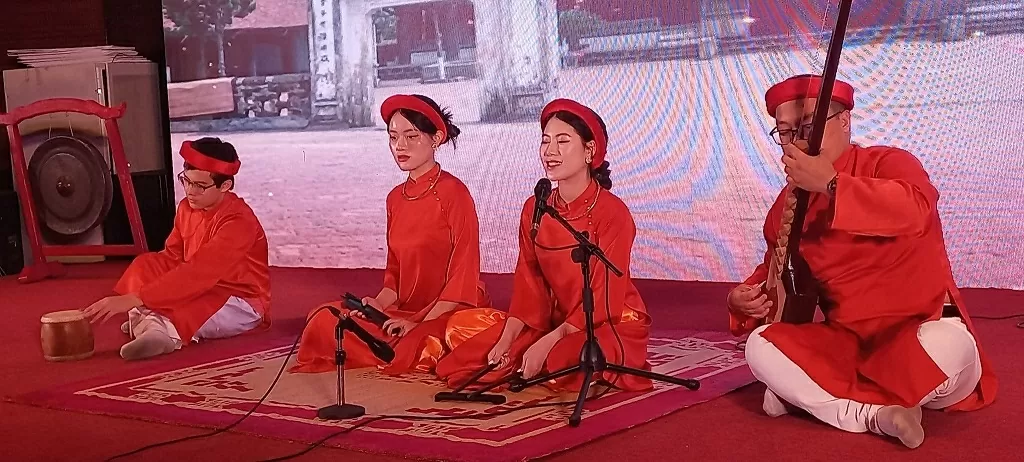 |
| Ca tru is increasingly attracting young faces. (Photo: Bui Trong Hien) |
Igniting a love for heritage among the youth
Not only artists, but ca tru is also attracting young faces who seek traditional art as a way to connect with cultural roots.
Mr. Hoang Hai Dang (Thuong Mo Club), although having joined the club for only two months, has already felt the ancient, nostalgic beauty of ca tru and feels proud to contribute to preserving this traditional art.
Ca tru has also entered the classroom, becoming a research subject for conservatory and cultural arts students. Many schools invite artists to perform, allowing students to “see and hear” firsthand.
Some contemporary art projects are experimenting with combining ca tru with visual arts, electronic music, and multimedia performances. Although controversial, these efforts open up new approaches.
The Hanoi Ca tru Festival is not just an art celebration but also a powerful message that heritage can only endure when it is loved, practiced, and passed on.
The city of Hanoi has identified ca tru as a distinctive cultural product, linked with heritage tourism, so that every visitor to the capital can experience the sound of the phach and the lute.
In the context of integration, when modern music is pervasive, ca tru still holds its place if new approaches are embraced, as passionately advocated by researcher Nguyen Quang Long in many projects that contribute to the revival of ca tru; aiming for the future where ca tru is removed from the list of Intangible Cultural Heritage in Need of Urgent Safeguarding to become a Representative Intangible Cultural Heritage of Humanity.