




80 years of Vietnam's diplomacy: A Peace Envoy at the 1973 Paris Peace Talks
WVR - On January 27, 1973, the Paris Agreement on Ending the War and Restoring Peace in Vietnam was signed. Contributing to that resounding success of Vietnamese diplomacy was a woman who won the admiration of the entire world…
Latest
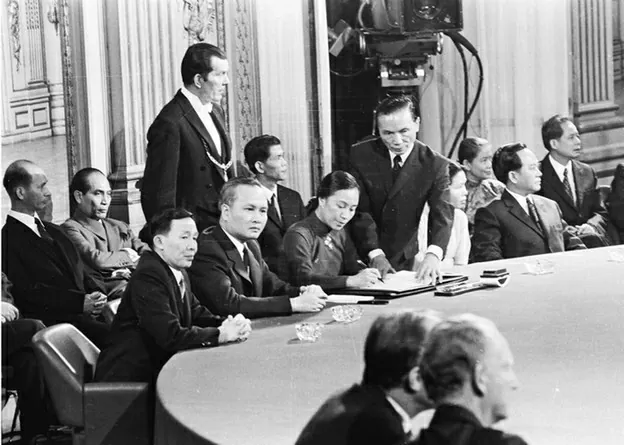 |
| Head of the Negotiating Delegation of the National Liberation Front of South Vietnam Nguyen Thi Binh signed the document at the Paris Conference on January 27, 1973. (Photo: Archive) |
The “Viet Cong” female leader
On January 27, 1973, the Agreement on Ending the war and Restoring peace in Vietnam (the Paris Agreement) was signed, marking an important turning point in our people’s resistance against the United States for national salvation. In addition to prestigious names in Vietnamese diplomacy such as Le Duc Tho and Xuan Thuy, Madame Nguyen Thi Binh — Vietnam’s first female Foreign Minister and Head of the Negotiating Delegation of the Provisional Revolutionary Government of the Republic of South Vietnam at the Paris Conference — is still remembered with deep admiration.
In her memoir Family, Friends, and Country, Madame. Nguyen Thi Binh called diplomacy a special front in the resistance war against the United States — a heavy responsibility and “a very important chapter in my life of activism”.
When Madame Nguyen Thi Binh assumed the position of Foreign Minister and Head of the Negotiating Delegation of the Provisional Revolutionary Government of the Republic of South Vietnam at the Paris Conference, it stirred the whole international media. Newspapers at the time eagerly sought photos and biographies of the woman leading the “Viet Cong” delegation.
During the years of negotiations at the Paris Conference, “Madame Binh”, as the media referred, consistently made a strong impression on the Western press with her persuasive, intelligent speeches — sometimes firm, sometimes witty — earning global respect and touching the hearts of the people.
According to French journalist Madeleine Riffaud, all political leaders agreed: “The Viet Cong scored a great victory through Madame Binh’s reception in Paris. Madame Binh was like a queen, welcomed like a head of state, with full official protocol, and warmly applauded. She shook public opinion in Paris and around the world. The Front’s flag flew over Paris. Magnificent! Truly rare!”
The Paris Agreement negotiations involved 201 public sessions, 45 private high-level meetings, 500 press conferences, 1,000 interviews, and thousands of anti-war rallies in support of Vietnam. Every Thursday, Parisians would see “Madame Binh” — elegant and poised in the traditional Vietnamese ao dai — arriving at the International Conference Center to hold press conferences and briefings, give interviews, and attend international meetings as Foreign Minister.
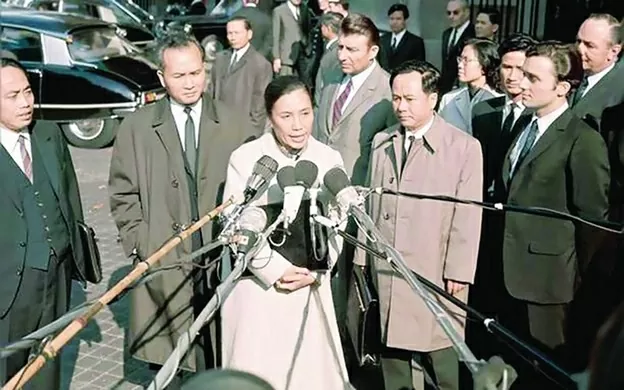 |
| Head of the Negotiating Delegation of the National Liberation Front of South Vietnam Nguyen Thi Binh answering journalists’ questions at the Paris Conference, 1973. (Photo: Archive) |
In her memoir, Madame Nguyen Thi Binh recalled press conferences with up to 400 journalists, or live television broadcasts where she answered (in French) dozens of questions from French and American reporters. Alone among seasoned journalists, under the glare of bright lights, she responded calmly, firmly yet gracefully, making clear her goodwill in seeking a political solution to end the war.
The French news agency AFP described: “Madame Binh, dressed in a traditional Vietnamese ao dai of green patterned silk, appeared completely at ease. At times, she smiled, making her face even more radiant, and answered reporters with clarity and precision, giving the impression of a refined lady full of courage and confidence”.
Diplomacy from heart to heart
Throughout her years in diplomacy, she called her work “people to people diplomacy” — person to person, heart to heart. She brought friends closer to the Vietnamese people. Her friends came from all walks of life, all skin colours, all social classes, from ordinary citizens to heads of state across different political systems.
She traveled across continents to publicize Vietnam’s cause, rally support from the international community, and prepare information for sharp diplomatic offensives in negotiations. Her arguments — forceful yet reasonable and compassionate — spread worldwide through the press and media, inspiring admiration for a small nation daring to stand up to a great power to defend its right to live in independence and freedom.
The Paris Conference on ending the war in Vietnam was the longest diplomatic negotiation in world history, lasting 4 years, 8 months, and 16 days. She impressed observers by balancing “hard” and “soft” approaches. Her firm proposals and sharp diplomatic style — as the only woman at the negotiating table — drew Western public attention. Those present saw Madame Nguyen Thi Binh as gentle yet skillful and full of resolve.
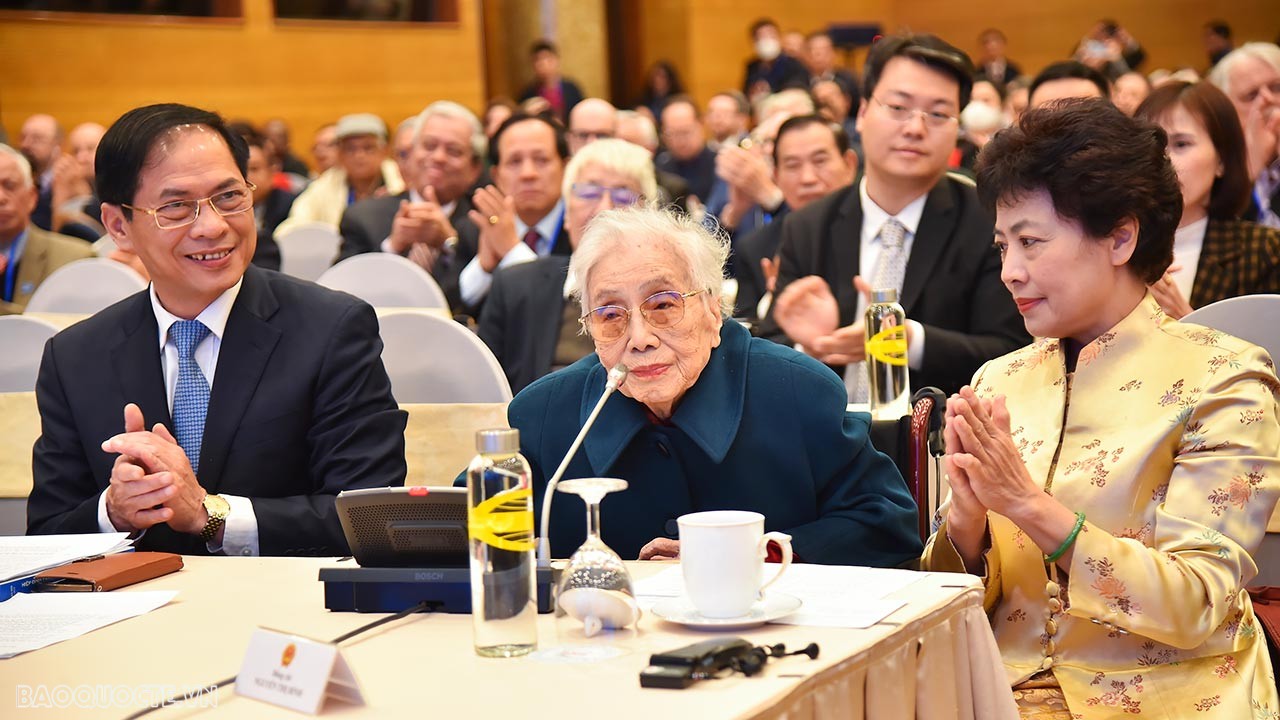 |
| Madame Nguyen Thi Binh at the 50th Anniversary Ceremony of the signing of the Paris Agreement. (Photo: Tuan Anh) |
In the fierce struggle of a small country against an empire, having a woman as the head of the delegation both attracted attention and gained international sympathy — clearly an advantage for diplomacy. As she later remarked: “If you are a woman who knows how to act tactfully, people will be more inclined to feel for you and listen to what you have to say about your position”.
When speaking about her personal life, Madame Nguyen Thi Binh affirmed: “I am a happy person” because “I married the one I love.” However, for several Lunar New Years in a row, she was unable to be with her husband and children, but had to spend the occasion in a foreign land. Whenever she missed them, she could only quietly restrain her feelings…
She told herself: “Doing revolutionary work well is loving my young children”. How could she not miss and love them? When she left, her eldest child was only 8 years old, and the younger one just 4 — an age when a mother’s care is most needed. Because of her duty and responsibility to the country, she had to entrust them to relatives for upbringing.
“I had the honour of representing the people of South Vietnam to sign a historic document. The outcome of the Agreement was paid for with the blood and sacrifice of our countless compatriots and comrades. At that moment, I thought of loved ones who had passed away and could not witness this historic moment… Overcome with emotion, tears welled in my eyes. That emotion has stayed with me all my life.” — Excerpt from the memoir “Family, Friends and Country” by Madame Nguyen Thi Binh, former Vice President of Vietnam, the country’s first female Foreign Minister, and Head of the Negotiating Delegation of the National Front for the Liberation of South Vietnam at the Paris Conference.
At that time, living conditions were extremely difficult. Madame Nguyen Thi Binh shared in her memoir: “We lived very modesly. Some journalists wanted to film the daily life and living conditions of the ‘Viet Cong’ delegation head, but we firmly refused, citing Vietnamese customs that do not allow public exposure of women’s private living spaces. In reality, we could hardly let them see my room where Binh Thanh’s (Pham Thanh Van) and I stayed — up in the attic under the roof, furnished with only two iron beds like those in hospitals. Some journalists, out of curiosity, asked me where I had my ao dai tailored, where I had my hair done, and how I took care of my appearance, I found ways to respond evasively…”


