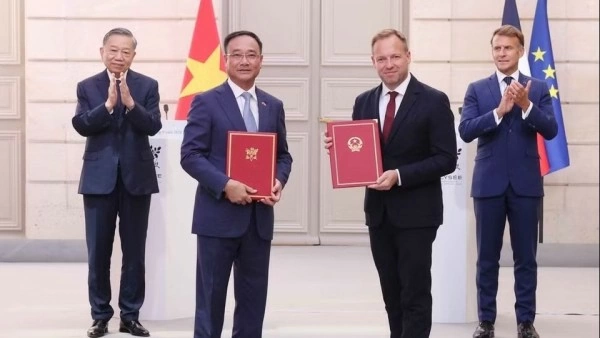







Vietnam's journey: From participation to shaping the rules of global cybersecurity cooperation
WVR - The Hanoi Convention holds strategic significance in legal, diplomatic, and national security aspects, said Dr. Tran Hai Linh.
Latest
 |
| Dr. Tran Hai Linh, Member of the Central Committee of the Vietnam Fatherland Front, President of the Vietnam-Korea Business and Investment Association (VKBIA), Founding President of the Vietnam-Korea Experts and Intellectuals Association (VKEIA). (Photo: Nguyen Hong) |
Proactive Role
According to Dr. Tran Hai Linh, Member of the Central Committee of the Vietnam Fatherland Front, President of the Vietnam-Korea Business and Investment Association (VKBIA), and Founding President of the Vietnam-Korea Experts and Intellectuals Association (VKEIA), the United Nations Convention against Cybercrime, or the Hanoi Convention, with the theme “Combating Cybercrime – Sharing Responsibility – Looking to the Future”, opened for signing in Vietnam at the end of October 2025, holds strategic significance in legal, diplomatic, and national security aspects.
Dr. Linh affirmed that this is the first time a major international convention on combating cybercrime and cross-border electronic judicial cooperation is named after Hanoi, the political and diplomatic centre of Vietnam. This event also reflects the international community's trust and recognition of Vietnam's proactive and positive role in promoting a safe, transparent, and responsible cyberspace. Vietnam is not only a beneficiary but also a contributor of intellect, voice, and initiatives in the international process on cybersecurity.
The VKBIA President emphasized that the Hanoi Convention opens opportunities for Vietnam to enhance international legal cooperation in handling high-tech crime, protecting personal data, and addressing cross-border challenges in cyberspace.
This will serve as a foundation for Vietnam to improve its capacity in investigation, prosecution, and adjudication, while also creating a solid legal corridor to attract digital investment and strengthen the trust of international partners. The naming of the Convention as "Hanoi" is also a symbol of global integration and responsibility, demonstrating Vietnam's gradual transition from being a "participant" to a "rule-maker" in global issues.
Evaluating Vietnam's leading role in the negotiation process, Dr. Linh noted that this is a prominent highlight showcasing Vietnam's diplomatic prowess and growing international prestige. In a world with diverse approaches to cybersecurity, digital sovereignty, and data privacy, Vietnam has acted as a "dialogue bridge" between groups of countries with different legal systems and interests. The flexibility and diplomacy, along with the principle of respecting international law and the legitimate interests of all parties, have helped Vietnam harmonize viewpoints, contributing to a rare consensus in the negotiation process.
Notably, Vietnam's role as host and co-chair of many key negotiation sessions demonstrates its ability to "lead with trust" – a form of soft power characteristic of modern multilateral diplomacy. We have proven that instead of imposing or confronting, dialogue and cooperation are the sustainable paths to building a safe and fair digital order for all.
Responding to questions about balancing the interests of major powers, Dr. Linh stated that in the context of increasingly intense geopolitical competition, Vietnam has demonstrated independent, autonomous, and flexible multilateralism. Vietnam does not take sides but focuses on the common interests of the international community: A safe, reliable, and human-serving cyberspace. Throughout the negotiation process, Vietnam also played the role of mediator, reconciling differences between developed and developing countries, between blocs with different approaches to privacy and digital sovereignty.
In particular, he noted that Vietnam has skillfully applied "bamboo diplomacy" – firm roots, flexible body, far-reaching branches – to both protect national interests and contribute to common benefits. Through this, Vietnam has shown the ability to "be friends with all, confront none", while promoting cooperation based on international law, equality, and mutual benefit. This balance and credibility have helped Vietnam become a center of trust, where countries can engage in dialogue and find common ground in a sensitive field like cybersecurity.
Commenting on the impact of the Hanoi Convention, Dr. Linh pointed out that this document is not only a new legal framework in cybersecurity but also a symbol of cooperation, trust, and global responsibility in the digital era. The Convention will help establish a unified legal cooperation platform, enabling countries to share information, support investigations, extradite, and effectively handle cybercrime while ensuring human rights, privacy, and digital sovereignty of each nation.
Experts believe that the negotiation and consensus process on the Hanoi Convention also provides valuable lessons for other multilateral initiatives: only equal dialogue, mutual respect, and focusing on common interests can create genuine unity. Vietnam, although a developing country, can still play the role of "consensus builder", connecting voices between major powers and smaller nations. Therefore, the Hanoi Convention not only contributes to enhancing global cybersecurity but also opens a new model of international cooperation – flexible, practical, and oriented towards sustainable development.
Roadmap to the future
Additionally, to maintain a proactive role and increase influence in promoting the implementation of the Hanoi Convention and other international cybersecurity cooperation mechanisms, Vietnam should continue to synchronously deploy foreign policy, domestic capacity, and multilateral, multi-sectoral links. Therefore, Dr. Linh proposes several specific steps such as:
Transition from signing to substantive implementation: Develop a national-level implementation roadmap for the Convention, including legal frameworks, technical guidelines, and inter-sectoral coordination standards; Issue guidance documents for agencies, localities, businesses, and professional organizations to clearly understand responsibilities and cross-border coordination processes when incidents occur.
Next, strengthen enforcement capacity: Enhance the capacity of investigation, courts, and prosecution forces on cybercrime (intensive training, joint practice programs with international partners). Develop and fund Central and local Computer Emergency Response Teams (CERTs); organize annual inter-sectoral, international drills.
Enhance legal and technical standards: Improve related laws and guidelines (personal data protection, cybersecurity, electronic judicial cooperation) to align with Convention commitments while ensuring respect for human rights. Promote technical standards, and cybersecurity information-sharing frameworks among parties based on confidentiality and legal compliance principles.
 |
| The United Nations Convention against Cybercrime, or the Hanoi Convention, with the theme "Combating Cybercrime – Sharing Responsibility – Looking to the Future", holds strategic significance in legal, diplomatic, and national security aspects. |
Promote public-private and multilateral cooperation: Encourage the PPP (public–private partnership) model, with the state coordinating with technology companies, banks, and telecommunications to establish early warning sharing foundations. Create regular forums between government, businesses, academia, and civil society to update risks and coordinate responses.
Establish Centers of Excellence, by setting up a regional hub in Hanoi (or connecting Hanoi–Korea) specializing in training, research, and technical cooperation in cybersecurity, highlighting Vietnam's digital diplomacy.
Implement bilateral and regional technical cooperation programs: Expand training programs, and expert exchanges with advanced partners (Korea, EU, Japan, USA) and actively participate in the ASEAN framework to share lessons and standards.
Support SMEs & critical infrastructure by providing technical support packages, and training for small and medium enterprises – a vulnerable yet crucial group for the supply chain; prioritize protecting essential infrastructure (healthcare, energy, finance) with a common risk assessment model and financial protection for security upgrades.
Transparency, monitoring, and reporting, building indices/assessment frameworks for Convention implementation progress: Number of international cooperation cases, response time, CERT capacity, case processing rate… Publicly report periodically to increase international trust.
Maintain multilateral spirit, balance interests: Continue to play the role of consensus builder, maintain a stance of respecting international law, human rights, and common interests, so that the Convention is applied substantively and not used as a geopolitical tool.
Strategic communication and constructive diplomacy; use technical diplomacy: Organize international conferences, and workshops in Vietnam, invite experts, partners, and announce clear cooperation initiatives to maintain influence after the Convention is signed.
In summary, Vietnam needs to quickly transition from the negotiation stage to substantive implementation, complete the legal framework, enhance investigation and incident response capacity, and promote public-private and multilateral cooperation. Establishing centres, expertise, international training programs, and cross-national drills will help Vietnam not only comply but also lead the implementation of the Convention. Along with transparency in the process and evaluation indices, Vietnam will maintain a proactive role, contributing to building a safe, reliable cyberspace for the region and the world.