



UK Parliamentary Under-Secretary of State: ASEAN has long been a voice for peace, stability, and an 'anchor' for regional cooperation
WVR - Following the success of the ASEAN Future Forum (AFF) 2026, UK Parliamentary Under-Secretary of State for the Indo-Pacific Region Seema Malhotra shared with The World and Vietnam Report the achievements in Vietnam-UK relations as well as cooperation within ASEAN.
Latest
 |
| UK Parliamentary Under-Secretary of State Seema Malhotra shares at the discussion session on energy security at the ASEAN Future Forum. (Photo: Thanh Long) |
In her seven months in Southeast Asia, UK Parliamentary Under-Secretary of State Seema Malhotra has observed that ASEAN possesses favourable conditions to enhance its role and position, with Vietnam emerging as an increasingly proactive factor in promoting dialogue, cooperation, and regional initiatives.
How do you assess Vietnam's organization of the ASEAN Future Forum and what are your expectations after the forum concluded?
It's been an important space in which the UK is also able to mark its five-year anniversary as a Dialogue Partner and to be able to be part of the discussions that are looking to the future challenges that ASEAN will be addressing.
I think seeing so many of the ASEAN countries represented, the conversation that's also involving young people, the way in which this is both looking at assessing the geopolitical challenges as well as what we talked about today in a session in which I spoke, energy security, demonstrates that for ASEAN, which has long been a voice for peace and stability and an anchor for regional cooperation, recognizing today's geopolitical challenges also requires reforms for tomorrow.
In those conversations, to see that this has been a credible, forward-looking platform, one in which countries were able to come together in dialogue, in which experience and expertise from across the region but also from the experience that we're able to bring as a dialogue partner, has been important in being able to bring practical ideas, new suggestions for partnerships, but to also say “how are we going to work together?”
For the UK, as a long-term partner working with ASEAN and seeing the importance of being able to be led by ASEAN's priorities but to be able to bring our expertise, our insight, and investment, it's been a very important forum and one in which I've been very appreciative to be able to take part.
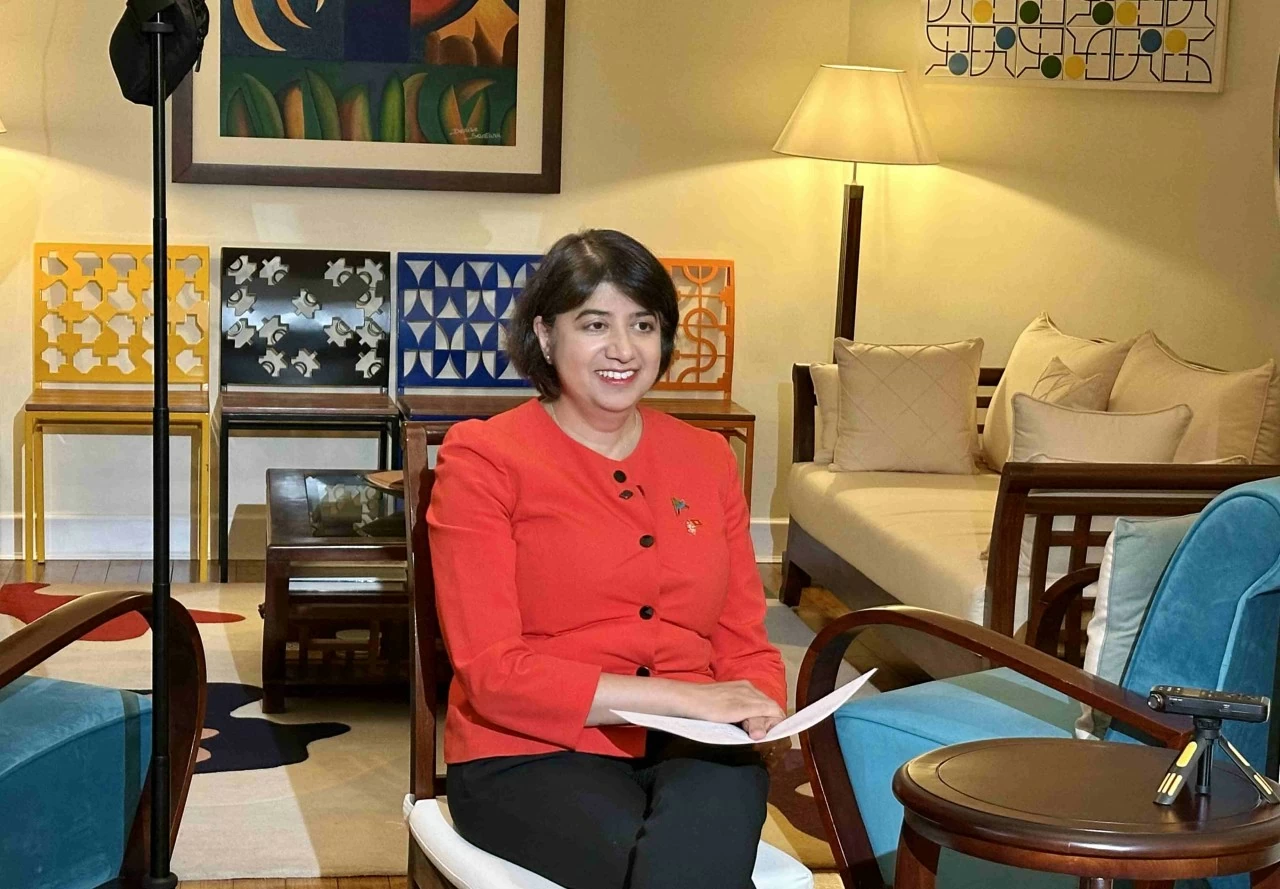 |
| UK Parliamentary Under-Secretary of State Seema Malhotra in the interview with The World and Vietnam Report. (Photo: Yen Vi) |
What do you think about this year’s theme and how relevant do you see this theme to the UK's broader engagement in the Indo-Pacific?
I would say that the theme that's also been focused on peace, prosperity, and people-centered development has been looking at how we move together, how we advance together. That sense of togetherness in a complex international environment, which was also a backdrop for the General Secretary, President To Lam's important contribution at the Shangri-La Dialogue.
It recognizes that in a time of great instability internationally, that we need to look differently at how we manage that flux in the international environment, but remain steadfast in those principles of centrality, of cooperation, and how we move forward together in the shared goals of prosperity and security.
What I think it has also highlighted is the importance of recognizing that our economic security is underpinned by our energy security, by our collaborations between nations and our dialogue to look at how we come together to also address the conflicts that we've seen today that are a challenge for how we have peace tomorrow.
Economic security and energy security, where we see the disruption to fuel supplies impacting energy costs, has also led to a growing demand for accelerating progress on ASEAN's energy security, on the power grid work to be able to see renewable and clean and green energy being able to then be part of energy security in the region.
These are spaces in which for sustainable development, for opportunity, for trade and the economy, that we see expertise coming in, including from the United Kingdom, to see both where the new technologies can be accelerated, but also where we can see, for example, with Laos with hydropower or Vietnam with offshore wind, that we can be looking to build resilience within countries for energy security as well as between countries through the power grid and the associated infrastructure.
This is an important part of how the UK with our expertise in technology, AI, in energy and climate, in some of the work we're doing to facilitate greater finance for the green energy transition, including with the Green Finance Facility we're launching on my visit here. These are examples of where we are supporting ASEAN in building its capability, its growing capacity and having the infrastructure for its own stability and being able to bring our experience and expertise of our own journeys, including on the clean energy, to be relevant to supporting ASEAN's journey.
It can be seen that the ASEAN Future Forum takes place at a time when the region faces multiple challenges simultaneously. What cooperation priorities should ASEAN and the United Kingdom promote in response to those challenges?
This is a very important question about the instability that is the context for decision-making both for nations and for regions together. It is important to recognize that the UK and ASEAN with our long-standing relationships and the way in which we work through our five years as a Dialogue Partner, can come together and prioritize our economic security, our energy security, our climate action, but also resilience of supply chains that are able to withstand the shocks in the way that we have seen. Those shocks can come very quickly.
It is important to also recognize that in many of my conversations in ASEAN countries — and this is my eighth ASEAN country that I'm visiting in the last seven months — that the conversations I have across ASEAN also are looking to our greater defense partnerships and collaboration. It's where we also have seen with our defense partnerships, our joint exercises, our insights, our intelligence, our looking to how defense needs to be future-proofed with how conflict is operating today and for tomorrow, that we work together on defense and security, and including maritime security.
Those areas of collaboration, of insight with our defense attachés in the region working in partnership with countries here, our recognition that our economic development is also recognizing that we need to have the workforce for the economy and our security for the future, growing ways in which we see green growth and climate security, because climate could also be a source of conflict in the future where we see regions and nations and parts of nations under greater strain.
That we are seeing technology applied to build climate resilience as well as to build security and stability for the future. So I very much hope that in those areas of skills, including in science and technology, ways in which our partnerships between our universities are looking to build those opportunities in nations and to have those opportunities for Chevening scholars and the students able to study — we have 40,000 students studying from ASEAN countries in the United Kingdom. We see a growing partnership with our diaspora communities, people-to-people ties, over 400,000 in the United Kingdom.
But importantly, our collaborations supporting our economic development between our countries. Last year we saw a 17% increase in trade with ASEAN countries in the United Kingdom. And for Vietnam, we see that our trade annually is worth over £10 billion. That is something in my meetings with ministers here, we have sought to look to increase and to also increase in areas where we know our economies and our nations need to build their capacity and also their opportunity.
Those are areas in which as we look forward to the next five years, we are grateful to Vietnam having been our country coordinator for ASEAN and with whom we are negotiating our next five-year partnership, that we are looking to those areas and priorities, those shared priorities between ASEAN and the United Kingdom, to be able to bring our partnership to bear to have greater impact and to build that prosperity and security for tomorrow.
In recent years, Vietnam has become more proactive in expanding and upgrading its relations with the wide range of countries and has taken a more visible role in articulating the views at major regional forums. How do you assess this development?
The UK strongly welcomes Vietnam's increasingly proactive and also confident international engagement, and does that with a growing sense of purpose in regional and also global forums.
That's been important in how we work bilaterally but also multilaterally. And this is recognized in the ASEAN Future Forum where it's been advancing ASEAN cooperation, sustainable development, regional dialogue where we also see an opportunity for ASEAN to have an even greater leadership over the next decade. It is important because what we see is the reinforcing of ASEAN centrality, of unity, and of resilience at a time of global uncertainty.
And nations will look to ASEAN leadership, nations in the region will look to ASEAN's centrality and leadership to sustain that stability, that green transition, strengthening institutions, governance, regulatory frameworks, investment in human capital, particularly at a time when there is instability in the wider world.
That's an area on which as we, as also believing together in a free and open Indo-Pacific and in an international rules-based order, conversations that have been very much part of every aspect of my work in ASEAN and with Vietnam, will continue to be guiding principles.
That work through our ongoing bilateral relationship with Vietnam, as our country coordinator in ASEAN and the country with which we're supporting and developing our next five-year plan of action, is an extremely important bilateral relationship, but also one through which we work together in the wider ASEAN forum.
We recognize the importance of our relationship with ASEAN and also the importance of our Comprehensive Strategic Partnership with Vietnam. Our Comprehensive Strategic Partnership with Vietnam and my visit here is part of continuing that growing momentum of our relationship.
On my visit here that has also been part of marking our five years of Dialogue Partner with ASEAN has been recognizing the importance of both of those relationships with Vietnam and with ASEAN, and the importance of ASEAN centrality as a cornerstone of our engagement in the region and as a foundation for the stability, security, and prosperity of the region.
That's the backdrop in which the relationship we're developing and growing with Vietnam on having that strong bilateral relationship, particularly in climate and in energy and in sustainable growth, is important for serving as a model for wider ASEAN collaboration and demonstrating how practical delivery on green growth and energy transition can be replicated regionally as well.
We are working closely with Vietnam on supporting its green energy transition. That includes renewable energy and making sure that that becomes embedded in the grid, in offshore wind and also modernization of energy systems. On my visit here, I'll be launching the Green Finance Facility. That's an extremely important part of how we play a role bringing UK expertise in green finance and financial services, but also to support the development of bankable clean energy projects.
It's also important in our work that we do through the Asian Development Bank. I recently attended the Asian Development Bank's annual meeting as the Alternate Governor from the United Kingdom. And as part of the reforms and priorities that we want to see there, of which are important for ASEAN countries and the wider Asia and Indo-Pacific, looking at access to green finance and transition to green energy, renewable energy, that we need to see accelerate.
And countries really recognize that on the back of the challenge of climate change but also global instability and disruption to supply chains. This is an area in which we also are making our own transition, but we see it as extremely important and part of our responsibility to support Vietnam and nations across ASEAN and across the world be able to make that transition for their own security and also for prosperity that that energy security underpins.