


The 'vigorous middle age' of Vietnam-Germany relations
WVR - On the occasion of the 50th anniversary of Vietnam-Germany diplomatic relations (23/9/1975 - 23/9/2025), I would like to share some thoughts on half a century of friendship between Vietnam and the country I consider my second home.
Latest
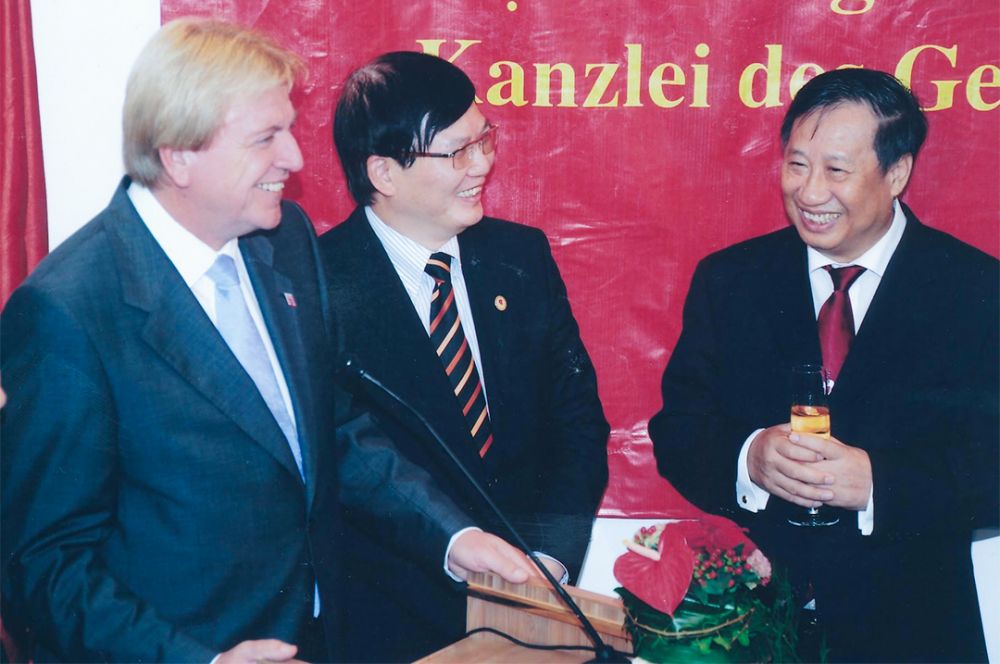 |
| From left to right, Hessen State Premier Volker Bouffier, Vietnamese Consul General in Frankfurt (Germany) Nguyen Huu Trang, and Deputy Prime Minister, Foreign Minister Pham Gia Khiem at the official opening of Villa Hanoi - the headquarters of the Vietnamese Consulate General in Frankfurt, on September 13, 2010. (Photo: Courtesy by author) |
Over the past half-century of many upheavals, I am proud and fortunate to have spent 49 years engaged with the German language and Germany in various roles, from being a law student in both parts of Germany before reunification, to diplomatic negotiations and three terms at the Vietnamese diplomatic and consular missions in Berlin and Frankfurt am Main.
All beginnings are difficult (Aller Anfang ist schwer)
In 1975, our nation's resistance achieved a glorious victory with the Great Spring Victory, unifying the country. Although peace was restored, the nation was still littered with the remnants of war. Our friends who had wholeheartedly supported our resistance, the socialist countries in Eastern Europe, and newly independent friends in Asia, Africa, and Latin America, were also facing countless difficulties due to the Cold War and embargoes.
At that time, Germany was still divided. The German Democratic Republic (GDR) in the East had established diplomatic relations with the Democratic Republic of Vietnam very early, on December 16, 1954. As a child, I learned about that distant country from colourful magazines published by their Embassy in Hanoi, which I was fortunate to have. I loved Germany from that day.
Meanwhile, the Federal Republic of Germany (FRG) in the West only established diplomatic relations with Vietnam later (on September 23, 1975), but appointed an Ambassador in Beijing concurrently. Nearly a year later, in August 1976, the first Resident Ambassador, Peter Scholz (1976-1978), and a few new diplomatic staff arrived in Hanoi, but they had no headquarters. He and his diplomatic delegation had to temporarily stay and work at the Thong Nhat Hotel on Ngo Quyen Street (now Sofitel Metropole) in rooms he later recalled as dark and damp due to frequent power cuts, even with... rats.
The first Ambassador of the Socialist Republic of Vietnam (later Deputy Prime Minister, Foreign Minister) Nguyen Manh Cam and his associates, when arriving in Bonn, also had to temporarily stay in a small house shared with many families in the Bad Godesberg area.
This was a period when both sides were cautious and probing each other, especially with the US embargo on Vietnam after 1975 and differing views on Vietnam's assistance to the Cambodian people to escape genocide (1978-1979).
Despite the official relationship having its twists, the Vietnamese people still remember the kindness of the West German people in anti-war movements, supporting and helping Vietnam through initiatives like "Hilfsaktion für Vietnam", "Medikamente für Vietnam"... Even today, many individuals from these organizations continue to engage in activities connecting the friendship between the two peoples, exemplified by the FG (Freundschaftsgesellschaft) organization led by Professor Dr. Giesenfeld, an active partner of the Vietnam-Germany Friendship Association (VDFG).
After 1986, with the Doi moi policy of the 6th Congress of the Communist Party of Vietnam, bilateral relations began to flourish, initially with exploratory visits from major German companies like Siemens. Some German non-governmental organizations also resumed support, humanitarian activities, and provided scholarships for Vietnamese students to study in West Germany.
In 1988, I was among the Vietnamese who went to West Germany to study social sciences (Law) on a scholarship from the German Academic Exchange Service (DAAD), as DAAD previously only offered scholarships in technical fields.
At this time, Europe was undergoing fundamental changes with the dissolution of the Soviet Union and Eastern European socialist countries, including the GDR. On October 3, 1990, Germany was reunified. The GDR's embassy in Hanoi merged with the FRG's embassy, and the Vietnamese embassy in Berlin ceased operations, becoming the Berlin Office (1990-2000).
During Germany's reunification, Vietnamese people living, studying, and working in Germany were also affected. Tens of thousands of workers were sent to Germany under agreements between our government and the GDR government. During the restructuring of the East's economy, most of the old East German factories and enterprises were dissolved, leaving workers in mass unemployment.
Vietnamese workers were caught in this whirlwind. They not only lost their jobs but also faced the risk of losing their legal residency in reunified Germany. The new German government introduced measures to encourage foreign workers to return home (such as a reintegration allowance of 3,000 DM). Many Vietnamese accepted this and returned home, but the majority chose to stay and had to fend for themselves.
One could say that a decade from 1990, the two countries' relations faced seemingly insurmountable challenges, especially as the newly unified Germany was redefining its position in a post-Cold War Europe, and Vietnam began its deep international integration by normalizing relations with major countries, joining APEC, ASEAN...
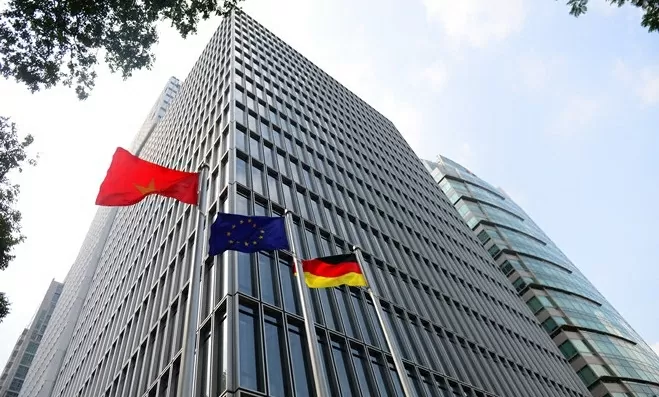 |
| The German House in Ho Chi Minh City. (Source: Zing) |
Overcoming differences to build trust
In difficult times, we adhere to the principle of "Unchanging principles to respond to all changes" to resolve issues, turning challenges into opportunities, "turning big problems into small ones, and small ones into none" as President Ho Chi Minh advised Vietnamese diplomacy. As I was directly involved in handling many "difficult cases" in Vietnam-Germany relations during this time, I have drawn a few valuable lessons for myself.
Firstly, persist in dialogue under all circumstances.
At the end of 1994, Prime Minister Helmut Kohl made his first official visit to Vietnam as the Prime Minister of reunified Germany. The issue of illegal residency and the activities of organized crime groups involving Vietnamese people were discussed at the highest level for the first time, alongside other important bilateral issues. Before the visit, the German delegation hinted that this was the biggest "obstacle" to clearing the relationship.
When accompanying German Ambassador Christian Kraemer to see off the delegation at Noi Bai Airport, the Ambassador whispered to me: "Prime Minister Kohl is very pleased with the meetings in Hanoi and even promised to return".
In early 1995, Prime Minister Kohl sent a delegation led by State Minister of the Chancellor's Office Schmidbauer and State Minister of the Foreign Office Hoyer to Hanoi to concretize previous agreements between the two Prime Ministers. The two State Ministers signed the "Hanoi Declaration" with Minister of the Government Office Le Xuan Chinh on January 6, 1995, whereby Vietnam would take back 40,000 Vietnamese nationals without legal residency status in Germany through direct negotiations between the two countries.
However, while the negotiation teams were exchanging, local foreigner offices in some places continued deportations without prior consultation or waiting for Vietnam to verify and issue travel documents, leaving hundreds of Vietnamese stranded in Hong Kong (China) or Bangkok (Thailand). This caused negotiations to stall and risked failing to implement the high-level agreement.
After the first round in Hanoi, the two sides agreed to meet again in Bonn (as the German Government had not yet moved to Berlin) and decided to elevate the heads of delegation to Deputy Foreign Minister and State Secretary of the Federal Ministry of the Interior. Between negotiation rounds, both sides maintained dialogue through their embassies.
For the "German House" project, which later became a "lighthouse project" in the Strategic Partnership, a similar situation occurred.
During Prime Minister Angela Merkel's visit to Vietnam from March 3-4, 2011, the two sides signed a "Joint Declaration" upgrading relations to a future-oriented Strategic Partnership and a government agreement on Germany leasing land in District 1 (old) Ho Chi Minh City, which was previously purchased from the Saigon government to build the "German House" (referred to as Agreement I). The design, construction, and operation of the German House would be negotiated and signed in a separate agreement (referred to as Agreement II).
In reality, reaching an agreement like Agreement I required very high political determination from both sides, and on Vietnam's side, decisions had to be made at the highest level. After the utmost efforts, the negotiators from both countries finally found an amicable solution that both sides agreed upon.
Negotiating Agreement II, which seemed simpler, revealed significant differences in opinions as they delved into specific technical issues. The most challenging was reconciling the privileges and immunities that the German state would enjoy as the lessee and owner of the German House with Vietnamese laws related to the business operations of this building, as well as international law on privileges and immunities for the part of the building used as the German Consulate General in Ho Chi Minh City.
Secondly, strive to listen and understand.
In every negotiation, each side pursues and defends its expectations and desires to the highest degree. The issue is that often the positions of the two sides are too far apart, and without finding a common voice, the desired results cannot be achieved, especially when each side insists on protecting its interests without considering the interests of the other side.
Regarding the issue of taking back those not granted residency by Germany.
After reunification in 1990, Germany faced numerous difficulties, including the residency issue of hundreds of thousands of foreigners who came to the GDR for work and those who entered Germany during the political upheaval years. The majority of asylum applications were rejected, leaving them in a precarious legal situation. Additionally, the activities of organized foreign crime groups destabilized society. We sympathize with their situation and put ourselves in their position to find common ground. Doing so also helps stabilize the Vietnamese community in Germany for residency and business.
Regarding the German House Project in Ho Chi Minh City, both sides wanted to build this house as a new symbol, a "lighthouse project" in the newly established Strategic Partnership. The German government entrusted the construction and operation of the building to a private investor, although the German government remains the owner in name. For private investors, their primary concern is the economic efficiency of using this 30-story office building to quickly recoup their investment and operate profitably.
On July 21, 1995, the Agreement on the Repatriation of Vietnamese Nationals Not Granted Residency by Germany was signed in Berlin between the Head of the Vietnamese Government Negotiation Team, Deputy Foreign Minister Nguyen Dy Nien (later Foreign Minister), and German Interior Minister Manfred Kanther.
Later, Germany consistently regarded this as the best agreement they had achieved with a foreign country, contributing to satisfactorily resolving a complex issue and opening up a trusting cooperative relationship between the two countries, even in areas considered extremely complex like crime prevention cooperation.
During the visit of our National Assembly's high-level delegation to Germany (March 12-14, 2013), on March 13, the Vietnamese Ambassador to Germany and the State Minister of the German Foreign Office signed the Agreement on the Design, Construction, and Operation of the German House (Agreement II) with the witness of National Assembly Chairman Nguyen Sinh Hung and Foreign Minister Westerwelle.
Later, we, the Vietnamese negotiators, and the German negotiators truly became trusted friends. Personally, I always remember the time spent at the negotiation table or having private, trusted exchanges with Dr. Lenguth, Director General of the German Ministry of the Interior, Dr. Böse, State Secretary of the Berlin Ministry of the Interior, later Minister of the Interior of Schwesig-Holstein, and Ms. Rogall-Grothe, Director General, later State Secretary of the Federal Ministry of the Interior, or Dr. Freiherr von Werthen, Director General of the German Foreign Office and later German Ambassador to Japan.
Building new pillars for future cooperation
The Vietnam-Germany friendship has passed through a dynamic half-century and is beginning to transition into a new phase of development.
There is a saying "At fifty, one knows the mandate of heaven", meaning at 50, one understands destiny. Broadly speaking, in international relations, partners need to understand and grasp the trends of the times to take timely steps, bringing the relationship to even greater heights.
So what is the "mandate of heaven" for the upcoming period in Vietnam-Germany cooperation?
Over the past 50 years, especially 15 years of Strategic Partnership, the two countries have become trusted friends and leading economic and trade partners in the region. However, there is still much untapped potential to create new momentum for development.
Vietnam is one of the countries with the largest German-speaking community in the region, with hundreds of thousands of people living, working, and integrating well in Germany, along with the second and third generations becoming a positive part of Germany's multicultural society.
In Vietnam, many generations of Vietnamese have studied, worked, and bonded with Germany, considering it their second home. They are the bridge and also the driving force for bilateral relations.
Germany is renowned for its basic university education and dual vocational training system, with outstanding benefits (such as tuition, living expenses...). The German people highly value Vietnamese people for qualities they consider gradually disappearing even in Germany, such as diligence, hard work, dexterity, and eagerness to learn.
Recently, learning the language to study at German universities, vocational training, or work has become a trend, especially as traditional English-speaking destinations face many obstacles.
However, the key issue is that learning German in Vietnam is not simple, even at major universities or language centers in Hanoi or Ho Chi Minh City. Previously, both sides had the intention of making German one of the main foreign languages taught in Vietnamese schools, but the project failed due to a lack of teachers.
Vietnam-Germany cooperation in education and training has a long-standing tradition, but why has it not yet made a breakthrough? Why hasn't the Vietnamese-German University (VGU), one of the "lighthouse projects" of the Strategic Partnership, become an outstanding training and research institution in the region and the world, with German as the language of instruction and study?
Our people have a tradition of valuing education. President Ho Chi Minh once said, "For the benefit of ten years, plant trees; for the benefit of a hundred years, cultivate people". The coming era is the development era of Vietnam. We consider science, technology, education, and training as the keys to success and have made proficiency in English a mandatory requirement to become a global citizen in education at all levels.
Additionally, teaching and popularizing certain important world languages will undoubtedly supplement new development momentum. German, with over 100 million people worldwide using it as their mother tongue (Germany, Austria, and Switzerland), needs more investment and attention in Vietnam, serving as a foundation for cooperation in education, training, vocational training, and high-quality labor. Germany can contribute much more to this issue.
The "vigorous middle age" of this relationship will surely yield new fruits if we "know the time, know the situation, know ourselves, and know others".
That is also understanding the mandate of heaven!
| Ambassador Nguyen Huu Trang is Vice President of the Vietnam-Germany Friendship Association, former Director General of the Consular Department, Ministry of Foreign Affairs; former Head of the negotiation team for the Repatriation Agreement and Protocol on Crime Prevention Cooperation (1995), former Head of the negotiation team for Agreement II on the German House. |