





National Book Awards 2026: When history steps out of the pages
WVR - This year's National Book Awards made a special impression when the A Prize was awarded to "Lich su Viet Nam bang hinh" (Vietnamese History in Pictures) by artist Tran Dai Thang, Dong A Book Company, and various authors, and "Lịch sử văn minh thế giới" (The Story of Civilization) by Will and Ariel Durant and numerous translators.
Latest
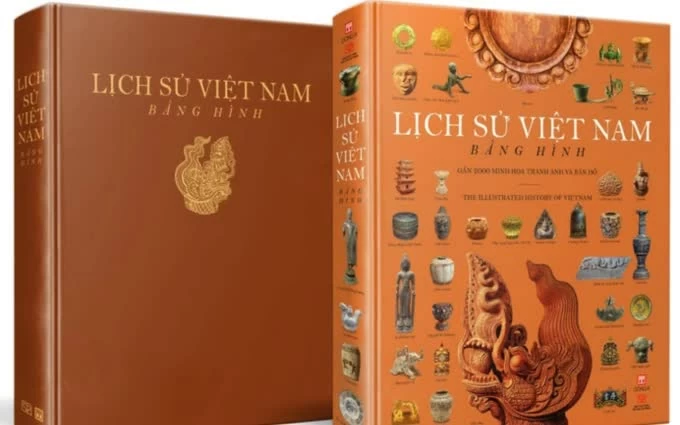 |
| "Lich su Viet Nam bang hinh" stands out with its approach of depicting history through images. (Source: Dong A) |
One book takes readers back to national history with vivid images; the other offers a panoramic view of the history of human civilization. Together, these works create an engaging dialogue between national and world history, between a nation's memory and humanity's journey.
The uniqueness of Lich su Viet Nam bang hinh lies in its approach of illustrating history through images. For a long time, popularizing Vietnamese history, especially among the younger generation, has faced challenges due to the gap between academic knowledge and reading experience. Many events, dynasties, and figures are often presented in dry academic language, making history more of a "subject to memorize" than a story to explore.
With a system of illustrations, maps, visual documents, and modern presentation, the book offers a different approach. History is no longer a series of disjointed timelines but becomes a visual journey where readers can "see" the past. Events and life across dynasties appear more vivid, making history more relatable, easier to absorb, and sparking curiosity.
From a broader perspective, the book reflects an encouraging trend in the Vietnamese publishing industry to bring history back to the public through creative forms. As the younger generation becomes more accustomed to the visual culture of the digital age, telling historical stories through illustrations, graphics, or new presentations is not just an aesthetic choice but a cultural strategy, helping history step out of the classroom and become part of the reading life.
If Lich su Viet Nam bang hinh is a journey back to national roots, then Lich su van minh the gioi opens up a vast picture of humanity. The series consists of 11 parts, 45 volumes, each part comprising three to five books, with translations by many translators such as Huynh Ngoc Chien, Phan Thanh Luu, Pham Viem Phuong, Bui Thanh Chau, Bui Xuan Linh, and Do Lan.
Written over several decades, this monumental series is considered one of the major historical-philosophical works of the 20th century. It not only recounts events but also explains how civilizations formed, developed, and interacted with each other.
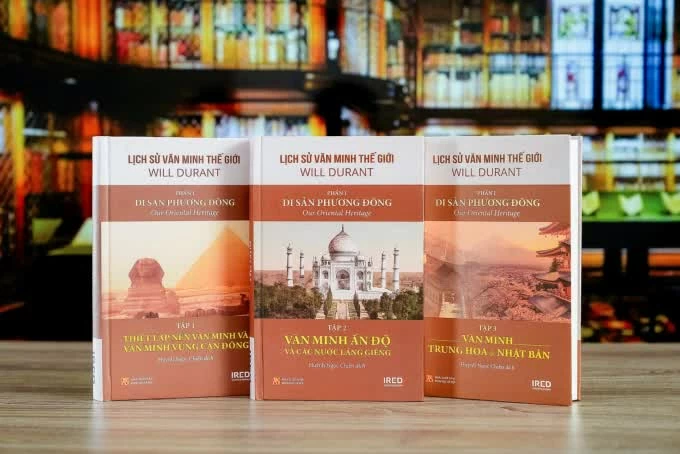 |
| The series "Lich su van minh the gioi" is published by the Social Sciences Publishing House and IRED Institute of Education. (Source: IRED) |
The translation and complete publication of the series in Vietnamese hold special significance. This is not only a commendable effort by the translators but also an important contribution to the intellectual life of the country. In the context of globalization, accessing classic academic works helps broaden perspectives, allowing Vietnamese readers to place national history in relation to world history.
Notably, the awarding of the highest prizes to these two historical works at the 8th National Book Awards also conveys a thought-provoking message: history is not just a story of the past but a shared memory of the community, a foundation for understanding where we come from and where we are headed.
The growing interest in historical works, books on civilization, or works that recreate the past indicates that reading culture is gradually returning to sustainable values. When the past is told through more dynamic approaches, history has the opportunity to come closer to modern life and become an inspiration for thinking about the future.