 |
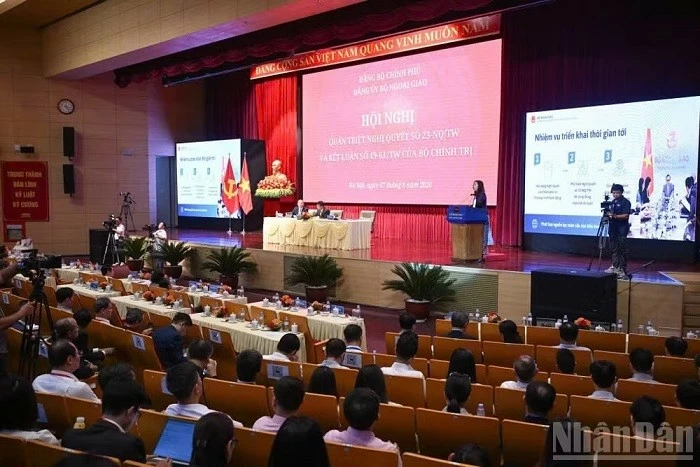
| The Ministry of Foreign Affairs organized a conference to thoroughly grasp Resolution No. 23-NQ/TW and Conclusion No. 49-KL/TW of the Politburo on August 7. (Source: Nhan Dan) |
In early August, two events occurred within the same policy stream, attracting the attention of the overseas Vietnamese community: the 33rd Diplomatic Conference held in Hanoi from August 1–7 with the theme “Promoting the pioneering role and fulfilling the essential, regular tasks of Vietnam's foreign affairs in the new era”; and on August 2, the Politburo issued Resolution No. 23-NQ/TW on the work of overseas Vietnamese. The resolution was thoroughly grasped and implemented within the framework of the 33rd Diplomatic Conference on August 7.
Placing these two milestones side by side, the noteworthy aspect is not only the specific tasks of the Foreign Affairs sector or policies for overseas Vietnamese. More thought-provoking is the increasingly clear perspective on the country's foreign affairs resources: this strength is not only created by representative agencies, international agreements, or official diplomatic activities but also by the Vietnamese community living, studying, working, and integrating in countries around the world.
For the Vietnamese community in Europe, this is a meaningful change. After decades of integration, Vietnamese people not only live in the host society but have become a part of it. They have careers, social positions, networks, and communication spaces through which Vietnam naturally presents itself in European life.
From natural "bridges"
In Europe, Vietnamese people are present in many fields: business, science, healthcare, education, arts, services, and social life. Along with this are thousands of restaurants, shops, and small businesses bringing Vietnamese products, dishes, and stories into everyday life.
A Vietnamese restaurant can be where a European first learns about pho. A community festival can help a city better understand Vietnamese Tet. A Vietnamese entrepreneur can open up a new trade relationship. A scientist can create additional research collaboration. A young Vietnamese person can introduce the Vietnamese language and culture to peers.
These activities are often viewed as individual contributions. But from a foreign affairs perspective, they can be seen as links in a social network connecting Vietnam with the world. This approach aligns with the new perspective expressed in Resolution 23-NQ/TW. The resolution identifies overseas Vietnamese as an inseparable part of the Vietnamese ethnic community, as one of the important strategic resources, as a bridge between Vietnam and the world, accompanying and directly participating in the cause of building, developing, and defending the homeland.
From a European perspective, the most notable point lies in the term "resource". A resource only truly becomes a strength when it is connected, organized, and facilitated to thrive.
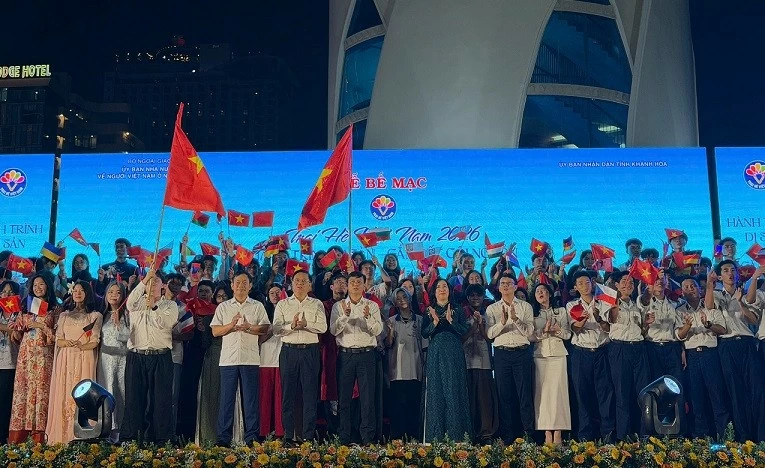 |
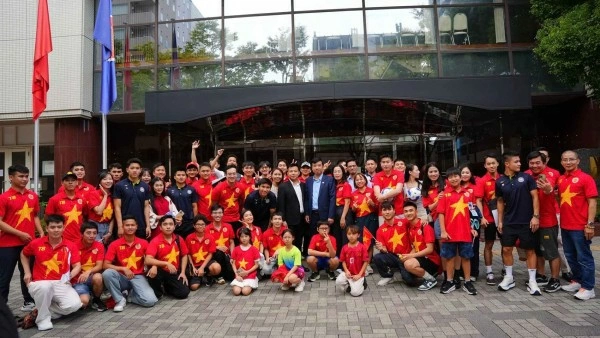
| Vietnam Summer Camp 2026. (Photo: Thanh Long) |
Cultural diplomacy does not only occur in meeting rooms
From Europe, the power of culture in building a national image is quite evident.
One may not know much about a country, but they might know it through its food, music, cinema, fashion, language, or everyday stories. Pho is an example.
In recent years, in many European cities, the Vietnamese community and various associations have organized numerous activities to introduce Vietnamese cuisine and culture. Pho Cultural Roadshow Europe 2026 is a recent example: when the community, artisans, businesses, associations, and representative agencies participate together, a dish can become the starting point for broader encounters about culture, people, and the country.
The important thing is not just how many more people know about pho, but how Vietnam is perceived. A dish introduced merely as a consumer product will create a different experience than one placed within the story of the land, ingredients, cooking techniques, and Vietnamese life.
This is also the gap between promoting a product and building soft power.
When a bowl of pho is elevated to cultural status
The story of Vietnamese cuisine in Europe also shows a notable change in the market. Two or three decades ago, when many Vietnamese restaurants began to form, the diners' needs were relatively simple: a delicious meal, filling, and affordable.
Today, diners still want delicious food, but they are increasingly interested in the experience. Where does the dish come from? What are the ingredients? Why do Vietnamese people cook it that way? What land, customs, or stories are associated with the dish?
Diners are not just looking for a meal. They want to understand more about what they are eating and sometimes want to take home a memory. This is an opportunity for Vietnamese cuisine to be elevated in Europe. Behind a Vietnamese dish is an entire cultural space: the land, climate, ingredients, cooking techniques, family customs, and community history.
Thus, a bowl of pho can simply be a dish. But it can also be a very natural way to begin telling the story of Vietnam.
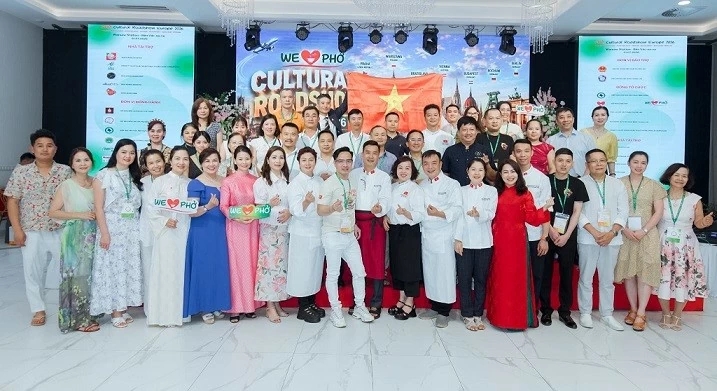 |
| Pho Cultural Roadshow Europe 2026 in Warsaw, Poland on July 1. |
The Vietnamese closest to the European public
There is an advantage of the Vietnamese community in Europe that is sometimes not fully recognized: the ability to directly interact with the host society.
Those working in restaurants, services, and businesses directly with customers are the group that frequently meets the local public the most. A doctor may see many patients each day. An engineer works with international colleagues. A businessperson meets partners in meetings. But a restaurant owner, chef, or server may talk to dozens, even hundreds of European diners every day.
Very ordinary questions like “What makes this pho special?”, “Why eat it with these herbs?”, “How is the broth cooked?” open up natural cultural exchanges.
Therefore, improving the quality of Vietnamese restaurants is not just a matter of the culinary industry. It is also a way to enhance the quality of interactions between Vietnamese culture and the host society.
From restaurants to "Cultural touchpoints"
From this reality, one can envision a simple direction where each Vietnamese restaurant becomes a cultural touchpoint. It is not necessary to turn the restaurant into a cultural center. Sometimes, it is enough for the food to be made correctly and tastier; the menu to tell a better story; the server to explain the dish to customers; the restaurant space to have small corners to help diners experience and understand more about Vietnam.
A regional dish introduction, a conversation with an artisan, a pho experience activity, or simply a few minutes of the chef telling customers the story of the dish can create a different experience. From a meal, a guest can learn something new about Vietnam.
Cultural diplomacy, in that sense, does not necessarily have to start from a major event. It can occur in small, frequent, and close interactions.
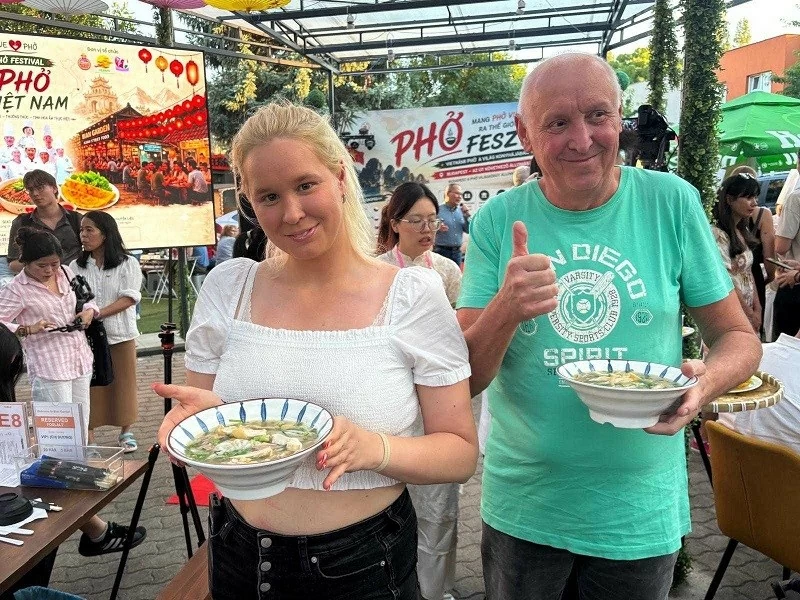 |
| International guests enjoying pho in Budapest, Hungary on July 10. |
From a journey to a network
If Pho Cultural Roadshow Europe 2026 demonstrates the power of a journey connecting communities, artisans, businesses, and representative agencies across many cities, then Pho Week Europe 2026 opens up a different approach. The program was announced to launch in Berlin on July 15, 2026, at the end of the Roadshow journey. Scheduled from December 7–13, 2026, in response to Pho Day on December 12, the program is built on a decentralized model, with activities taking place at Vietnamese restaurants and business locations in many European countries.
The noteworthy point is this model. It is not necessary to bring all activities to a central stage. The existing spaces within the community – restaurants, business establishments, activity locations – can simultaneously become places to introduce Vietnamese culture. One place organizes a pho experience. Another introduces regional dishes. Another invites chefs to interact. Another tells the story of ingredients. Another simply focuses on making a really delicious bowl of pho.
Each point is a small space. But when many points connect, they can create a large cultural space. From this perspective, the network of Vietnamese restaurants in Europe is not just a business network. It can also become a cultural connection network in everyday life.
From "Being mobilized" to "Being given space to contribute"
From a European perspective, one of the notable new points of Resolution 23 lies in the approach to overseas Vietnamese resources.
The resolution emphasizes the need to elevate thinking from "mobilizing, gathering, caring" to "accompanying, creating mechanisms, mobilizing overseas Vietnamese resources to participate more deeply" in the process of integration, building, and developing the country. At the same time, the resolution highlights the role of overseas Vietnamese as "cultural ambassadors, representing the country and people of Vietnam".
This raises a practical question: how can the existing resources in the community have more space to thrive?
The Vietnamese community in Europe already has social networks, local knowledge, language skills, integration experience, and extensive relationships with the host society. The issue is not to create a new community but to better connect the existing resources.
From this perspective, overseas Vietnamese are not just subjects of policy but increasingly can become participants in creating foreign affairs values. A doctor contributes with expertise. A businessperson with a business network. A scientist with knowledge. An artist with creativity. A chef with culinary culture. A young person with the ability to connect two generations and two cultures.
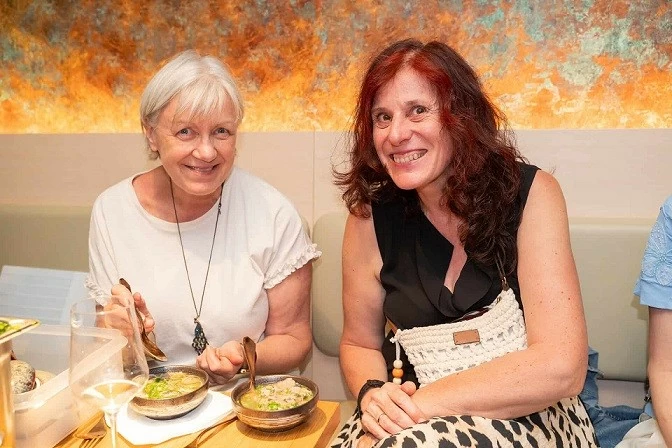 |
| International diners enjoying pho at the Pho Roadshow Europe 2026. (Source: society.at) |
A part of the new foreign affairs infrastructure
One can envision Vietnam's foreign affairs infrastructure in the new era not only comprising the system of representative agencies and official institutions. It is also created from the social networks that Vietnamese people have built globally. An association can be a connection point. A business is an economic gateway. A school is a space for knowledge exchange. An artisan is a cultural storyteller. A Vietnamese restaurant is a place for the public to encounter Vietnamese culture.
This is not about turning every Vietnamese person into a diplomat. On the contrary, the strength lies in each person contributing from their position and capability. In this sense, "foreign affairs infrastructure" is not only built by institutions. It is also formed from trust, social relationships, knowledge, reputation, and the presence of Vietnamese people in international life.
When these resources are connected with each other and more effectively with Vietnamese Representative Missions abroad, they can create a network that no single institution can replace.
Overseas Vietnamese have often been referred to as "bridges" between Vietnam and the world. But a bridge is just a point on a journey. When these bridges are connected into a network, they can create a new social infrastructure – where Vietnam is present in international life through the knowledge, reputation, culture, and relationships that the community has built.
This is perhaps a practical way for the spirit of Resolution 23-NQ/TW and the orientations of the 33rd Diplomatic Conference to enter life: not only for overseas Vietnamese to look towards Vietnam but to step out into the world with Vietnam.
| Author Mai Hai Lam, born in 1972, is a Vietnamese entrepreneur, educator, and cultural activist in Poland, with over 30 years of studying, living, and working in Poland. The author has many activities in the field of Vietnamese language education, building the Vietnamese community, connecting businesses, and promoting Vietnamese culture and cuisine internationally. 2023 - present: The author is the founder and President of We Love Pho (AISBL) – an international non-profit organization based in Brussels, Belgium, operating in the field of promoting Vietnamese culinary culture, especially Pho; connecting communities and promoting Vietnamese cultural exchanges with the international community. As President of We Love Pho, the author organizes and develops many programs to promote Pho and Vietnamese culinary culture in Europe, connecting artisans, chefs, businesses, restaurants, and the Vietnamese community in many countries. In December 2025, the author won Third Prize – National Award for External Information, Initiative category. |