


33rd Diplomatic Conference: Overseas Vietnamese contribute to Vietnam's diplomacy
WVR - The Vietnamese community abroad places high hopes on the new directions of the 33rd Diplomatic Conference, emphasizing the pioneering role and crucial, regular tasks of Vietnam's foreign affairs in the new era.
Latest
Insights from experts, association leaders, and the younger generation of overseas Vietnamese shared with the World and Vietnam Report reflect confidence that the Diplomatic sector will continue to innovate, modernize, and strongly connect with the resources of the overseas Vietnamese community.
Leveraging national soft power
Pham Khanh Nam, Editor-in-Chief of Huong Viet Magazine in Germany, stressed that in the context of digital transformation and deepening international integration, the need to innovate external information work and leverage national soft power is increasingly evident. From this reality, further perfecting coordination mechanisms between the Ministry of Foreign Affairs, Vietnamese Representative Missions abroad, and associations, businesses, media agencies, and organizations of overseas Vietnamese holds significant importance.
“Encouraging initiatives in cultural diplomacy, business connectivity, educational cooperation, science and technology, and digital transformation in foreign affairs will help expand cooperation space, strengthen ties between the Vietnamese community and their homeland, and enhance the effectiveness of national image promotion,” Nam emphasized.
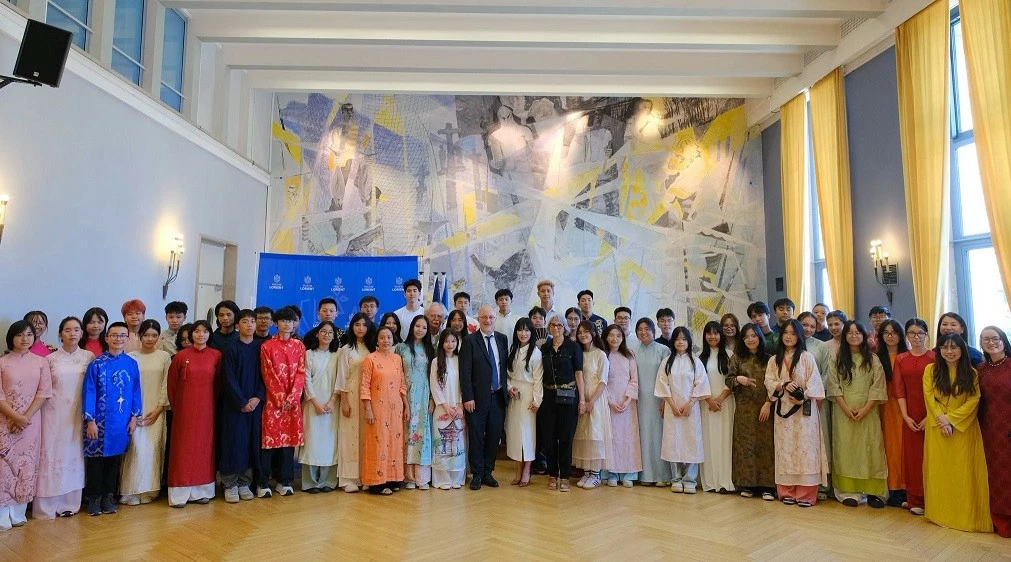 |
| Vietnamese cultural promotion activities in France always receive the support of the Vietnamese community and international friends. (Source: Vietnamese Embassy in France) |
Hoang Thu Trang, President and co-founder of the ART SPACE Association in France, also expressed hope that the 33rd Diplomatic Conference will continue to affirm culture as a crucial pillar of Vietnam's foreign affairs in the new era.
After nearly 20 years of living and working in Europe, she observes that Vietnam's image today garners much interest and goodwill from international friends. However, for culture to truly become a national soft power, more investment is needed in modern, creative cultural stories that can resonate with a global audience.
“I hope the Diplomatic sector will continue to facilitate community organizations, artists, filmmakers, content creators, and especially the younger generation of overseas Vietnamese to participate more in promoting the country's image. In the digital age, every young person can become a 'cultural ambassador' if given the right opportunities and connections.”
From her experience organizing festivals, exhibitions, and film and art projects in many European countries, Trang notes that international friends not only want to know what Vietnam has but also want to understand who the Vietnamese are, especially the younger generation, how we live, create, and contribute to the world. Therefore, she believes cultural diplomacy in the new phase should shift from introducing culture to telling Vietnamese stories in a global, youthful, and creative language.
She shares: “As an overseas Vietnamese, a mother of children born and raised in France, and a cultural worker, I wish to continue accompanying foreign affairs agencies to build sustainable bridges between Vietnam and the world, while inspiring the young Vietnamese generation to preserve their identity, be proud of their roots, and actively spread Vietnam's good values internationally.”
Shared aspiration to contribute
Following information about the 33rd Diplomatic Conference, Ngo Van Tai, Secretary of the Vietnamese Student Branch in Thailand and Vice President of the Vietnamese Student Association in Thailand, believes this is not only an important event for the Diplomatic sector but also meaningful for the Vietnamese community studying and working abroad. According to him, the achievements of foreign affairs in recent times have opened many opportunities for the younger generation to enhance learning, connect, and contribute practically to the country's development.
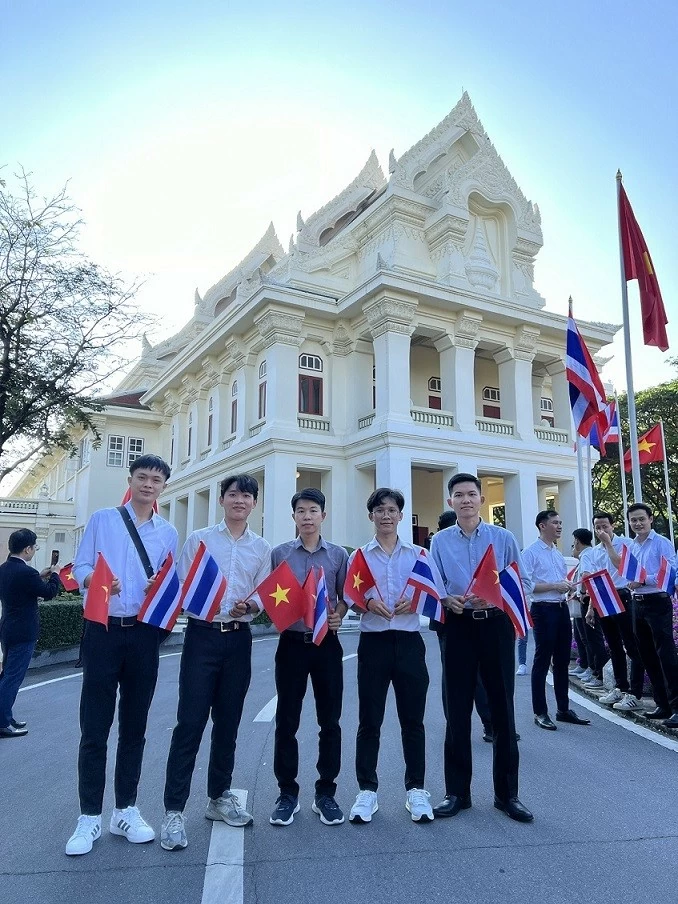 |
| Vietnamese students in Thailand participate in friendship exchange activities between the two countries. (Photo: Courtesy by author) |
“Previously, I often thought diplomacy was mainly associated with high-level visits or negotiations between countries. Only when studying and researching abroad did I realize more clearly that foreign affairs are present in very close aspects, from favorable conditions for study and research, opportunities to collaborate with international colleagues, to the pride of introducing oneself as Vietnamese and always receiving interest and goodwill from international friends,” Tai shared.
Especially during his doctoral studies and now as a postdoctoral researcher in Thailand, he has had the opportunity to work with many international colleagues. According to him, many scientific exchanges often start with stories about Vietnam. What excites him is that more and more international friends know about Vietnam not only through culture and cuisine but also show interest in education, science, innovation, and cooperation potential.
“Through these conversations, I realized that every Vietnamese abroad can contribute to spreading the country's image through seriousness in study, responsibility in work, and daily interactions,” he shared.
As a young scientist in Thailand, he hopes the Diplomatic sector will continue to play a bridging role, creating more mechanisms for the Vietnamese intellectual community abroad to connect with domestic universities, research institutes, and businesses, thereby bringing knowledge, experience, and international cooperation networks to serve the country's development.
He affirmed: “I believe many young Vietnamese abroad always wish to contribute to their homeland with their expertise. For us, love for the country is not only expressed when returning but also in the effort to study, work responsibly, and contribute to spreading Vietnam's image in the host country. I hope the Diplomatic sector will continue to accompany us so that this aspiration to contribute has more opportunities to be realized.”
Mobilizing the strength of Overseas Vietnamese
According to Le Thuong, Vice President of the Union of Vietnamese Associations in Japan, the Diplomatic sector needs to continue to be a bridge, listening and creating conditions for intellectuals, entrepreneurs, and the younger generation of overseas Vietnamese to contribute more in education, science and technology, innovation, and people-to-people exchanges.
From her practical activities in Japan, she believes that people-to-people diplomacy and cultural, educational exchange activities play an important role in fostering understanding and trust between peoples of different countries. “We overseas Vietnamese always wish to become voluntary 'cultural ambassadors', contributing to spreading the image of a peaceful, dynamic, integrated, and rich-in-identity Vietnam to international friends,” she shared.
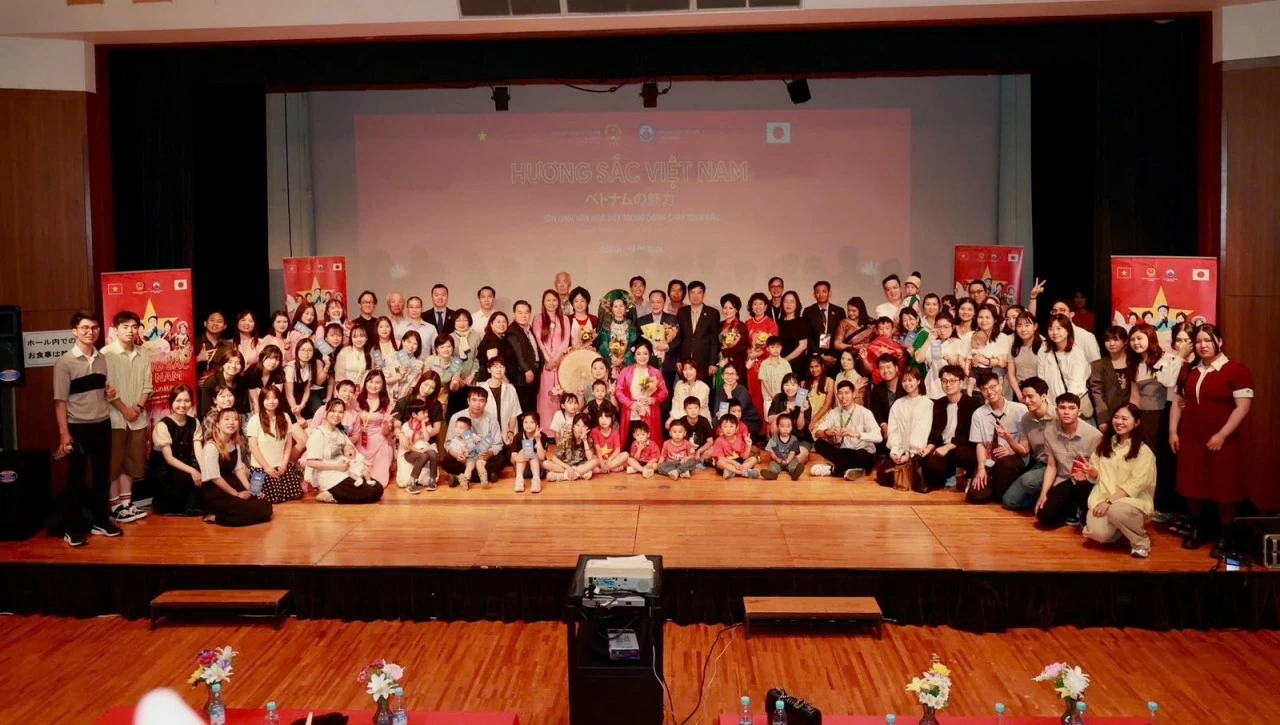 |
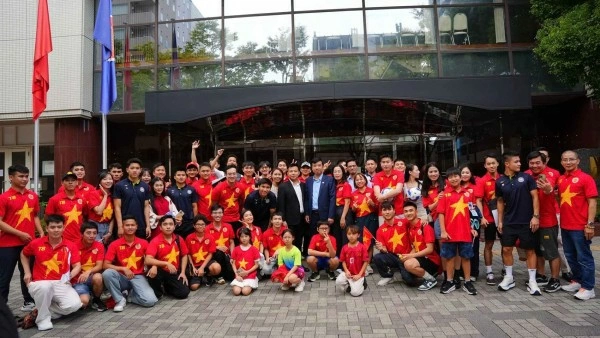
| Delegates, artists, and the Vietnamese community take a souvenir photo at the "Huong Sac Vietnam" Program in Higashi Osaka, Japan. (Photo: Courtesy by author) |
Sharing the same view, Dr. Tran Hai Linh, Member of the Central Committee of the Vietnam Fatherland Front, President of the Vietnam-Korea Business and Investment Association (VKBIA), and Founding President of the Vietnam-Korea Experts and Intellectuals Association (VKEIA), also believes that in the new era, the Diplomatic sector needs to continue affirming its role as a creator, becoming a strategic bridge to gather the strength of over 6 million overseas Vietnamese.
According to him, when effective connection mechanisms are established, each overseas Vietnamese can become a 'people's ambassador', each entrepreneur a bridge for investment, each scientist a nucleus for innovation, thereby multiplying the strength of foreign affairs, contributing practically to the country's development and enhancing Vietnam's position on the international stage.
It is evident that entering a new era, the requirement for the Diplomatic sector is not only to expand foreign relations but also to effectively play the role of connecting resources for national development. The expectations of overseas Vietnamese are the companionship and trust placed in the Diplomatic sector to continue strengthening the great national unity bloc, bringing the overseas Vietnamese community closer and contributing more practically to their homeland.