



Over 100 students contribute creative ideas for Hanoi's traditional craft villages
WVR - After nearly two weeks, the Summer Design Workshop "Re 2026 - Revitalizing Craft Villages" concluded with an awards ceremony at Hanoi Architectural University. The program gathered over 100 students from 11 universities, bringing numerous creative ideas to help preserve and promote the values of the capital's traditional craft villages.
Latest
On July 13, the closing and awards ceremony of the Summer Camp "Re 2026 - Revitalizing Craft Villages" took place at Hanoi Architectural University. The program is part of the Hanoi Creative Design Festival 2026, with the support of UNESCO, UN-Habitat, and numerous businesses and craft artisans.
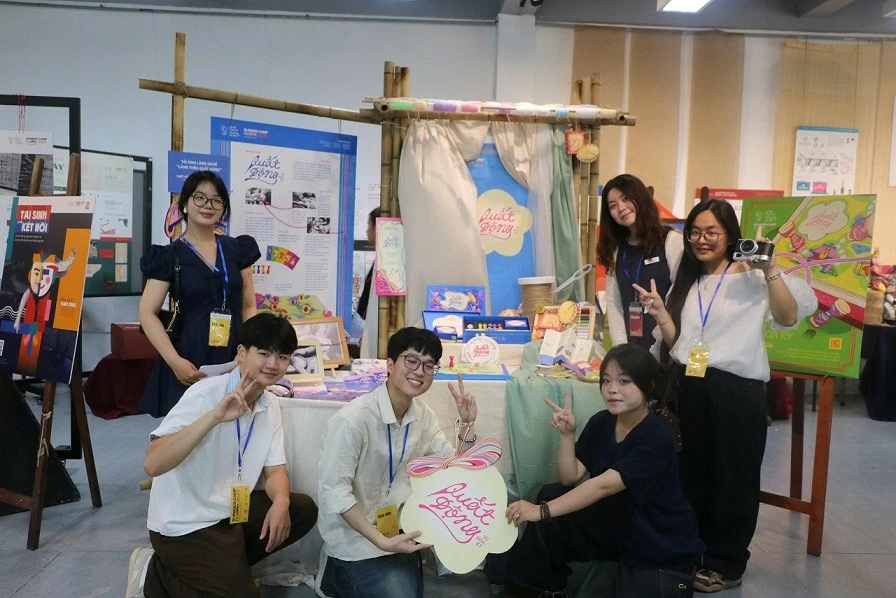 |
| Students at the creative space of Quat Dong embroidery village. (Photo: Duong Nguyen) |
This year's Summer Camp attracted over 100 students from 11 universities in Hanoi and the northern region.
The teams were organized in an interdisciplinary model, combining fields such as design, architecture, fine arts, culture, media, and creative economy to research and propose development solutions for five traditional craft villages in Hanoi: Ha Thai lacquer, Kim Lan ceramics, Dao Thuc water puppetry, Phu Vinh bamboo and rattan weaving, and Quat Dong embroidery.
A highlight of the program was that students not only worked in the design workshop but also visited the craft villages for field surveys, met artisans, and learned about production processes, cultural life, and the unique values of each locality.
Based on this, the groups identified the "design DNA" of each craft village, from materials, colors, patterns, techniques to cultural stories, to develop ideas with a contemporary touch.
In addition to designing products under the "Re" theme, the groups also developed brand positioning (Re), proposed application and commercialization possibilities (Re), and created digital media products (Re) to promote the craft villages' images to a wider audience.
Notably, the "Re" category brought many short videos telling the stories of the craft villages on digital platforms. Media products about Kim Lan ceramics, Quat Dong embroidery, Ha Thai lacquer, Phu Vinh bamboo and rattan weaving, and Dao Thuc water puppetry attracted over 310,000 views and more than 10,000 interactions, contributing to spreading traditional cultural values through a new approach by the youth.
Evaluating the quality of the proposals, Ms. Bui Thi Thanh Huong, Editor-in-Chief of Architecture Magazine, stated that the expert council did not view these merely as exercises within the workshop framework but as proposals with potential for further development and real-world implementation.
According to her, the Summer Camp was designed as an "open creative workshop," where artisans, designers, lecturers, and students could research, dialogue, and co-create.
This model contributes to realizing Hanoi's commitment in UNESCO's Creative Cities Network, while also enhancing the connection between cultural heritage, creative industries, and the knowledge economy.
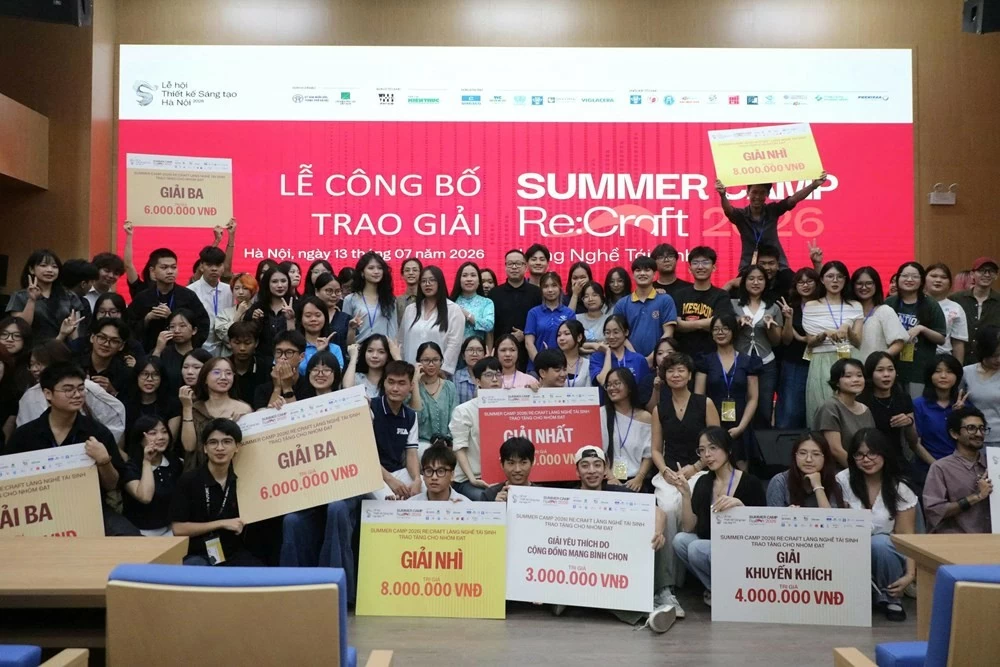 |
| The organizers award groups with outstanding proposals. (Photo: Duong Nguyen) |
At the closing ceremony, the organizers awarded groups with outstanding proposals, recognizing notable ideas for their applicability, cultural value, and communication effectiveness.
According to the organizers, the exemplary products and proposals will continue to be refined for presentation at the Hanoi Creative Design Festival 2026, creating opportunities to connect with businesses, investment funds, and international cultural organizations, contributing to bringing young people's creative ideas into practice, breathing new life into the capital's traditional craft villages.