



Greening industrial zones: A boost for Vietnam's next growth chapter
WVR - Greening industrial parks is a strategic investment in Vietnam’s long-term competitiveness. As the country works toward its net zero 2050 target, these same parks will shape how growth and sustainability come together.
Latest
 |
| Minh Nguyen, Vietnam Country Manager, The Global Energy Alliance for People and Planet. (Source: GEAPP) |
Vietnam’s industrial parks have long powered the country’s economic rise. With about 400 zones nationwide, 290 of which are already operational, they provide jobs, attract investment, and anchor Vietnam’s position as a regional manufacturing hub. Greening these industrial parks is a strategic investment in Vietnam’s long-term competitiveness. As the country works toward its net zero 2050 target, these same parks will shape how growth and sustainability come together. Their transformation is essential to maintaining Vietnam’s position as a dynamic and future-ready economy.
The government has steadily strengthened the policy framework guiding this transition. The Power Development Plan VIII charts the path for renewable integration and energy security. Decree 35/2022, building on Decree 82/2018, advances Vietnam’s approach to industrial park development through updated models such as eco-industrial parks, supporting-industry parks, and high-tech zones. It streamlines planning and approval processes under the 2017 Planning Law, helping investors move faster while improving transparency. A national information system for industrial parks now supports more consistent data sharing and coordination across regions. Together with the Vietnam Green Growth Strategy, these evolving frameworks show how Vietnam continues to align industrial modernization with sustainable growth.
Across global markets, supply chains are transforming. Manufacturers are adopting sustainability standards to remain competitive. For Vietnam, this shift is an opportunity. Greening industrial parks strengthens export potential, attracts quality investment, and future-proofs industries. Clean energy, storage, and efficiency measures reduce costs and improve reliability. These actions reinforce ASEAN’s renewable-energy goals and the objectives of PDP8, linking clean power to continued economic growth.
Partnerships driving transformation
Industrial parks depend on stable and affordable energy. Integrating renewables into these systems requires coordination, investment, and technical innovation. No single actor can address these challenges alone. When government, industry, financiers, and technical experts work together, progress becomes practical and scalable.
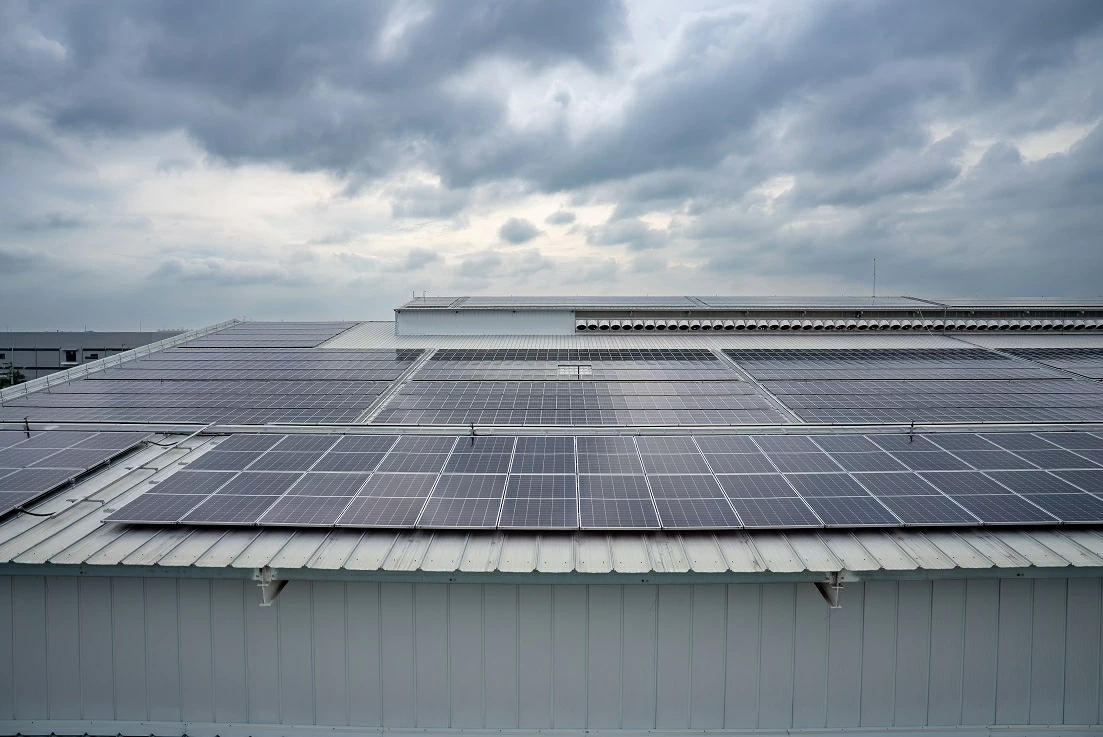 |
| Rooftop solar power system at a factory in Hoa Phu Industrial Park, Bac Giang. (Source: GEAPP) |
A recent feasibility study at the Regina Miracle factory in VSIP Hai Phong, which was carried out with technical support from RCEE-NIRAS and in coordination with park authorities, energy planners, and industry partners, offers early evidence of how clean-power solutions can take shape inside industrial zones. The analysis shows that the factory’s 3.3-megawatt rooftop solar system already supplies a meaningful share of its energy demand and still manages to produce surplus electricity during weekends and low-load periods.
The study assessed how a 1,013 kW / 2,345 kWh battery energy storage system could store this unused solar output, reduce peak-hour dependence on the grid, limit curtailment, and improve cost stability under Vietnam’s time-of-use tariff structure. Using modeling tools such as REopt and the System Advisor Model, the findings demonstrate how well-designed BESS configurations can support load-shifting, enhance solar utilization, and provide resilience during grid fluctuations.
This work is generating practical insights that inform Vietnam’s broader industrial-sector transition. The collaboration among technical specialists, regulators, the industrial park operator, and the Alliance creates shared reference points on performance, investment needs, and operational requirements. These lessons are helping shape regulatory discussions and providing a development pathway that other industrial zones can adapt as they explore their own clean-energy options.
Partnerships like these connect policy direction with real-world implementation. Public institutions set standards and incentives for cleaner production. Financial partners design blended capital models that reduce risk and attract investment. Industrial operators apply technology, share insights, and inform future regulation. Together, they turn government ambition into measurable results.
This shift is as much about people as it is about technology. Workers are developing new skills in energy management and automation. Communities are benefiting from cleaner air and more reliable electricity. Local suppliers are entering a growing market for sustainable products and services. When government, business, and development organizations work side by side, the benefits reach far beyond the factory gates.
Scaling success and the road ahead
Vietnam is demonstrating that growth and decarbonization can progress together. Clear policies, new financing pathways, and knowledge exchange are driving momentum across the country. The Ministry of Planning and Investment and the Vietnam Industrial Park Authorities are piloting eco-industrial parks in Ninh Binh and Can Tho, where clean energy and resource efficiency are already integrated into operations—proof that clear direction and coordination accelerate transformation.
Through programs such as Enhancing Access to Battery Energy Storage for Low-carbon Economies (ENABLE), concessional and private capital are being mobilized to support renewable integration and storage. ESG-linked funds and blended finance models are adding further momentum, encouraging investment in rooftop solar, efficiency upgrades, and sustainable infrastructure. Initiatives like the Vietnam Industrial Energy Efficiency Program and projects supported by the United Nations Industrial Development Organization are equipping parks with tools to measure, improve, and replicate performance nationwide.
When policy, finance, and knowledge move in sync, progress scales faster. This alignment between government vision, private innovation, and technical expertise is shaping a cleaner and more competitive industrial future for Vietnam. The country’s low-carbon transition is well underway, and the next phase is about scale, turning pilots into national models and ambition into lasting value.
Greening industrial parks lies at the heart of this journey. It fuels innovation, supports communities, and strengthens Vietnam’s leadership in sustainable development. With steady collaboration and shared purpose, Vietnam’s industrial parks can stand as models of growth that are both dynamic and sustainable—proof that economic strength and environmental responsibility can advance together.