



FIATA World Congress 2025: Innovation and digital transformation reshaping green logistics
At FIATA World Congress 2025 (FWC 2025), leading experts in the logistics industry shared insights on how technology, data, and innovation are reshaping the future of the industry in the new context.
Latest
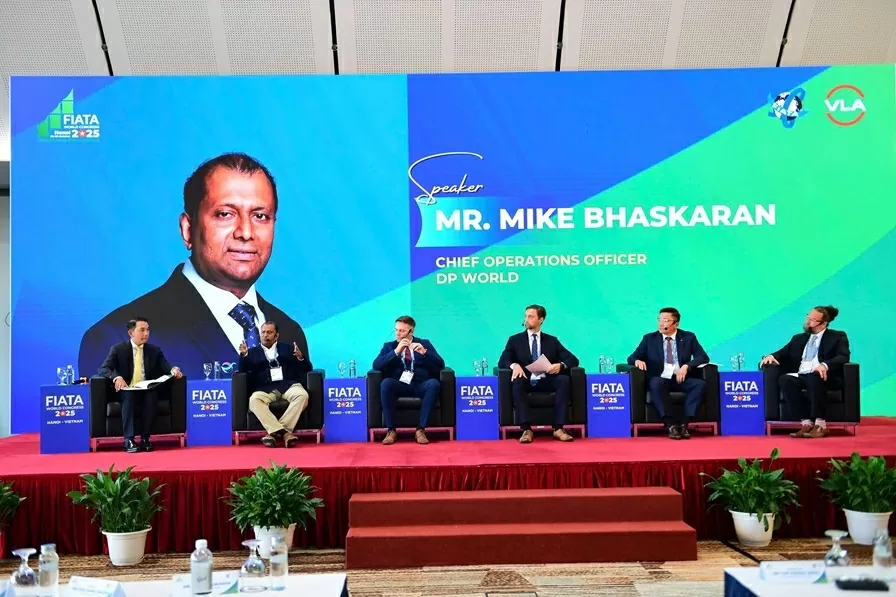 |
| Mr. Mike Bhaskaran, Chief Operating Officer (COO) of DP World, emphasised the role of AI and automation in optimising port operations – a crucial link in the global logistics chain. (Photo: FIATA World Congress 2025) |
The global supply chain is being reshaped
Opening the discussion session on the topic “Digital transformation and innovation – Breakthroughs in developing green and sustainable logistics”, Mr. Yap Kwong Weng, CEO of Vietnam SuperPort (YCH Group), stated that the world is witnessing a profound digital transformation alongside significant geopolitical, trade, and supply chain cost fluctuations.
According to him, businesses are restructuring the global supply chain through strategies like “reshoring”, “near-shoring”, and “friend-shoring”, moving production closer to consumption markets or to reliable countries. This increases costs but opens up opportunities for Southeast Asia, including Vietnam.
He cited: “Apple has committed to investing an additional $1 billion in production in the U.S.; Hyundai Motors has achieved an 82% global component localisation rate. These are clear examples of the strategic shift towards a more flexible and sustainable supply chain model globally.”
AI and Automation – Reducing time, cutting emissions
Mr. Mike Bhaskaran, Chief Operating Officer (COO) of DP World, emphasised the role of AI and automation in optimising port operations – a crucial link in the global logistics chain.
“Customers are most concerned about time. AI helps coordinate manpower, smartly stack containers, and significantly reduce waiting times,” he stated.
DP World employs “innovation in boxing” technology, allowing containers to be stacked 4–5 layers high instead of 2–3. It automatically calculates weight and position to avoid risks, saving yard space and reducing processing time. “As a result, trucks don’t have to idle for hours, significantly cutting emissions,” he affirmed.
According to Mr. Bhaskaran, AI is not just an automation tool but the core of decision-making strategy: analysing real-time data, predicting bottlenecks, and enabling businesses to act instantly. Combined with deep learning, systems can optimise the entire chain — from yard layout and manpower coordination to operating autonomous vehicles.
“All aim towards three goals: increasing efficiency, reducing emissions, and enhancing customer experience,” Mr. Bhaskaran shared.
Data standardisation and maritime digital transformation
Dr. Chuck Feng Ming Tsai, Chairman of Yang Ming Marine Transport Corporation, representing the maritime transport industry, believes that “digital transformation only makes sense when it starts with data standardisation”.
“Without standardised data, there can be no genuine digital transformation,” said Dr. Chuck Feng Ming Tsai.
According to Dr. Tsai, the “lean supply chain – low cost” model is gradually being replaced by a “flexible supply chain – multi-point” approach. The shift from “Made in China” to “Made in Asia” is not just a relocation of production but a change in mindset – from cost optimisation to resilience optimisation.
He cited examples of real-time data helping to accurately predict port arrival times, reduce fuel consumption, and emissions. However, major challenges remain in data infrastructure and workforce, especially the initial investment costs and standardisation across countries.
Yang Ming is currently deploying AI, IoT, and satellites for real-time ship tracking, operational simulation using digital twins, and expanding IoT smart containers to enable cargo monitoring, data security, and route optimisation.
“A smart port can help ships cut down hours of docking – saving fuel and reducing CO₂. It is a practical step towards green maritime transport,” he stated.
Dr. Tsai concluded that the global maritime industry is aiming for carbon neutrality by 2050. About 53% of newly built ships are now using clean fuels like LNG, methanol, or ammonia. “No fuel is perfect, but the important thing is to start today – improve efficiency and experiment with new technologies,”.
Balancing innovation and sustainability
Concluding the discussion session, Glenn Palanacki, Vice president of Product strategy at Descartes, emphasised: “Innovation is not about creating new technology, but about solving the real problems of customers.”
According to him, Descartes builds every product with a spirit of co-creation with customers, ensuring solutions meet ESG standards while optimising costs.
He cited examples of many European companies requiring logistics partners to provide CO₂ emission reports for each shipment. Descartes developed a tool to select transport routes that are “slower but cleaner”, automatically calculating and reporting emissions – turning ESG compliance into a competitive advantage.
“Technology is only sustainable when it is economically viable. Every initiative – from AI, IoT to data platforms – must deliver long-term value for both businesses and the planet,” he stated.
From different perspectives – infrastructure, data, automation, or people – all speakers agreed that digital transformation is the only path for logistics to become flexible, sustainable, and resilient to crises.
However, technology alone cannot drive change. It is the connection between people, data, and common goals that truly propels the global logistics industry into a green and sustainable era.