




Extraordinary story of Truc Lam Zen School – a World Cultural Heritage Site
WVR - On July 12, after a long and dedicated journey, the complex of Yen Tu - Vinh Nghiem - Con Son, Kiep Bac was officially inscribed by UNESCO as a World Cultural Heritage Site.
Latest
 |
| Extraordinary story of Truc Lam Zen School – a World Cultural Heritage Site: Dr Trinh Le Anh remarked that the complex of Yen Tu - Vinh Nghiem - Con Son, Kiep Bac monuments and scenic landscapes embodies a harmonious blend of nature, poetry, and Zen meditation. (Photo: Courtesy by Author) |
This recognition is not only an honourary title, but also the world’s acknowledgment of a great cultural lineage that has flowed through the Vietnamese soul for nearly a millennium.
Along the sacred Yen Tu mountain range, each stone, pine tree and stream silently tells stories of a radiant era in Vietnam’s cultural, spiritual and historical journey - a chain of sacred milestones where one can truly touch the essence of Đai Viet’s spirit.
It is here that the extraordinary story of the Truc Lam Zen Sect began - founded by none other than a king-turned-Buddha. The solemn chants echo from millennia-old wooden sutras housed in Vinh Nghiem Pagoda, while the heroic aura of Tran Hung Đao, the national hero, still seems to shine over the land of Kiep Bac.
At the heart of this heritage lies the Truc Lam Zen Sect - a uniquely Vietnamese school of Buddhism. In the 13th century, after leading his people to twice repel the Mongol invasions, Emperor Tran Nhan Tong left the throne and retreated to Yen Tu Mountain. There, he unified various Buddhist schools to form a distinctly Vietnamese Zen tradition. Alongside his two successors, Phap Loa and Huyen Quang, he developed a philosophy imbued with the spirit of engaged Buddhism, deeply rooted in the nation’s identity.
“Con Son welcomes us with the charm of a picturesque landscape, where the murmur of the stream still whispers as it did a thousand years ago in Nguyen Trai’s poetry - where the Third Patriarch Huyen Quang chose to enter monastic life. It is a place where nature, poetry and meditation are in perfect harmony”.
To practice Buddhism, in the Truc Lam tradition, is not to escape life, but to live fully within it - protecting the homeland and serving the people as the path to enlightenment. This philosophy nurtured a resilient yet compassionate national spirit, which enabled Dai Viet to stand tall and shine through history.
As someone who has studied, listened, travelled and written about this journey, I consider myself fortunate to have walked along this path of heritage, to truly feel it with all senses.
Pilgrimages often begin in Quang Ninh, regarded as the spiritual capital and birthplace of Truc Lam Buddhism. Arriving in Yen Tu, one steps into a realm of the sacred, where mist and ancient trees intertwine. Each step towards Dong Pagoda is a moment of self-reflection, culminating in the serene peace found at Ngoa Van Hermitage - where the Buddha-King entered Nirvana.
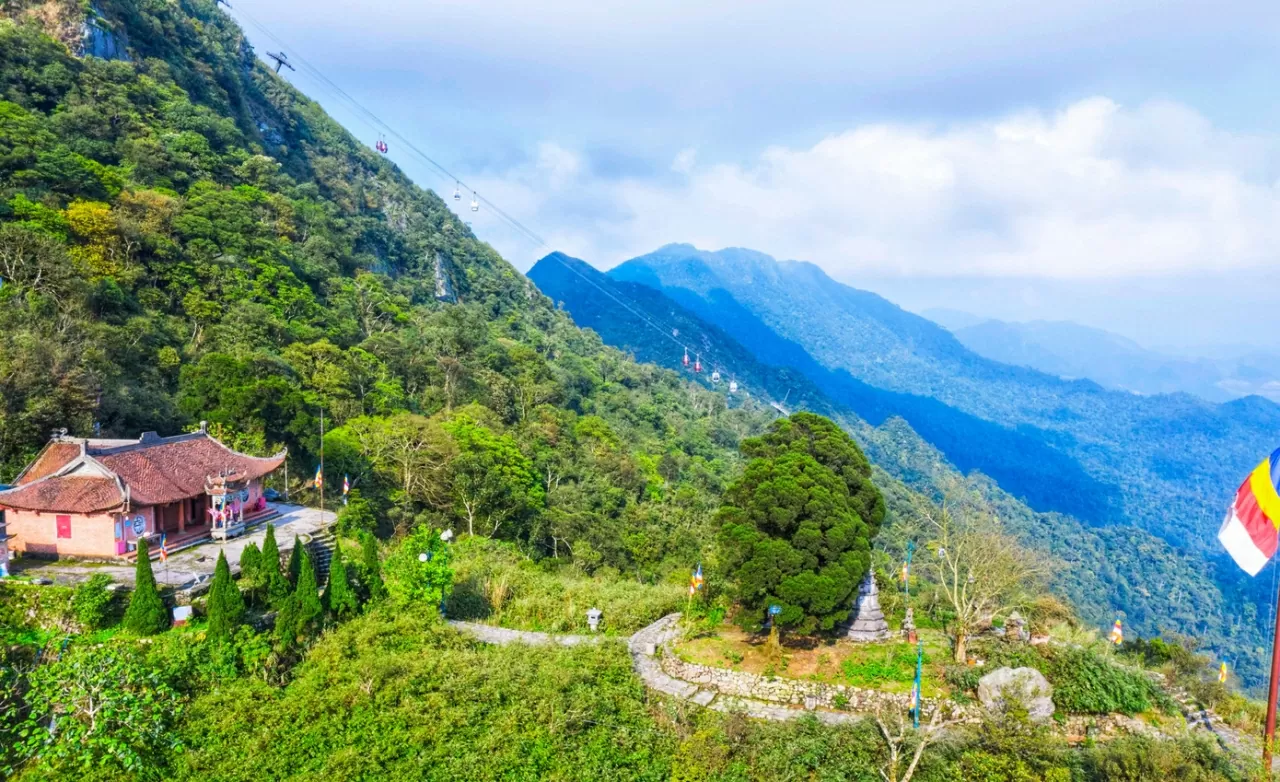 |
| The Complex of Yen Tu - Con Son - Kiep Bac - Vinh Nghiem Listed as a UNESCO World Cultural Heritage Site (Photo: Hoang Duong) |
Leaving Yen Tu, the heritage trail continues to Bac Giang, home to the stately and ancient Vinh Nghiem Pagoda - more than just a temple, it served as a central Buddhist academy of Vietnam, founded and expanded by the Second Patriarch, Phap Loa.
Within the quiet sanctuary of this temple, one can still feel the intellectual legacy of the ancients, preserved in over 3,000 wooden Buddhist scriptures - a documentary heritage recognised by UNESCO. Not far from there lies Bo Da Pagoda, with its serene tower garden, where the remains of thousands of monks rest - a testament to enduring faith.
“Kiep Bac carries an awe-inspiring heroism. Standing at the junction of the Luc Dau River - where six rivers converge - one can still faintly hear the call of Tran Hung Dao’s ‘Proclamation to the Generals’, and sense the bravery of those legendary naval battles. Kiep Bac is not only a sacred temple, but a symbol of national defence and the military heart of ancient Dai Viet”.
Yet perhaps the place that resonates most deeply with my heart is Con Son - Kiep Bac, once part of Hai Duong Province, and now within the expanded city of Hai Phong after the historic administrative merger on July 1.
I have breathed the misty mountain air of Con Son, stilled my soul in its ancient temple and sacred shrine. Con Son embraces visitors with its poetic, mountainous beauty - where the stream still sings as it did in Nguyen Trai’s verses, and where Huyen Quang, the Third Patriarch, chose to live a monastic life. Here, nature, poetry and Zen meditation exist in seamless unity.
In contrast to the contemplative Con Son, Kiep Bac radiates a fierce, heroic spirit. Standing at the confluence of the six rivers of Luc Dau, one can almost hear the echoes of Tran Hung Dao’s rallying words. More than a shrine, Kiep Bac is a symbol of the sacred duty to protect the nation - a strategic military heart of Dai Viet.
Beyond the two main complexes, this region is also home to hidden gems such as Thanh Mai Pagoda, Nham Duong Pagoda, and Kinh Chu Cave - the latter etched with the calligraphy of emperors and scholars from centuries past.
The pride we feel today is the result of 13 years of tireless dedication by countless individuals. I understand that this UNESCO inscription is not merely to be recognised by the world, but to give us, the Vietnamese people, a chance to look back and more deeply cherish the values we hold.
It is the fruit of rigorous research by scientists and cultural authorities, who meticulously demonstrated that these are not isolated monuments - but an inseparable, unified whole, narrating one extraordinary story: The story of Truc Lam Zen and the soul of Vietnam.