

Developing Ho Chi Minh's ideology on human rights diplomacy
WVR - Vietnam's re-election to the United Nations Human Rights Council (UNHRC) for the 2026-2028 term marks a significant victory in human rights diplomacy...
Latest
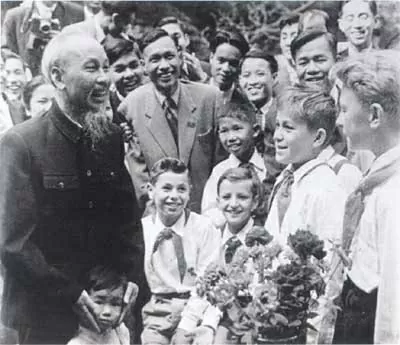 |
| President Ho Chi Minh conversing with children during a visit to Czech in 1957. (Archival photo) |
The re-election further affirms Vietnam's position and role in international multilateral forums on human rights, continuing to contribute to the common work of the Human Rights Council to better ensure human rights worldwide.
Based on President Ho Chi Minh's ideology of "being ready to establish diplomatic relations with any government that respects the equality, territorial sovereignty, and national sovereignty of Vietnam, to jointly protect peace and build world democracy", the principles of human rights diplomacy are clearly demonstrated, actively contributing to promoting, ensuring, and protecting security, peace, and development; thereby promoting, ensuring, and protecting human rights, which are the three pillars of the UN's activities.
Principles of human rights diplomacy
The principle of human rights diplomacy is to rely on the people, taking the people as the root, to leverage the nation's "soft power" in supporting state diplomacy, aiming to promote Vietnam's image and protect its interests, especially at regional and global people's forums; thereby mobilizing global public support for humane and progressive development trends and for the vulnerable (victims of war, natural disasters, epidemics, women, children, the elderly...).
Additionally, there is "heartfelt diplomacy", leveraging human dignity to "persuade, conquer, and win over people" with reason and ethics to cultivate and develop the dignity of progressive humanity; closely combining political diplomacy with economic and cultural diplomacy to find commonalities, exploiting all possible potentials to "maximize the comprehensive strength of the entire nation, the whole political system combined with the power of the era, and garner maximum international community support".
Applying and creatively developing Ho Chi Minh's diplomatic principles and human rights diplomacy in the new era – an era of prosperous, thriving, civilized, and happy development – requires proactive and active implementation of solutions for human rights diplomacy.
Firstly, turning challenges into opportunities, effectively utilizing favorable conditions from domestic and international contexts to enhance innovation in thinking and methods of implementing human rights diplomacy, aiming to build trust and strengthen international consensus in support of Vietnam.
Secondly, flexibly and creatively applying diplomatic methods and arts, clearly distinguishing between subjects and partners; focusing on combating the schemes and tactics of hostile forces that smear and distort Vietnam's human rights situation; exposing false and hostile rhetoric.
Thirdly, steadfastly adhering to the viewpoint that humans are the subject and center of all development policies; building a clean, strong, efficient, and effective political system as a foundation to improve the quality of external affairs in general and human rights diplomacy in particular.
Fourthly, enhancing external information on human rights based on thoroughly understanding and effectively implementing Conclusion No. 57-KL/TW dated June 15, 2023, of the Politburo to raise awareness among officials, party members, and the public about the importance of Vietnam's human rights foreign policy within the framework of the Communication Project on Human Rights in Vietnam (according to Decision No. 1079/QD-TTg dated September 14, 2022, of the Prime Minister).
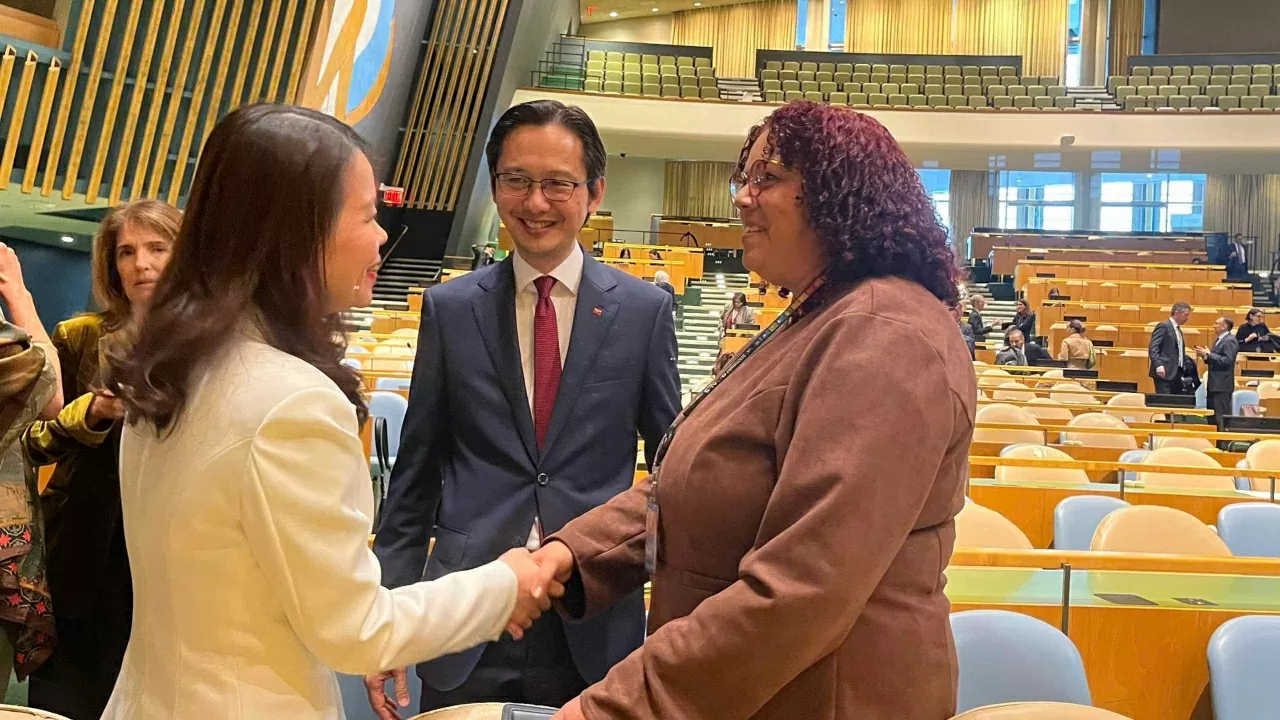 |
| International friends congratulate Vietnam on its re-election to the UNHRC for the 2026-2028 term. (Source: Vietnam's Delegation to the UN) |
Multilateral imprint
Since joining the UN, Vietnam has consistently been a responsible member in the UN's human rights activities. Specifically, Vietnam has seriously fulfilled its obligations under international human rights conventions to which it is a party. To date, Vietnam has ratified and joined 7 out of 9 core UN human rights conventions; ratified and joined 25 ILO conventions, including 7 out of 8 core conventions.
Moreover, Vietnam continues to fully, seriously, and responsibly implement international commitments on human rights, including the comprehensive plan to implement UPR recommendations from cycles I to IV.
Notably, Vietnam has proactively and actively promoted its role as a member of the UNHRC for the 2023-2025 term under Vietnam's motto "Respect and Understanding - Dialogue and Cooperation - All human rights for all". Accordingly, Vietnam proposed and drafted a resolution commemorating the 75th anniversary of the Universal Declaration of Human Rights and the 30th anniversary of the Vienna Declaration and Programme of Action at the 52nd session of the Human Rights Council; drafted a resolution on Climate Change and Human Rights in the context of a just transition at the 56th session of the Human Rights Council; was part of the core group drafting a resolution on protecting and empowering children in cyberspace; drafted 11 joint statements with the co-sponsorship of many countries; organized 5 side events with the participation of numerous nations... These results lay the foundation for Vietnam to continue to excel in its duties during the 2026-2028 UNHRC membership term.
Additionally, Vietnam has facilitated the activities of non-governmental organizations (NGOs) by extending the registration period for NGO representative offices to up to 5 years; reducing administrative procedures, processing time, and issuing registration, renewal, amendment, and re-issuance of operation registration... The Vietnamese government has also provided 7 forms and reports to facilitate the administrative work of foreign NGOs in Vietnam. By early 2024, over 900 NGOs have established relations and activities in Vietnam; many NGOs have made positive contributions to human rights activities as well as Vietnam's socio-economic development.
In recent years, Vietnam has built and implemented a wide-open, stable, and long-term dialogue framework at multilateral forums. Vietnam actively engages in dialogue at several UN organizations under the UN Charter-based mechanism to ensure labor rights for persons with disabilities; ensure a safe working environment for maritime workers; and enhance education in preventing the trafficking of women and girls. Vietnam also participates in dialogue under the Universal Periodic Review (UPR) mechanism.
With special procedures, Vietnam has welcomed and exchanged with special procedure experts (or special rapporteurs) of the Human Rights Council, such as on minority issues, extreme poverty and human rights, the impact of foreign debt on human rights, the right to health care, culture, freedom of religion, and recently, the Special Rapporteur on the right to development... This helps special rapporteurs better understand the policies, laws, and practices ensuring human rights in specific areas in Vietnam.
Within the ECOSOC framework, to date, the ECOSOC NGO Committee has granted special consultative status to 4 Vietnamese organizations (Vietnam Family Planning Association (2007), Vietnam Peace and Development Foundation (2009), Women's Development Center under the Vietnam Women's Union (7/2014), Sustainable Rural Development Center under VUSTA (2019). With consultative status, Vietnamese organizations have the opportunity to attend international events, provide input, contribute expertise, monitor the implementation of international commitments that Vietnam participates in, build networks and lobby, express views at international forums to help ensure better enjoyment of the rights of Vietnamese people and actively counter the opposition of Vietnamese organizations abroad at this forum.
At international and regional organizations, Vietnam actively participates in dialogue at the ILO, World Trade Organization (WTO), within the ASEAN framework...
Moreover, Vietnam also engages in annual human rights dialogues between Vietnam and the US, Australia, and the EU. Through dialogue, information is exchanged, understanding is enhanced, experiences and challenges are shared, and disagreements in understanding, approach, and implementation of human rights are reduced, contributing to promoting cooperative relations between Vietnam and other countries.
With people's organizations and international scholars: Vietnam also opens a "channel II" dialogue mechanism between people's organizations and scholars to discuss topics related to freedom of religion, expression, and facilitates visits by delegations and representatives of countries, foreign journalists to localities,... This influences international public opinion, enhances mutual understanding, and elevates Vietnam's humane and progressive image on the international stage.
Notably, Vietnam actively participates in maintaining peace and providing international humanitarian aid. Since 2014, Vietnam has sent hundreds of officers from the Ministry of Defense and the Ministry of Public Security to serve with the UN peacekeeping mission in South Sudan. Vietnam is always active and ready to join hands with other countries to overcome the consequences of natural disasters and provide international humanitarian aid.
| Vietnam's re-election to the United Nations Human Rights Council for the 2026-2028 term marks a significant victory in human rights diplomacy, further affirming its position and role in international multilateral forums on human rights, continuing to contribute to the common work of the Human Rights Council to better ensure human rights worldwide. |
Future directions
In the future, Vietnam needs to clearly identify hostile, extremist, and politically opportunistic forces opposing the Party and State both domestically and internationally. The ideological struggle between socialism and capitalism is not only occurring globally but also within Vietnam today. It is crucial to combat opportunists and those with ideological and political degradation. These are essentially "hidden" hostile forces posing as "middle factions" (V.I. Lenin), which are highly dangerous because they "attack from within", indirectly promoting "self-evolution", "self-transformation", and "deviation" of the Party's ideological foundation from within. Based on this, Vietnam's human rights diplomacy in the coming time should focus on several points:
Firstly, consistently grasp the situation, promptly forecast the viewpoints, schemes, and tactics of peaceful evolution in general, including in the field of human rights, to proactively and actively identify, dialogue, criticize, refute, prevent, and handle openly and transparently by law, especially for the leaders, in line with relations with international partners, and resources directly related to dialogue, struggle, and partners, subjects of dialogue, and struggle.
Secondly, adhere to the principle of dialogue in struggle, to innovate content and methods, aiming to improve the quality and effectiveness of ideological and theoretical dialogue and struggle in human rights diplomacy. Diversify forms of struggle but do not expand, instead focus directly on the issues that need to be addressed, the subjects of struggle, based on maintaining principles: flexible, humane in method, open, transparent, democratic in action, contributing to creating a healthy, consensual social opinion". It is important to leverage the positive assessments of foreign individuals and organizations, including overseas Vietnamese, about the human rights situation in Vietnam; and be ready to acknowledge what has not been achieved in protecting and ensuring human rights, especially subjective limitations and shortcomings in specific cases; from there, propose several public, clear measures and roadmaps to better implement in the near future.
Thirdly, resolutely overcome the situation of domestic media outlets publishing false, unverified information for foreign media to exploit, incite public opinion. It is important to closely monitor and capture public opinion both domestically and internationally, while creating a positive information flow, pushing back negative, distorted, and false information, and promptly providing information for public; strictly handle violations by organizations and individuals according to legal regulations.
Tags: