




Cooperation is key for peace and stability in the East Sea
Whether the Code of Conduct in the East Sea (COC) becomes true sooner or later, the spirit of cooperation and de-escalation must always be promoted to maintain peace, stability, security, and safety in the East Sea.
Latest
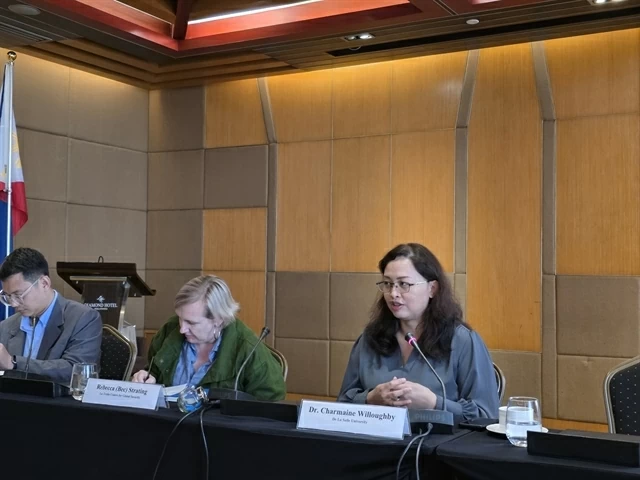 |
| Professor Charmaine Willoughby, Head of the Department of International Studies at De La Salle University (Philippines), shares insights on the East Sea issue. (Photo: Vy Anh) |
“Mature” enough but requires more effort
The long-awaited negotiations on the Code of Conduct (COC) in the East Sea are expected to conclude soon with strong impetus from the Philippines as the ASEAN Chair in 2026. However, speaking to ASEAN journalists during the Southeast Asian Maritime Journalism Program organized by the Australian Department of Foreign Affairs and Trade in collaboration with La Trobe University (Australia) earlier this February in the Philippines, regional experts believe the COC is “mature” enough but still requires more effort to achieve the expected final outcome.
According to Professor Charmaine Willoughby, Head of the Department of International Studies at De La Salle University (Philippines), political pressure or haste could lead to an agreement with vague content.
She noted that Manila has invested significant diplomatic capital to push for progress on the COC, raising expectations that some result must be achieved.
Therefore, instead of a fully negotiated mechanism to regulate behavior in disputed waters, she suggests that ASEAN and China could aim to sign a framework document, postponing contentious details to a later date.
Such an approach would allow ASEAN and China to reach consensus without addressing the most challenging issues – including sovereignty disputes, enforcement mechanisms, or legal obligations.
Professor Willoughby opined that failing to produce any document could pose significant challenges for the ASEAN Chair in 2026, both domestically and regionally.
Associate Professor Robert Medillo at the Philippine Defense College believes ASEAN has the capacity to foster consensus to issue declarations and joint communiqués, but with the COC, challenges remain.
He suggests that future declarations might merely reiterate commitments to “accelerate” negotiations – a diplomatic cycle allowing parties to maintain momentum without fundamentally altering the situation at sea.
If negotiations stall or only result in a statement lacking weight, experts suggest regional countries might turn to other equally significant areas of cooperation.
Willoughby argues that maritime cooperation does not necessarily have to depend entirely on resolving territorial disputes. Environmental protection, enhancing coastal community resilience, and non-traditional security cooperation are areas where collaboration can proceed even without resolving sovereignty disputes.
“ASEAN provides many such platforms. If we all focus solely on the COC, that’s fine, but there are many other things we can do and collaborate on; we just need to be more creative in utilizing the ASEAN framework and ‘umbrella’ to achieve these goals,” Willoughby remarked.
She also mentioned the rise of “mini-lateral” cooperation – small groups of like-minded countries collaborating through defense, academic, or media networks.
Medillo cited practical examples emerging among Southeast Asian countries, suggesting that nations working together send a signal of responsible regional governance to the international community.
Preventing incidents leading to conflict
Instead of pursuing an ambitious comprehensive agreement, Jim Gomez, Chief Correspondent of the Associated Press (AP) in the Philippines, specializing in maritime reporting, proposes a more realistic intermediate goal: Preventing incidents that could ignite conflict.
Close encounters between aircraft and ships in disputed waters highlight how miscalculations can easily escalate into crises.
He suggests that ASEAN and China could negotiate limiting rules – such as minimum distances between ships and aircraft, communication procedures, and restrictions on dangerous behaviors like using lasers or aggressive intercepts.
Such technical arrangements would avoid escalating tensions while directly addressing the most urgent risk: Unintended military escalation.
He noted that sources indicate some policymakers have begun considering this possibility as a small-scale regional agreement focused on safety.
In a post-COC context or with a “weak” COC, security dynamics may increasingly shift towards deterrence. Medillo emphasized the expansion of defense cooperation between the Philippines, the United States, and partners like Japan and Australia to prevent escalating tensions.
Jim Gomez views this as a form of “deterrence 2.0” – deploying multinational forces in strategic areas to deter aggressive actions.
In summary, experts express optimism about the COC’s prospects, appreciating the efforts between ASEAN and China to soon achieve an effective and efficient COC in line with international law as expected. However, whether the COC becomes true sooner or later, the spirit of cooperation and de-escalation must always be promoted to maintain peace, stability, security, and safety in the East Sea.