



March Government Press Conference: Focus on energy security and interest rate policy
WVR - The March 2026 regular government press conference focused on prominent issues such as fuel supply and interest rate policy direction.
Latest
On afternoon of April 4, at the March 2026 regular government press conference, numerous questions related to fuel supply, electricity consumption forecasts, the rice market, and food safety control were raised.
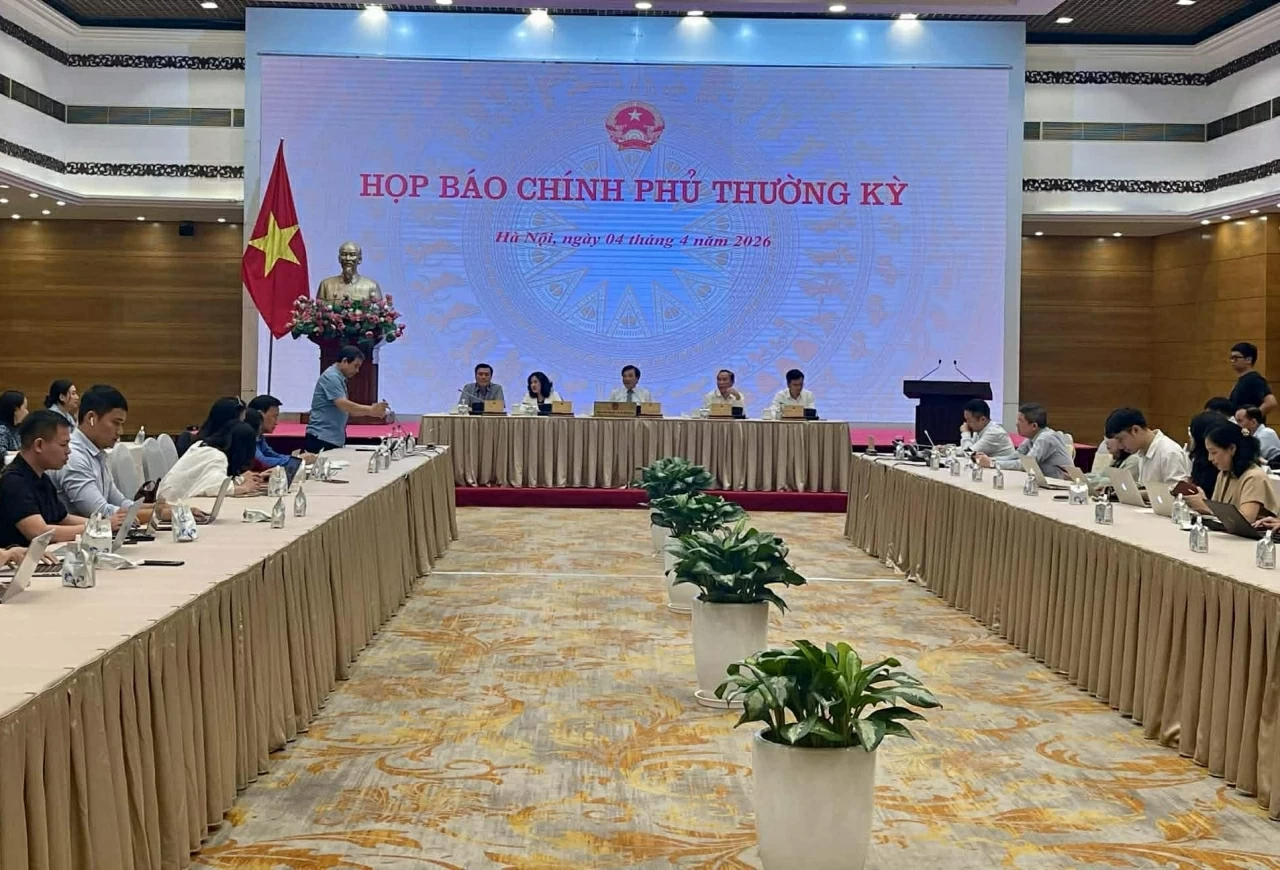 |
| Overview of the March 2026 regular government press conference. (Photo: Phi Khanh) |
Ensuring energy security, fuel supply
With the tense military situation in the Middle East, could the Ministry of Industry and Trade provide information on the domestic fuel supply for April, especially the supply for business production?
Answering this question, Deputy Minister of Industry and Trade Nguyen Sinh Nhat Tan stated that regarding fuel supply, the military conflict in the Middle East since February 28 continues to escalate, causing numerous repercussions, particularly affecting fuel and gas energy supplies. The scale and impact have now surpassed the oil shock of the 1970s that disrupted the global economy at the time.
Since early March 2026, the Politburo and the government have directed the Ministry of Industry and Trade to develop two fuel management scenarios: a scenario under four weeks (within March) and a longer scenario (possibly extending to the end of April).
Regarding the management of fuel supply and pricing, the Ministry of Industry and Trade ensures implementation according to five principles: Strictly following directives from the Politburo, government, and Prime Minister; Ensuring energy security and fuel supply; Updating global market prices to manage fuel prices in line with actual developments; Assessing impacts on the public and affected sectors, evaluating solutions to achieve the "dual goals"; Ensuring stable prices, balancing the interests of the state, businesses, and consumers.
In practice, the Ministry of Industry and Trade has advised the government to issue two resolutions (Resolution No. 36 and Resolution No. 55) related to energy management.
The Ministry of Industry and Trade has also coordinated with the Ministry of Finance to propose the government issue a resolution for temporary budget advances to the Fuel Price Stabilization Fund (BOG Fund) to continue stabilizing fuel prices. As a result, by the end of March, fuel supply had increased by 10% in production output.
The Dung Quat oil refinery has ensured raw materials for production until the end of April and May. The Nghi Son oil refinery ensures raw materials for production until the end of April.
Notably, in March, key fuel trading enterprises imported approximately 3.2 million m3 of fuel products, along with domestic inventories currently at a high level of about 2.6-2.8 million m3.
The Ministry of Industry and Trade affirms that domestic fuel supply is sufficient to meet production and consumption needs until the end of April 2026. The Ministry is striving to manage and develop scenarios for the following months.
Regarding solutions, the Ministry of Industry and Trade has been implementing various groups of solutions, including: Continuing to enhance domestic production capacity; Diversifying energy supply and import sources; Developing additional renewable energy sources such as E5 biofuel; Enhancing storage capacity and risk management, including both national and commercial reserves; Increasing the application of technology, data analysis, forecasting, and market management.
 |
| Deputy Minister of Industry and Trade Nguyen Sinh Nhat Tan provides information on the domestic fuel supply situation. (Source: VGP) |
Proactive and flexible, timely implementation of solutions
Representative of the State Bank of Vietnam answered the question on interest rate policy management from now until the end of the year and specific solutions to support interest rates as well as economic growth,
Deputy Governor of the State Bank of Vietnam Pham Thanh Ha stated that recently, international developments have been complex and unpredictable, especially the escalating geopolitical tensions and military conflicts in the Middle East, causing oil prices to rise, putting pressure on inflation in various countries and posing many challenges for monetary policy (MPT) management and banking operations.
In this context, following the directives of the government and the Prime Minister, the State Bank of Vietnam (SBV) has proactively and flexibly implemented management solutions to help control inflation, stabilize the macroeconomy, and promote sustainable economic growth.
The SBV has coordinated various MPT tools to fully meet the payment and settlement needs of the economy, maintaining stability in the monetary market.
Among these, the SBV continues to maintain the current interest rate levels to allow credit institutions (CIs) to access capital from the SBV at low costs to support the economy.
Regarding market interest rates, the SBV issued document No. 2342/NHNN-CSTT on March 30, 2026, requiring credit institutions and foreign bank branches to focus on implementing solutions to stabilize market interest rates, contributing to monetary market stability:
First, strictly adhere to SBV regulations on interest rates;
Second, enhance internal control and inspection activities, promptly correct and strictly handle violations of interest rate regulations;
Third, balance capital sources – ensuring liquidity and payment ability of CIs, avoiding disruptions in market interest rates.
Fourth, continue to publish loan interest rate information on the bank's website to provide reference information for customers when accessing loans.
However, the interest rate level faces upward pressure due to various factors such as:
The total capital mobilization of the CI system may be affected and face competition from other investment channels, leading to an upward trend in deposit interest rates from the end of 2025 after a period of stability; Credit growth outpacing capital mobilization growth indicates high credit demand to meet capital needs for the economy, especially in the context of double-digit growth targets.
In the coming time, many major international organizations assess that the global situation remains uncertain, difficult to predict, with many risks impacting growth, inflation, and global economic stability.
In this context, the SBV will continue to closely monitor global and domestic economic developments to manage MPT proactively, flexibly, and in a coordinated manner, closely aligning with fiscal policy expansion that is reasonable, focused, and targeted, along with other macroeconomic policies to steadfastly prioritize the goal of controlling inflation, contributing to maintaining macroeconomic stability, and supporting sustainable economic growth.
Specifically, regarding interest rates, the SBV will closely monitor domestic and international economic developments and market interest rates to manage interest rates in line with macroeconomic developments, inflation, and monetary policy objectives; flexibly use tools and measures to support liquidity for CIs; continue to require CIs to transparently disclose loan interest rates.
For CIs, it is necessary to strictly implement measures as directed by the SBV in document No. 2342/NHNN-CSTT on March 30, 2026, to stabilize the interest rate level, while ensuring a balance between credit growth and capital mobilization growth, avoiding disruptions in market interest rates.