




ASEAN's central role – Backbone for a stable region, free from 'choosing sides': Australian Ambassador
WVR - Australia views ASEAN-led mechanisms as essential for maintaining regional stability and balance amid increasingly complex geopolitical competition, said Ambassador to ASEAN Tiffany McDonald.
Latest
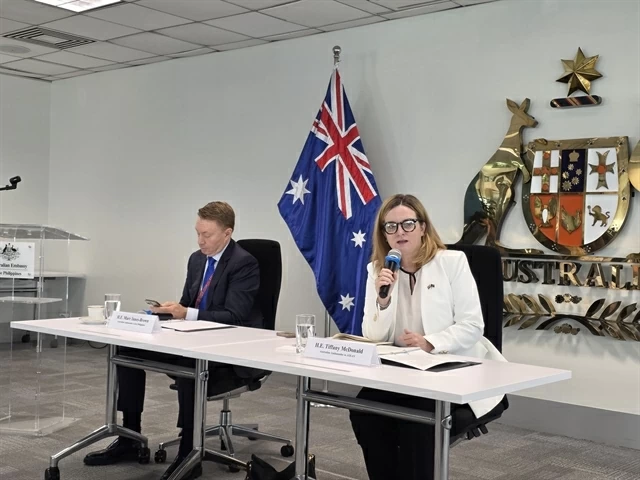 |
| Australian Ambassador to ASEAN Tiffany McDonald shares insights with ASEAN journalists during the Southeast Asia Maritime Journalism Program in Manila, Philippines. (Photo: Phương Hà) |
During the Southeast Asia Maritime Journalism Program organized by Australia's Department of Foreign Affairs and Trade in collaboration with La Trobe University (Australia) earlier this February in the Philippines, Australian Ambassador to ASEAN Tiffany McDonald shared with journalists from ASEAN countries Australia's support for ASEAN's strategic directions, including the South China Sea issue.
Steadfast support for ASEAN's central role
“We are actively collaborating with ASEAN to shape a region governed by rules and norms, where each country can choose how to pursue its national interests,” stated Australian Ambassador to ASEAN Tiffany McDonald.
Australia views ASEAN-led mechanisms as essential for maintaining regional stability and balance amid increasingly complex geopolitical competition.
Speaking from a regional perspective, Ambassador Tiffany McDonald noted that ASEAN mechanisms allow Australia to cooperate with all 11 ASEAN member countries – including the newest member, Timor-Leste.
The Australian Ambassador emphasized that Australia's regional policy always highlights the importance of ASEAN's central role.
“You often hear Australian diplomats, our Foreign Minister, and Prime Minister talk about the desire to build a region where ASEAN's central role is maintained,” McDonald said.
Canberra sees ASEAN as a driving force in shaping the rules and norms applied in the region, especially amid shifting foreign influence trends.
She emphasized that Australia is committed to supporting a regional order where balance is maintained and sovereignty is respected.
“What we are steadfastly promoting and investing in – through ASEAN mechanisms – is a region where no country has the right to dominate and no country is dominated,” she said. The goal is to ensure countries can pursue their own national interests.
As ASEAN prepares to celebrate its 60th anniversary next year, Australia expects ASEAN's role in shaping the regional order to become even more prominent, especially as geopolitical competition increases. However, McDonald stressed that Australia does not want countries to face the dilemma of choosing sides.
“We do not want a region where any country has to choose,” she said.
She linked this approach to Australia's policy framework built on three “Rs”: “rules”, “relationships”, and “resilience”.
While not naming specific foreign influence trends, the ambassador acknowledged that strategic competition is increasing across the Indo-Pacific.
“That does not directly answer the question of what the foreign influence trends are,” she said, “but I think the trend of the world becoming more competitive – a competitive space – means we must reaffirm and strengthen our commitment to maintaining rules and norms for the region's resilience.”
She added that enhancing ASEAN-led cooperation remains a focus to ensure long-term prosperity for both ASEAN member countries and Australia.
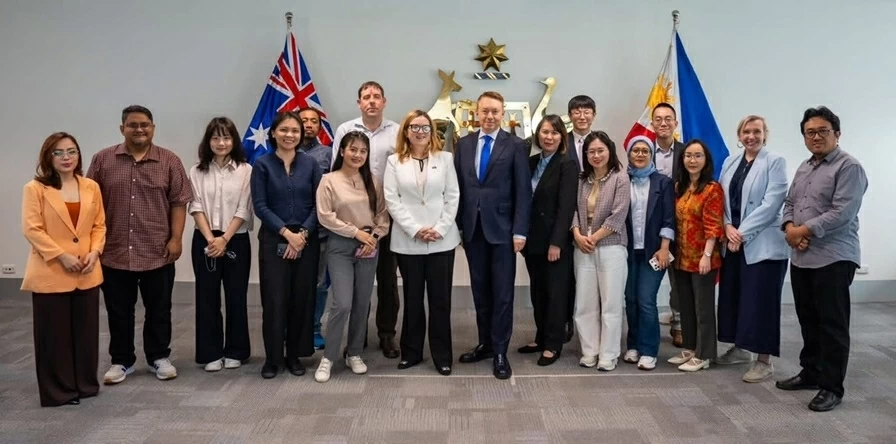 |
| Australian Ambassador to ASEAN Tiffany McDonald with ASEAN journalists. (Photo: Phương Hà) |
Upholding international law
Regarding the eagerly anticipated Code of Conduct in the East Sea (COC), as the Philippines, as ASEAN Chair this year, pushes for the early completion of negotiations between China and ASEAN, Canberra diplomats once again emphasized the aspect of upholding the law.
“While we are not directly involved in the negotiation process and do not have details on the current state of the negotiations, it is clear that we are very concerned. Overall, we expect agreements to enhance compliance with international rules and norms; we hope it will be a high-quality agreement and hope it reinforces ASEAN's central role in addressing maritime issues,” Australian Ambassador to the Philippines Marc Innes-Brown PSM told the press.
For her part, Ambassador McDonald stated that in working with ASEAN partners, she continues to advocate for a high-quality Code of Conduct, reaffirming ASEAN's interests, and most importantly, reaffirming the supremacy of the United Nations Convention on the Law of the Sea (UNCLOS) – the foundational legal framework governing global maritime activities.
“We know that ASEAN is negotiating with China on a Code of Conduct, and one of Australia's top goals in cooperation with ASEAN is to support and encourage a united ASEAN family,” she said.
McDonald highlighted the growing economic importance of the ASEAN-Australia relationship, noting that ASEAN has become Australia's second-largest trading partner.
“Two-way trade exceeded 195 billion AUD in 2024,” she said, emphasizing that maritime stability remains crucial to maintaining that economic relationship.
She noted that maritime trade is particularly important to Australia's economy. “One in four jobs in Australia is derived from trade, so it is crucial that the East Sea and other oceans and seas continue to be governed by the United Nations Convention on the Law of the Sea.”