






Comprehensive conservation plan for the Special National Monument Dong Khoi Ben Tre
WVR - The conservation, restoration, and rehabilitation plan for the Special National Monument Dong Khoi Ben Tre covers a research area of 9,000 hectares, aiming to preserve historical sites, recreate spaces associated with the Dong Khoi movement of 1960, and develop landscapes and tourism.
Latest
The People's Committee of Vinh Long Province recently held a conference to announce the conservation, restoration, and rehabilitation plan for the Special National Monument Dong Khoi Ben Tre. This serves as an important foundation for implementing a comprehensive conservation approach, preserving historical values while enhancing the cultural, landscape, and tourism potential of the local area.
Identifying conservation and restoration areas
The plan was approved under Decision No. 2413/QD-BVHTTDL dated September 16, 2026, by the Minister of Culture, Sports, and Tourism.
Accordingly, the research area encompasses a total of 9,000 hectares, including natural areas, landscapes, residential communities associated with the monument, and locations of significant events of the Dong Khoi Ben Tre movement. This area includes the communes of Dong Khoi, Mo Cay, An Dinh, Thanh Thoi, and Luong Hoa.
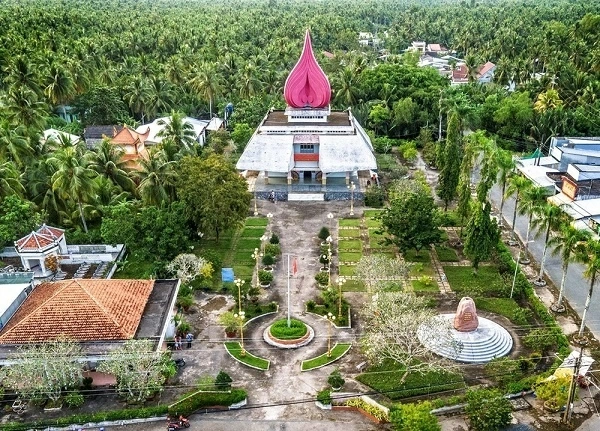 |
| The Special National Monument Dong Khoi Ben Tre. (Source: Van Hoa Newspaper) |
Within the overall plan, key components cover approximately 45.49 hectares, including the Dong Khoi Traditional House, Dinh Dinh Nhon, the Rach Ong Bong victory site, Phuoc Hiep victory garden, and the establishment site of the Dong Khoi Regiment. These locations, tied to historical milestones of the movement, are identified as focal points for conservation, restoration, and rehabilitation efforts.
In addition to existing monuments, the plan outlines the construction and restoration of historical spaces such as the Vam Nuoc Trong fort, guerrilla villages, Thanh Thoi strategic hamlet, and Binh Khanh fort.
The Dong Khoi Victory Square, along with a system of parks, greenery, transportation, and auxiliary structures, is also included in the investment orientation to create connectivity among the components within the monument complex.
Identifying conservation areas and restoration sites contributes to forming a synchronized spatial organization plan for the monument, reflecting the historical characteristics of each location. The extensive research scope also allows for consideration of the relationship between monument sites, natural landscapes, and residential areas, laying the foundation for long-term heritage management and protection.
The Special National Monument Dong Khoi Ben Tre is associated with the Dong Khoi movement of 1960, a significant event in the revolutionary struggle history of the South.
In 2016, the monument was ranked as a Special National Monument by the Prime Minister. The development of a comprehensive plan aims to enhance the protection of historical sites and mitigate the risk of eroding traces associated with the movement.
Developing landscape buffer zones linked to tourism
Alongside conservation efforts, the plan allocates approximately 45.32 hectares for developing landscape buffer zones and tourism through socialization. Service facilities are oriented to integrate with ecological spaces, fruit gardens, and residential areas, leveraging local landscape characteristics in conjunction with monument tours.
The infrastructure system, parks, greenery, and auxiliary structures are oriented for investment in alignment with the overall plan. The development of service and tourism spaces must ensure harmony with the landscape, preserve the historical value of the monument, and simultaneously create opportunities for local residents to participate in activities that enhance heritage value.
However, the conservation of sites associated with the Dong Khoi movement still poses a requirement for synchronized management. Some historical sites have not been adequately preserved; the impact assessment on the protection scope and adjacent areas of the monument still has limitations. Without long-term solutions, locations marking historical events risk gradually fading over time.
Therefore, the implementation of the plan needs to be linked with the management responsibilities of all levels of government, coordination among relevant units, and the community's awareness of monument protection. This is also a condition for the consistent implementation of conservation, restoration, and landscape development components, in line with the approved orientation.
On October 5, prior to the announcement conference, the People's Committee of Dong Khoi Commune widely disseminated the plan to officials, civil servants, units, organizations, and individuals. The commune administration also requested units, schools, and hamlets to enhance communication to residents, members, and youth, coordinating efforts to protect, preserve, and promote the value of the Special National Monument Dong Khoi Ben Tre.
With specific orientations for conservation, restoration, and landscape space organization, the plan provides a foundation for preserving the historical traces of the Dong Khoi movement while opening up avenues for combining heritage conservation with local tourism development.


