



The 59th ASEAN Foreign Ministers' Meeting achieves comprehensive and substantial results: Deputy Minister Dang Hoang Giang
WVR - On the occasion of the successful organization of the 59th ASEAN Foreign Ministers' Meeting (AMM-59) and related meetings in the Philippines, Deputy Foreign Minister Dang Hoang Giang gave an interview to the press about the event's outcomes.
Latest
Deputy Minister, what are the most notable outcomes of the 59th ASEAN Foreign Ministers' Meeting (AMM-59) and related meetings from July 20-24 in Manila, Philippines?
In the context of an international situation described as "uncertain, unstable, and unpredictable" in the opening speech by the Philippine Foreign Minister, ASEAN Chair 2026, the meeting was a great success, achieving comprehensive results, adopting many important documents, and transforming political commitments into substantial cooperation.
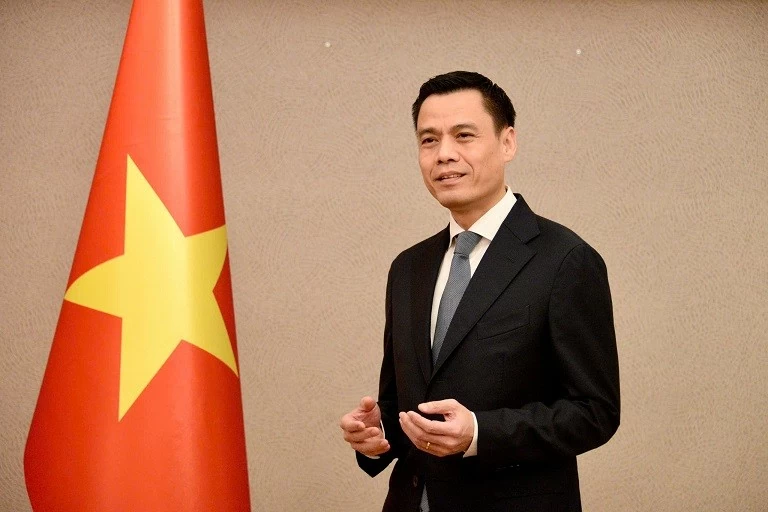 |
| Deputy Minister Dang Hoang Giang. (Photo: Bao Chi) |
Firstly, the process of building the ASEAN Community continues to be strengthened. The ministers positively evaluated the cooperation results of the first seven months of the year, agreeing to accelerate the implementation of the ASEAN Community Vision 2045 and decisively implement the priorities of the ASEAN Chairmanship Year 2026, focusing on fulfilling the commitments of the 48th ASEAN Summit and comprehensively implementing the High-Level Leaders' Declaration on responding to the Middle East crisis.
Secondly, ASEAN's network of external relations continues to expand and deepen. More partners seek to establish and upgrade relations with ASEAN, expanding their presence in ASEAN-led mechanisms. ASEAN's acceptance of Turkey as the 12th Dialogue Partner, Germany and Qatar as sectoral Dialogue Partners, and the UK's participation in the ARF reaffirms ASEAN's growing appeal and position as a central hub for connecting interests, coordinating cooperation, and shaping regional processes.
Thirdly, the enduring appeal and value of ASEAN-established norms of conduct continue to be affirmed through the success of activities commemorating the 50th anniversary of the Treaty of Amity and Cooperation in Southeast Asia (TAC). Participants reaffirmed TAC as a foundational code of conduct for relations among countries within and outside the region. The signing by Romania, Poland, Sweden, and Lithuania (bringing the total number of participating countries to 62) and numerous new participation requests affirm the vitality and role of TAC.
Fourthly, the Mekong-Japan and Mekong-Republic of Korea Foreign Ministers' Meetings continue to affirm the long-term commitment of both countries to sub-regional cooperation, jointly addressing common challenges, especially energy security and cybercrime, bringing practical benefits to the people and businesses in the Mekong region, contributing to the ASEAN Community building process.
Could you share the participation and most notable contributions of the Vietnamese Delegation at these meetings?
Embodying the proactive, responsible, and leading spirit of the 14th Congress's foreign policy in ASEAN, Politburo Member and Foreign Minister Le Hoai Trung and the Vietnamese delegation attended this series of meetings not just to participate but to actively create and contribute solutions. Through nearly 20 meetings, we have left many significant marks.
Firstly, we closely coordinated with the Philippine Chair and member countries, promoting unity and consensus within ASEAN; actively supporting the Chair in effectively implementing the set priorities and initiatives; proposing many initiatives and ideas to strengthen unity, increase resilience, and enhance ASEAN integration.
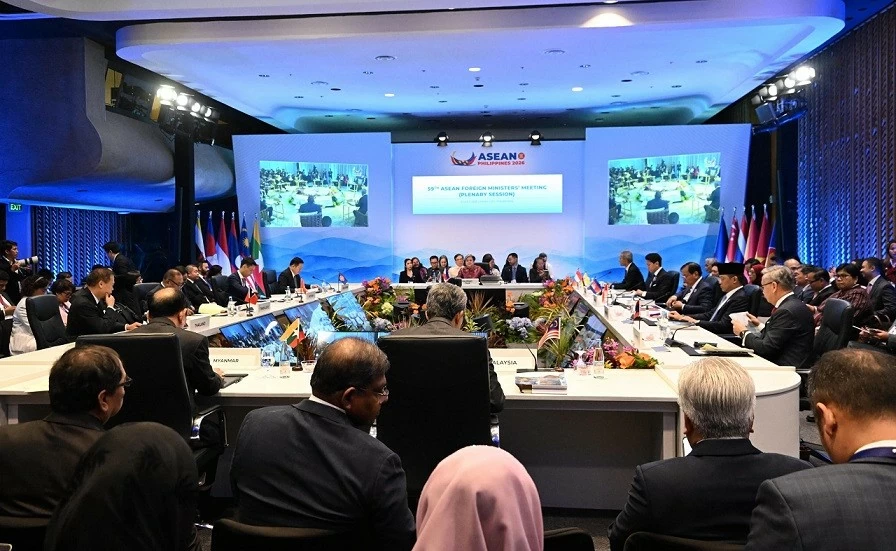 |
| Plenary session of the 59th ASEAN Foreign Ministers' Meeting (AMM 59). (Photo: Bao Chi) |
Secondly, as the only country currently coordinating relations with two ASEAN Dialogue Partners, Vietnam has left many marks in promoting ASEAN cooperation with the UK and New Zealand. We chaired negotiations, adopted the ASEAN-UK Action Plan 2027-2031, and the ASEAN-UK Foreign Ministers' Joint Statement on Cooperation within the AOIP framework; promoted consensus within ASEAN to accept the UK as the 28th member of the ARF. We also chaired negotiations and adopted the ASEAN-New Zealand Foreign Ministers' Joint Statement on promoting regional resilience, urging effective and comprehensive implementation of the ASEAN-New Zealand Action Plan 2026-2030 towards "quality over quantity".
Thirdly, we actively participated and contributed to guiding discussions on the South China Sea at the meetings, emphasizing the importance of peace, security, and stability in the South China Sea, highlighting the common interests and responsibilities of countries, ensuring that ASEAN's principled stance on the South China Sea is fully reflected in the conference documents.
Finally, under the co-chairmanship of Foreign Minister Le Hoai Trung, the 17th Mekong-Japan Foreign Ministers' Meeting agreed to resume the Mekong-Japan Summit at the earliest and most appropriate time.
It is known that within the framework of the conference, Politburo Member and Foreign Minister Le Hoai Trung had numerous bilateral meetings with the heads of delegations. Could you highlight the key points of these meetings?
On the occasion of attending the conference, Politburo Member and Foreign Minister Le Hoai Trung held about 15 bilateral meetings and exchanges with the heads of delegations. In these meetings, partners highly appreciated Vietnam's role, position, and development achievements; affirming Vietnam as an increasingly important partner in the region and the world.
Many partners are particularly interested in Vietnam's strong reform policies, achievements after 40 years of Doi Moi, and development orientations towards 2030, with a vision to 2045; thereby recognizing Vietnam not only as a market with great potential but also as a partner for cooperation, development, and addressing common regional and international issues.
The discussions indicate that the focus of relations with partners is shifting strongly from framework building to implementation and delivering concrete results.
All parties wish to promote high-level delegation exchanges, effectively implement the agreements reached, resolve existing issues, and expand cooperation in areas Vietnam is prioritizing such as science and technology, innovation, digital transformation, energy, green transition, marine economy, supply chain resilience, and high-quality human resource development.
Discussions on promoting negotiations, signing, and implementing free trade agreements, building new cooperation frameworks on green growth and green finance, connecting businesses, signing financial agreements, promoting investment, developing capital markets, and training human resources show the increasingly clear role of foreign affairs in paving the way, connecting, and mobilizing resources for national development.
Vietnam also proactively shared about the process of perfecting the market economy institution, developing the private sector, and transforming the growth model, thereby helping to clearly define the fields and cooperation potentials suitable to the strengths of partners as well as the country's priorities in the new development phase.
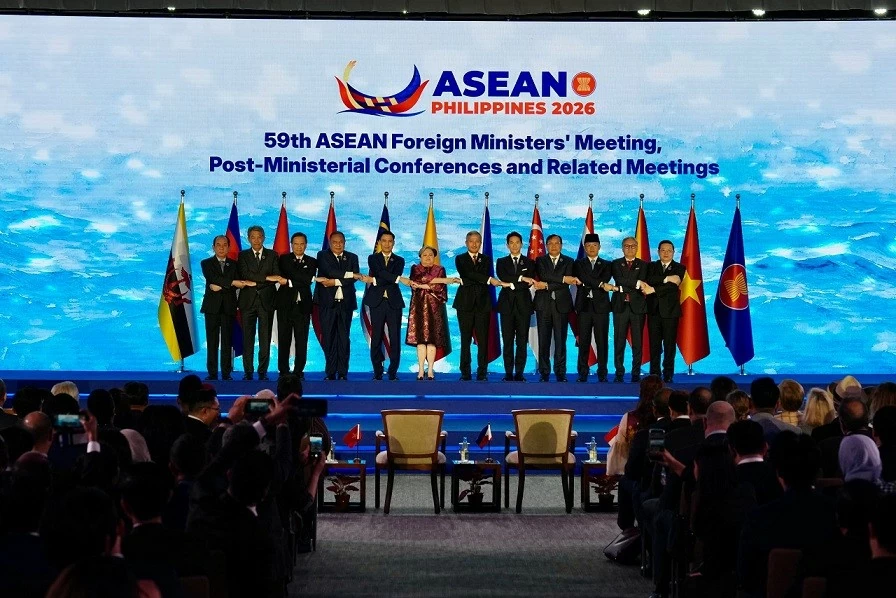 |
| ASEAN Foreign Ministers at AMM-59. (Photo: Bao Chi) |
Another notable aspect is that partners increasingly value Vietnam's role and reputation in ASEAN, the region, and internationally. Vietnam is recognized for having a balanced, responsible voice, capable of connecting partners with ASEAN and contributing to peace, stability, security, maritime safety, upholding international law, and addressing common challenges.
These are also evidences of the effort and determination to implement the foreign policy of the 14th Congress, Resolution 59, Resolution No. 06, and strategic resolutions of the Politburo, gradually transforming policy into concrete, substantial results.
In summary, the mission of Politburo Member and Foreign Minister Le Hoai Trung attending the 59th ASEAN Foreign Ministers' Meeting and related meetings was highly successful, contributing to deepening relations with partners both bilaterally and multilaterally, expanding development space, and creating favorable conditions for achieving the country's strategic goals.