


Vietnam-Chile: 55 years of friendship and a shared belief in self-determination
WVR - On the occasion of the 55th anniversary of the establishment of diplomatic relations between Vietnam and Chile (March 25, 1971 – March 25, 2026), Chile's Sur Andino newspaper published an interview with Vietnamese Ambassador to Chile Nguyen Viet Cuong on Vietnam-Chile shared belief in self-determination, in issue 190, on Sunday, May 24, 2026. The World & Vietnam Report is pleased to present this interview.
Latest
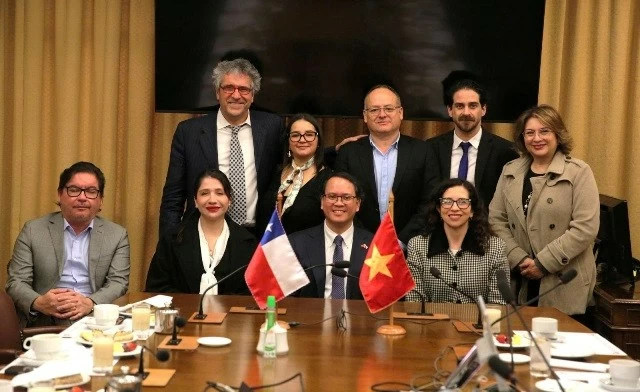 |
| Ambassador Nguyen Viet Cuong and the Chile-Vietnam Friendship Parliamentary Group at the Chilean House of Representatives. (Source: Vietnamese Embassy in Chile) |
On the occasion of the 55th anniversary of the establishment of diplomatic relations between Vietnam and Chile (March 25, 1971 – March 25, 2026).
Could you please share insights into the political, trade, and cultural relations between Chile and Vietnam over the years?
March 2026 marks the 55th anniversary of the establishment of diplomatic relations between Vietnam and Chile (March 25, 1971 – March 25, 2026). This is a milestone of special significance for two nations separated by approximately 18,000 km across the Pacific Ocean.
On March 25, 1971, Chile was one of the first South American countries to officially establish diplomatic relations with Vietnam, at a time when the Vietnamese people were still fighting for independence and national reunification. The 1971 milestone had an important historical precedent: on May 23, 1969, in Hanoi, President Ho Chi Minh received Mr. Salvador Allende, then President of the Chilean Senate. Two years later, when he assumed the highest position in the Chilean government, Allende and Chilean diplomacy made the decision to establish diplomatic relations with Vietnam, a decision that respected the national self-determination and development path of each country. This was the starting point for the friendship between the two nations.
Over more than half a century, both countries have undergone significant transformations. Vietnam transitioned from war to peace, from a closed economy to a deeply integrated nation. Chile became one of the most open economies in Latin America. Despite geographical distance and changes over the past half-century, generations of leaders and people from both countries have continuously nurtured and strengthened their relationship. In an era where international connections can shift rapidly, a relationship that endures over time is truly precious.
Bilateral relations are reinforced by a solid framework: the Comprehensive Partnership established in 2007, the Free Trade Agreement effective from 2014 – still the first and only FTA between Vietnam and a Latin American partner – and both being founding members of the Comprehensive and Progressive Agreement for Trans-Pacific Partnership (CPTPP), signed in Santiago in 2018. The official visit to Chile by President Luong Cuong in November 2024, the first head-of-state visit from Vietnam to Chile in 15 years, opened a new chapter for bilateral relations.
Two-way trade turnover has exceeded 2 billion USD in recent years, with both sides striving to raise it to 3 billion USD as soon as possible; Chile is Vietnam's fourth-largest trading partner in Latin America, while Vietnam tops Chile's list of ASEAN partners. Chilean cherries, salmon, and wine, along with Vietnamese textiles, electronics, and processed agricultural products, have become familiar in each other's markets.
Cultural and academic exchanges are also expanding through specific channels. At the beginning of 2026, the Embassy, in collaboration with the Chilean Association of Painters and Sculptors (APECH), organized the Chile-Vietnam Painting Competition: 55 Years of Diplomatic Relations, attracting 27 professional Chilean painters. The Embassy and APECH have had a cooperative relationship since 2014, and this competition continues that tradition.
Every time I travel through Chile's regions, from Patagonia in the south to the Atacama Desert in the north, I am reminded of Salvador Allende's May 1969 journey, when he traveled halfway around the world to Hanoi during wartime to meet President Ho Chi Minh. The Vietnam-Chile story began there, has been continued through many generations, and I believe the most exciting chapters are still ahead.
Could you elaborate on Vietnam's relationship with Latin America and the significance of Latin America in Vietnam's policy?
The Vietnam-Chile story, while uniquely historical, is part of the broader picture of Vietnam-Latin America relations. Latin America and the Caribbean are increasingly important in Vietnam's foreign policy, politically, economically, and culturally.
Vietnam currently has diplomatic relations with all 33 countries in the region, viewing the entire Latin America as a partner space, based on respect for independence, sovereignty, the choice of political systems of each country, equality, and mutual benefit.
In recent years, Vietnam's relations with the region have made notable strategic advances. At the end of 2024, Vietnam and Brazil upgraded their relationship to a Strategic Partnership, the first milestone between Vietnam and a South American country. Along with the Comprehensive Partnership with Chile established in 2007 and with Argentina in 2010, these milestones place Chile, Argentina, and Brazil at the forefront of Vietnam's partnerships in the region. At the end of December 2025, at the MERCOSUR Summit in Brazil, member countries of the Southern Common Market (Argentina, Brazil, Paraguay, Uruguay) issued a Joint Declaration officially launching negotiations for a Preferential Trade Agreement with Vietnam, opening a new interregional cooperation space between Southeast Asia and South America.
The political closeness, economic complementarity, and cultural empathy between the two sides have contributed to nurturing Vietnam-Latin America relations. Both sides share a commitment to multilateralism, the United Nations Charter, and resolving disputes by peaceful means. At the United Nations and multilateral forums, Vietnam and Latin American countries often share common voices on global issues, from poverty eradication and inequality to international institutional reform.
There is also a clear economic complementarity between Vietnam and Latin America. Latin America possesses many strategic raw materials for 21st-century industries, from copper and lithium to high-quality agricultural products; meanwhile, Vietnam has an increasingly strong industrial production capacity and serves as a gateway to the ASEAN market of nearly 680 million people. As global supply chains are being reorganized, the potential for cooperation remains vast.
However, perhaps what gives Vietnam-Latin America relations a special depth lies in culture and history. Both have fought for independence, both have a rich literary tradition, and both share the open spirit of their people – these are commonalities that need no borders to recognize. Pablo Neruda, Gabriel García Márquez, Violeta Parra have long been familiar to Vietnamese readers; conversely, Vietnamese art, cuisine, and culture are gradually being introduced more widely in Latin America.
Could you describe Vietnam's current development model?
In 1986, when the Communist Party of Vietnam initiated Doi Moi (Renewal), Vietnam's per capita income was only about 100 USD, much lower than many African countries at the time. A generation later, that figure has exceeded 4,500 USD; the poverty rate has dropped from about 70 percent to below 3 percent. This is one of the fastest and most sustainable poverty reduction journeys the modern world has witnessed.
Vietnam's secret does not lie in a single economic formula. It is a delicate combination: fully utilizing market rules to unleash productive forces while ensuring the market does not determine the fate of the vulnerable. The private economy is considered the most important driver of the national economy; at the same time, healthcare, education, and social security must reach all citizens, including those in remote areas. This is the socialist-oriented market economy model that Vietnam has gradually perfected over 40 years of Doi Moi.
FDI plays an important role in growth and manufacturing – in 2025, achieving the highest realized capital in five years, focusing on electronics, semiconductors, and renewable energy. But FDI alone does not create miracles. The decisive factor is that Vietnam has prepared both people and the investment environment to absorb FDI: a network of highways across the country, a well-trained technical workforce, a wide network of free trade agreements opening markets, and a state apparatus increasingly shifting towards a business-serving mindset – an orientation we call the Developmental State. Samsung, LG, and Foxconn come to Vietnam not because of cheap labor, but because of the emerging industrial ecosystem.
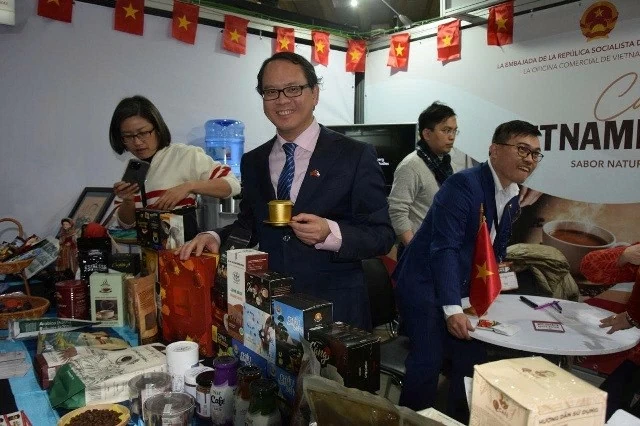 |
| Vietnamese Ambassador to Chile Nguyen Viet Cuong introduces Vietnamese coffee at the 2025 Coffee Fair in Santiago. (Source: Vietnamese Embassy in Chile) |
The deep application of knowledge is the decisive factor for the next phase, and Vietnam is heavily investing in this direction. Innovation centres and semiconductor chip design centers are forming, in collaboration with leading global technology corporations. The most recent National Congress of the Communist Party of Vietnam (early 2026) identified science, technology, and innovation as the central drivers of development, setting a GDP growth target of 10 percent per year for the next five years, aiming to make Vietnam a high-income developed country by 2045. The Party Congress calls this phase the "era of national development".
In this journey, Chile, as the first CPTPP partner and the only bilateral FTA partner of Vietnam in Latin America, is a crucial link for trans-Pacific economic cooperation. Looking back on 40 years of Doi Moi, one question many international friends often ask is: why has Vietnam succeeded? Our answer is: we do not chase a pre-existing model, but persistently learn, persistently adjust, and persistently maintain our direction. And most importantly, we have maintained the people's trust in the path we have chosen.
Can Vietnam today be defined as a country in the transitional period towards socialism?
This development story is closely tied to a more principled question about the path Vietnam is on. The clear answer is: Vietnam today is a country in the transitional period towards socialism, a consistent affirmation in the Constitution and official documents of the Communist Party of Vietnam since 1991.
The Vietnamese Constitution affirms that the State is a socialist rule-of-law state of the people, by the people, for the people, led by the Communist Party of Vietnam.
Vietnam is advancing towards socialism on a path with many unique characteristics. From a colonial, backward agricultural society, through decades of war for independence, the country began building socialism without going through a full capitalist development phase. In this process, we flexibly apply market rules to develop productive forces while maintaining a socialist orientation in distribution and social welfare; inheriting national cultural traditions alongside absorbing the cultural essence of humanity.
"Socialist orientation" here does not mean Vietnam has reached socialism, but is moving towards it. This is a deliberate, historical choice, different from pure free-market economics, and also different from the previous centrally planned model.
The Communist Party of Vietnam's platform outlines the image of a society where the people truly own, with a highly developed economy and an advanced culture that retains national identity, where people are comprehensively developed and ethnic groups within the Vietnamese community are equal and united. This spirit is encapsulated in the five traditional words familiar to Vietnamese people: rich people, strong nation, democracy, equality, civilization.
These are the goals Vietnam has persistently pursued for many decades – by its chosen path, not copying anyone's model. And it is this principle of self-determination that brought our two nations together 55 years ago: when Chile, under President Salvador Allende, established relations with Vietnam, both sides met in a shared belief – every country has the right to determine its own development path. That belief remains valuable today.
Currently, the world order is transitioning to a multipolar order. What is the stance of the Vietnamese Government on the ongoing changes in the international arena, Ambassador?
The documents of the 14th Congress of the Communist Party of Vietnam in early 2026 acknowledge a reality that I believe our friends in Latin America also feel very clearly: "The world is in an era-defining change." Strategic competition among major powers is increasing, protectionist trends are re-emerging in many regions, and global supply chains are being reorganized. Global challenges, from climate change, food security, energy security to cybersecurity, intertwine and impact each other, requiring international cooperation more than ever.
A trend we assess positively is the multipolarization and democratization of international relations based on international law. This trend opens up more space for developing countries, medium, and small nations to pursue national interests and independent foreign policies, and it is also a natural meeting point between Vietnam and many Latin American countries, including Chile, in viewing the world today.
In this spirit, Vietnam consistently follows an independent, self-reliant foreign policy, diversifying and multilateralizing relations, not joining military alliances, not siding with one party against another. We wish to be friends and reliable partners with all countries, acting for national interests and based on international law.
Vietnam desires a fairer international order, based on law, where disputes are resolved by peaceful means and global challenges are addressed through substantive multilateral cooperation. Vietnam supports the central role of the United Nations and the reform of this organization towards greater democracy and representation.
Ambassador, in the emerging new world order, what roles do major powers or regional organizations play?
In the emerging multipolar structure, major powers and regional organizations play different but interwoven roles. Major powers continue to shape global dynamics. Vietnam engages with major powers based on three principles: balancing relations with all major partners, not choosing sides in strategic competition, and placing national interests at the center. To date, Vietnam has established Comprehensive Strategic Partnerships with 15 countries and organizations, including all five permanent members of the United Nations Security Council.
Besides major powers, regional and interregional mechanisms play increasingly important roles, serving as bridges for countries with independent foreign policies to engage in multilateral cooperation. The Association of Southeast Asian Nations (ASEAN) is an example of how medium and small countries can unite to have a common voice on regional and international issues. Established in 1967, ASEAN admitted Timor-Leste as its 11th member in October 2025, and today has over 680 million people and a GDP of nearly 4 trillion USD. ASEAN's strength lies in its central role, consensus, and the ASEAN Way – dialogue, consultation, avoiding confrontation. In a region with strategic competition among major powers, ASEAN has maintained unity, not being drawn into any side.
Among the regional and interregional mechanisms that Vietnam participates in, the CPTPP holds a special significance for us – it is a bridge connecting the two sides of the Pacific, linking Asian economies with American countries. The CPTPP was signed in Santiago in 2018; both Vietnam and Chile are founding members. Preserving and expanding such multilateral spaces as the CPTPP is a shared responsibility of member countries, especially in a period where multilateralism is facing many challenges.
The potential for cooperation between ASEAN and Latin American integration mechanisms – particularly the Pacific Alliance (PA) comprising Chile, Mexico, Peru, and Colombia – remains vast. As two founding members of the CPTPP and two nations that have journeyed together for over half a century, Vietnam and Chile have a natural position to contribute to creating new interregional dialogue spaces.
Thank you very much, Ambassador!
Sur Andino (which can be translated into Vietnamese as "Nam Andes") is an electronic weekly newspaper based in Santiago de Chile, with journalist Luis Espinoza Garrido as Editor-in-Chief. The newspaper is published weekly, focusing on analyses of current affairs, economic, and social issues in Chile, the Latin American region, and international matters.
The interview with Vietnamese Ambassador Nguyen Viet Cuong was published by Sur Andino as a separate Supplement (Separata) issue 169, spanning seven pages, prominently placed at the end of the newspaper – a special layout reserved for content deemed of long-term reference value. The title of the interview, chosen by the Editor-in-Chief, is: "Vietnam-Chile: 55 Years and a Shared Belief in Self-Determination".