




US computer science graduates return to school as jobs lost to AI
“About 40,000 students enrolled this fall semester at San Jose State University, the largest incoming class in the school’s 168-year history,” President Cynthia Teniente-Matson said in a welcome email to freshmen on Aug. 25.
Latest
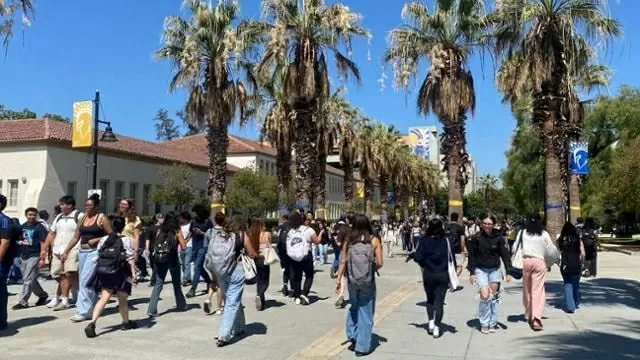 |
| Students walk across the San Jose State University campus between classes, Wednesday. Korea Times photo by Park Ji-yeon |
Located in Santa Clara County, California, the university is known for its high job placement rates at nearby big tech companies. Earlier this year it surpassed Stanford to rank No. 1 in international student employment outcomes.
But behind the record enrollment lies the reality of graduates struggling to find work as artificial intelligence transforms the labor market.
Since last year, major tech firms investing heavily in generative artificial intelligence (AI) have carried out mass layoffs. Demand for entry-level developers has plummeted, as entry-level jobs tend to be most vulnerable to automation, leaving many computer science graduates with no clear career path.
Unable to land jobs, more students are returning to campus, fueling record enrollment near Silicon Valley.
On Wednesday, the San Jose State campus was bustling with students carrying laptops and resumes into cafeterias and lounges. But their faces looked anxious.
Many have failed to clear tougher hiring bars or lost offers because of President Donald Trump’s immigration policies, which added uncertainty for foreign graduates.
Diana Omran, a computer science master’s student, compared the moment to the industrial revolution.
“Just as factories replaced manual labor, AI can replace us. I think I need to adapt,” she said. “I am applying everywhere, even for jobs I don’t really want, because the first job is just a foot in the door.”
Even experienced workers head back
The trend is not limited to new graduates. Choi Jung-hyun, which is an alias, who earned a master’s degree in computer science from a New York university and worked at a big tech company for three years, has reenrolled this semester to study AI.
“I saw not only entry-level but junior roles being replaced by AI. That’s why I came back,” he said, noting that many career workers are making the same choice.
Tech giants are reshuffling aggressively. Google offered voluntary retirement across departments in June, while Microsoft cut 15,000 jobs this year.
Analysts say these moves are part of broader cost-saving measures to offset multibillion-dollar AI investments.
Students delay graduation, add majors
Some undergraduates are also trying to hedge their bets. “I transferred here for the Berkeley degree, but with the job market this tough, I am considering a double major," said Aaron Hwang, a third-year computer science student at UC Berkeley. "I may have to think beyond tech after graduation.”
Charlie Dao, a senior in chemical engineering, said many of his mentees in computer science are postponing graduation or adding another major after failing to find internships. “AI has saturated the market,” he said, “so students are either going to graduate school or shifting to different fields.”
Venture capital firm SignalFire reported that demand for junior roles has dropped significantly, with the share of new engineering graduates hired by the Big Seven — Alphabet, Amazon, Apple, Meta, Microsoft, Nvidia and Tesla — falling by more than half since 2022.
AI squeezes, then recruits
Startups are following a similar pattern, using AI tools instead of hiring entry-level workers.
“It’s true that big tech and startups alike have raised the bar for new graduates,” said Scott Xiao, a partner at Goodwater Capital, a venture capital firm known for backing Coupang and Toss. “AI allows startups to operate productively without hiring inexperienced staff.” SignalFire estimated that new graduates made up less than 6 percent of startup hires last year.
At the same time, tech companies are willing to pay staggering sums for top AI talent. Meta reportedly offered up to $100 million to lure engineers from OpenAI. This polarization has left little room for entry-level or junior developers.
Chris Pollett, a San Jose State computer science professor since 2001, said the cycle is familiar. “We are seeing oversupply at the bottom. After the dot-com bust, the 2008 crisis and the pandemic, enrollments jumped when job markets froze. This year we saw the largest incoming class.”
Despite the gloom, some believe the contraction is temporary. As AI applications diversify, new niches could open. “Large language models can handle sophisticated tasks, but fields like security are branching out, creating new needs for people and new methods,” Pollett said.
Xiao agreed. “Hiring will not shrink forever. Startups can’t do everything on their own. Personalized software demand is growing, and each individual may soon have unique systems. Maintaining them will require more people. At some point, opportunities will return to new graduates,” he said.
| Russian Science and Culture Centre marks the Day of Remembrance and Sorrow in Hanoi WVR - On June 22, the Russian Centre for Science and Culture in Hanoi solemnly commemorated the Day of Remembrance and Sorrow. This day also ... |
| Vietnam Foundation and Department of Science, Technology, Information share a common vision on the teacher’s role in the AI-driven education Artificial intelligence (AI) is rapidly advancing and exerting a profound influence across all sectors, and education is no exception. The Vietnamese Government has taken decisive ... |
| Public school students will be exempt from tuition fees All public school students, from preschool to high school, will be exempt from tuition fees starting in the 2025–26 academic year. At the same time, ... |

| Prime Minister Pham Minh Chinh urges the Ministry of Science and Technology to be a pioneer in its field Prime Minister Pham Minh Chinh on August 16 called on the Party organisation of the Ministry of Science and Technology (MST), its leaders and staff ... |

| Science and technology diplomacy in the new era WVR - In the context of strong globalization, innovation, adaptation, and active participation in the global technology ecosystem have become imperative for every nation, especially ... |
(Source: Korea Times)