


Religious communication crisis in the digital era: Impacts on human rights
WVR - In recent years, the shift from traditional religious practices to the digital environment has created significant opportunities for spreading the ethical and humanitarian values of religion, while simultaneously increasing the risk of communication crises.
Latest
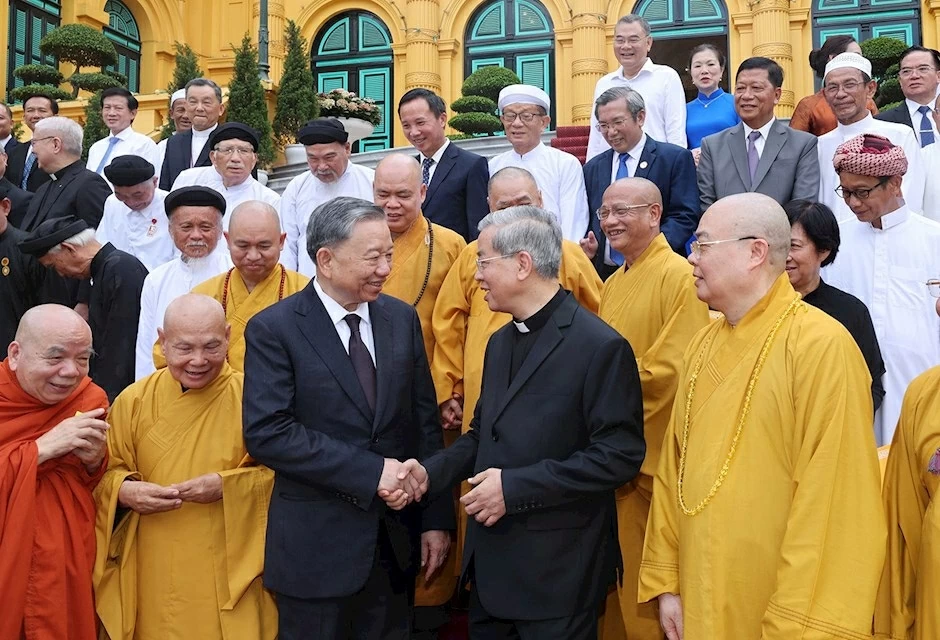 |
| The Party and State leader holds meeting with religious dignitaries. (Photo: Courtesy) |
Incidents related to statements and actions of religious figures, commercialization of spiritual phenomena, superstitious activities, or sensitive issues related to state management of religion are often distorted and manipulated, significantly impacting social life and infringing on human rights.
The digital space offers great opportunities for spreading the ethical and humanitarian values of religion, while also presenting new challenges for social governance in general and ensuring freedom of belief and religion in particular. This is especially true for Vietnam, a country with multiple beliefs and religions, 16 recognized religions, and 43 religious organizations with legal status, where approximately 95% of the population practices some form of belief or religion, and nearly 28 million adherents belong to various religions.
Identifying religious communication crises
Recent experiences show that religious communication crises in Vietnam manifest in various forms, prominently including the following:
| More from WVR |
 Human rights communication: Harnessing the 'hearts and minds' of the people Human rights communication: Harnessing the 'hearts and minds' of the people |
Firstly, deviations in ethics, lifestyle, and statements by some religious figures and clergy. In the digital era, every action, gesture, and statement by socially reputable individuals can be constantly monitored by the online community. A short video capturing inappropriate behavior or a controversial statement can quickly spread, creating a wave of negative public opinion, severely damaging the personal reputation and image of the religious organization.
Secondly, the commercialization of spiritual activities and superstitions under the guise of religion. The intersection of societal spiritual needs and market mechanisms, amidst a lack of stringent information control, has led to religious profiteering, resulting in media crises concerning transparency and the standards of religious practices. Activities such as star worship, spirit exorcism, and fortune-telling, often advertised on social media with a business-like approach and high fees, are examples. When these activities are scrutinized by the media and online communities for their unscientific nature or profiteering tendencies, trust crises quickly erupt.
Thirdly, exploiting sensitive religious issues to distort the policies of the Party and the State. Some opposition forces have thoroughly exploited incidents related to land, religious worship sites, and religious issues in areas with large ethnic minority populations, or the government's handling of administrative violations concerning unauthorized religious site constructions, to manipulate images, distort the nature of events, and accuse the government of "religious repression" and "violating religious freedom".
A notable example is the social media phenomenon involving Mr. Le Anh Tu, known as Thich Minh Tue, which garnered significant attention from 2024. Essentially, this is an individual practice of asceticism. However, some overseas media channels and domestic opposition forces have exploited this image to compare, criticize, and undermine the reputation of the Vietnam Buddhist Sangha, a member organization of the Vietnam Fatherland Front. By directing public opinion towards the "real monk - fake monk" dichotomy, these forces have incited extreme sentiments, increasing division within the religious community and complicating security and order in some localities where the individual has passed through.
Fourthly, the emergence of high-tech crimes such as forgery and fraud using deepfake technology. Malicious actors use artificial intelligence (AI) technology to create fake images and voices of religious figures to solicit donations and advertise substandard products, causing economic damage and eroding the trust of adherents. In recent times, hundreds of cases have been recorded where AI was used to fake images and voices of religious figures to promote and sell products of unclear origin, deceiving many adherents, especially the elderly. This is a warning bell about the risk of religious figures' honor and reputation being exploited, leading to unforeseeable social consequences and eroding the trust of the religious community.
Fifthly, the infiltration of "new religious phenomena" through digital platforms, spreading superstitious, unscientific content and enticing public participation. These groups often use pseudo-scientific tactics, such as healing with "energy", or propagate superstitious content to attract participants. The result has been family and social tragedies, such as neglecting family responsibilities, internal conflicts, and even actions that violate traditional cultural values (such as destroying ancestral altars). When these incidents are uncovered and spread, they create societal anxiety and concern about the safety of families and communities, while also posing significant challenges for state management in identifying, preventing, and handling activities that exploit religion in the digital space.
Impacts of religious communication crises
From the practical research above, religious communication crises can be understood as a state of negative, sudden, and rapidly spreading information related to beliefs and religion on media and social networks, severely undermining the credibility of religious organizations, eroding the trust of adherents, and negatively impacting social stability. Unlike media crises in economic, cultural, or entertainment sectors, religious media crises have distinct characteristics. Firstly, they are highly sensitive due to their association with the "sacredness" of religious beliefs. Religious belief is not only a matter of perception but also a matter of spirituality, ethics, and human spiritual identity. Therefore, when faith is damaged, social reactions often go beyond rational debate and can trigger strong emotional, even extreme religious reactions.
Currently, religious media crises are often "politicized" and "internationalized". In the context of the digital space blurring national boundaries, domestic religious incidents are easily exploited, distorted, and labeled as "human rights" and "religious freedom" issues by organizations and individuals abroad, thereby creating international public pressure on Vietnam. Thus, the essence of religious media crises is the conflict between religious values (faith, sanctity, ethics) and modern social norms (law, science, information transparency). When unfavorable information exceeds the "limits and norms" of social opinion, it creates a crisis flashpoint.
Religious communication crises are not only a media issue but also a human rights issue. Firstly, false and distorted information harms the right of people to access accurate information. When public opinion is led by unverified information, social trust is eroded, and a healthy religious environment is disrupted. Additionally, the honor and dignity of individuals and religious organizations can be severely violated. Unfounded judgments on social media can easily create a "systemic accusation" effect, where the wrongdoing of an individual is equated with the essence of an entire religious organization or religion.
On a broader scale, religious communication crises can negatively impact the right to live in a safe environment. When faith is incited towards extremism, the risk of social conflict cannot be underestimated. Notably, in recent times, activities exploiting religious freedom issues have been thoroughly used to incite opposition against the country. By exaggerating and distorting religious incidents to accuse Vietnam of "violating religious freedom", calls for external intervention are made. In the context of a rapidly developing digital space, cross-border media campaigns have become more sophisticated and difficult to control. This necessitates enhancing the capacity to manage religious information, ensuring freedom of belief and religion, while resolutely combating acts that exploit religion to infringe on national interests and human rights.
Religious communication crises in the digital era pose a non-traditional challenge to ensuring freedom of belief and religion in Vietnam. Correctly identifying the nature, characteristics, and impacts of this phenomenon is a crucial foundation for developing modern, humane, and effective management solutions, contributing to maintaining social stability and protecting human rights in the current digital transformation context.
| According to the Digital 2025 report by We Are Social and DataReportal, Vietnam currently has nearly 80 million Internet users and over 76 million social media accounts, with an access rate exceeding 75% of the population. With superior capabilities in transmitting large volumes of information, rapid dissemination, diverse expression methods, and no limitations on space, time, or the number of participants, the digital space has become a new environment for religious activities. |
| Vietnam's expectations for its UN Human Rights Council membership term 2026-2028 WVR - Vietnam's outstanding completion of its term as a member of the United Nations Human Rights Council (UNHRC) for 2023-2025 and its re-election for ... |

| Promoting the value of socialist human rights WVR - The aspiration for a prosperous, happy, and powerful nation by the mid-21st century necessitates a strong renewal in theoretical thinking and practical development. ... |
| Proactively shaping the rules in the digital era: Placing human rights at the center Artificial Intelligence (AI) is increasingly intervening in every aspect of social life, posing challenges to legal sovereignty, social governance, and ensuring human rights. |
| Vietnam respects and ensures human rights, including freedom of religion or belief: Spokesperson WVR - At the regular press conference of the Ministry of Foreign Affairs, Spokesperson Pham Thu Hang responded to the information from the U.S. Commission ... |
| Vietnam shows active, responsible participation at 61st Human Rights Council session WVR - On March 31, at the United Nations (UN) headquarters in Geneva, Switzerland, the final session took place, concluding the 61st regular session of ... |