


New impetus for overseas Vietnamese to contribute to the nation's development: National Conference
WVR - On December 25, in Hanoi, the national conference summarizing the implementation of Resolution No. 36-NQ/TW (2004) and directives from the Politburo and the Secretariat regarding work with overseas Vietnamese (OV) recorded many heartfelt opinions from ministries, sectors, representative agencies, and OV representatives for the sustainable development of the country.
Latest
The central report by the Ministry of Foreign Affairs, presented by Deputy Minister Le Thi Thu Hang at the conference, affirmed that over more than 20 years of implementation, Resolution 36 has been an extremely sound policy of the Party, yielding outstanding and significant results.
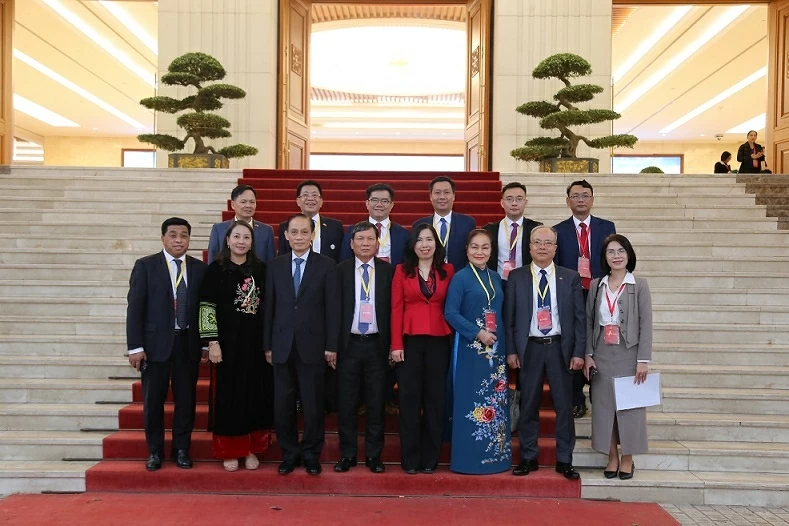 |
| Minister of Foreign Affairs Le Hoai Trung (third from left) takes a photo with OV attendees at the conference. (Photo: Thanh Long) |
However, according to the Deputy Minister, it is necessary to frankly acknowledge that the potential of the OV community has not been fully realized. Some policies, although more open, are still slow in implementation and have not kept pace with the rapid changes of reality.
Requirements of the new context
As the country prepares to enter the 14th Congress, ushering in a new era of development, the demand for intellectual contributions and innovative creativity from the overseas Vietnamese community is becoming increasingly urgent.
Recently, under the close direction of Prime Minister Pham Minh Chinh, Foreign Minister Le Hoai Trung, and the active contributions of various committees, ministries, sectors, localities, and the OV community, the Ministry of Foreign Affairs has conducted a comprehensive review through diverse and flexible forms: organizing dozens of conferences, seminars, and thematic discussions both domestically and internationally; widely collecting opinions from ministries, sectors, localities, people's organizations, and socio-political organizations, with over 200 summary reports and nearly 300 proposals and recommendations; 98 Vietnamese representative agencies abroad have actively gathered opinions from our compatriots overseas; collecting opinions from about 700 associations, intellectual networks, entrepreneurs, students, and the Trường Sa Clubs of overseas Vietnamese; directly collecting opinions from compatriots during their visits to Vietnam for domestic events (such as A80, A50, training courses for OV association leaders, Vietnamese language teachers...); synthesizing and analyzing nearly 2,300 opinions, proposals, and recommendations during the opinion collection phase of overseas Vietnamese for the draft documents of the 14th Congress.
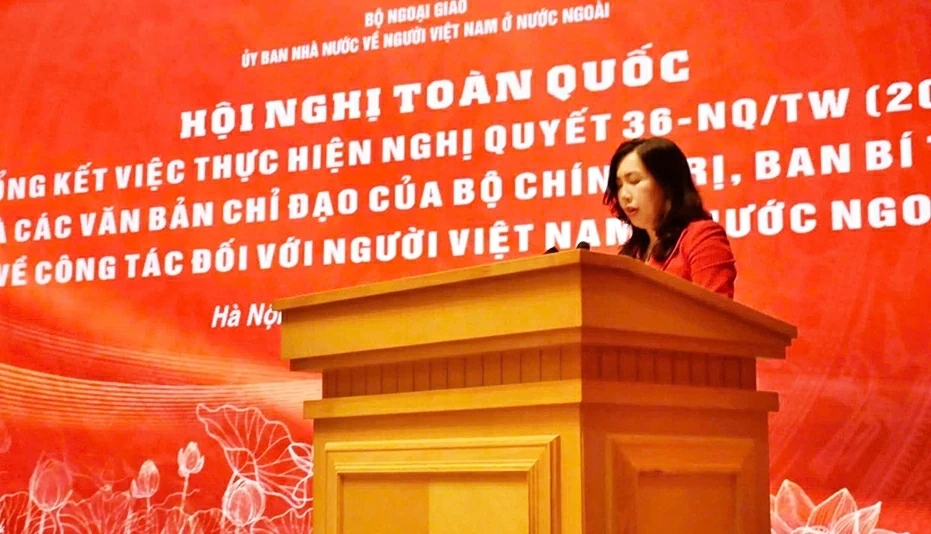 |
| Deputy Minister of Foreign Affairs Le Thi Thu Hang presents the central report at the conference. (Photo: Duong Tieu) |
According to Deputy Minister Le Thi Thu Hang, through the review process, many important results and lessons have been drawn. At the same time, new issues and requirements of reality have emerged in the context of significant changes in the world, the country, and the OV community compared to when Resolution 36 was issued over 20 years ago.
Based on the contributions during the review process of Resolution 36, the Ministry of Foreign Affairs has compiled and reported to the Prime Minister and the conference several proposals: Continuously reviewing and synchronizing legal regulations and policies to create a more open and favorable legal corridor for OV; creating breakthroughs in mobilizing OV resources, especially in science and technology for national development; creating breakthroughs in national unity and reconciliation, aiming to eliminate historical prejudices; promoting cultural and educational work, preserving national identity and the Vietnamese language; innovating methods of mobilization, information, and communication for overseas Vietnamese; strengthening care and support for the OV community.
Key solutions in science and technology
At the conference, Deputy Minister of Science and Technology Bui The Duy emphasized that leveraging the expertise and intellectual resources of the OV community to contribute to the development of science, technology, innovation, and digital transformation is being placed within an increasingly complete institutional framework, closely following the spirit of Resolution 57-NQ/TW of the Politburo.
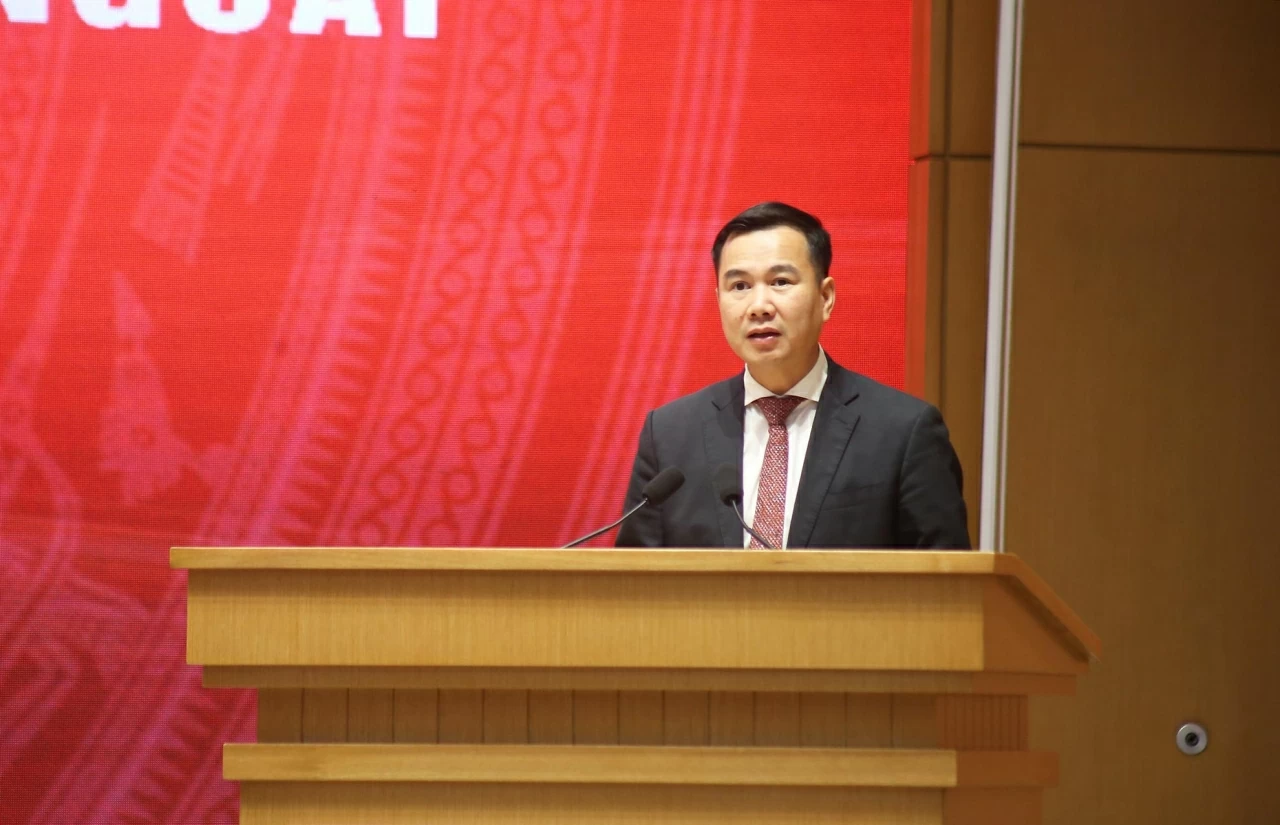 |
| Deputy Minister of Science and Technology Bui The Duy delivers a speech at the conference. (Photo: Thanh Long) |
Recently, the state has issued many important mechanisms and policies to attract, develop, and utilize talents, including the OV intellectual community.
Notable is the Law on Science, Technology, and Innovation in 2025, along with guiding decrees on the autonomy mechanism of science and technology organizations, policies to attract experts, chief engineers, and young scientific talents; allowing flexible remuneration mechanisms, even exceeding salary frameworks, creating favorable conditions for working environments and ownership, and exploiting research results.
Additionally, the Digital Technology Industry Law in 2025 and the revised Atomic Energy Law have established a legal foundation for developing human resources in cutting-edge technology fields such as artificial intelligence, semiconductors, big data, digital assets, and new energy; simultaneously encouraging the participation of OV and international experts.
Through national science and technology programs, Vietnam has connected and attracted many OV experts and scientists to participate in key tasks; implemented new cooperation models such as programs to search for security vulnerabilities for national digital transformation platforms; and launched the VNCONNECT database system for Vietnamese AI experts worldwide.
Deputy Minister Bui The Duy also candidly pointed out that leveraging the intellectual resources of overseas Vietnamese has not yet achieved a breakthrough commensurate with its potential, due to fragmented attraction activities, lack of a unified coordination hub; non-integrated expert databases; and inflexible cooperation mechanisms.
From here, the Ministry of Science and Technology proposes key solutions, including shifting from general attraction to "ordering" based on major national problems; building an interconnected expert network and database; diversifying forms of participation for OV intellectuals; leveraging the role of Vietnamese representative agencies abroad in connecting talents and the innovation ecosystem.
Affirming that leveraging OV intellectual resources is a pillar in the national development strategy, the Deputy Minister stated that if Resolution 36 is the ideological foundation, then Resolution 57 is the call to action, aiming to transform the vast potential of the OV community into real development momentum for the country.
The role of religion in national unity
Regarding support for the OV community in religious and belief activities, Deputy Minister of Ethnic and Religious Affairs Y Thông stated that, implementing Resolution 36-NQ/TW, Directive 45-CT/TW, and Conclusion 12-KL/TW of the Politburo, the Government Committee for Religious Affairs has coordinated with ministries, sectors, and domestic religious organizations to implement many practical activities to support and guide religious and belief activities for OV.
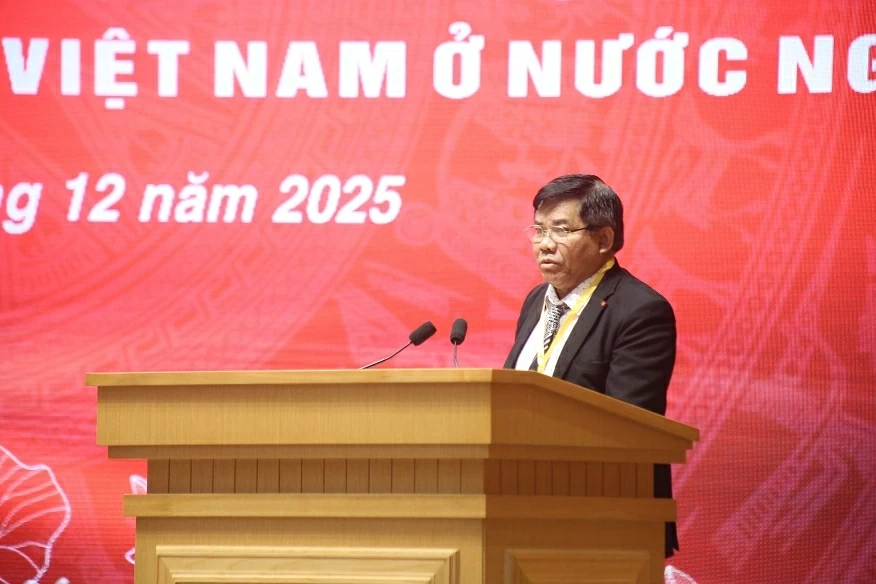 |
| Deputy Minister of Ethnic and Religious Affairs Y Thong speaks at the conference. (Photo: Thanh Long) |
According to the Deputy Minister, domestic religious organizations have actively accompanied the OV community. The Vietnam Buddhist Sangha organizes many visits, sends monks and nuns to guide activities at overseas places of worship, establishes Buddhist associations and coordinating committees in many countries, and organizes Dharma propagation during major festivals.
The Vietnam Catholic Church and Protestant Churches regularly send clergy abroad to serve the religious needs of believers. The Cao Dai Tay Ninh Holy See and some other religious organizations have also established representative boards and ordained clergy abroad, contributing to maintaining stable religious activities within the community.
Additionally, the Ministry of Ethnic and Religious Affairs coordinates with the Vietnam Fatherland Front and the Ministry of Foreign Affairs to organize OV meetings and conferences to inform about the domestic socio-economic, belief, and religious situation; listen to the aspirations and strengthen the connection of OV with their homeland.
The Ministry is also implementing a project to support the religious and belief activities of the OV community for the period 2022–2026, considering religious activities as a bridge for community solidarity, preserving national cultural identity, and preventing the exploitation of religion to cause division.
However, Deputy Minister Y Thông also pointed out some difficulties, such as the increasing demand for religious activities among OV while lacking Vietnamese clergy, places of worship, and facing legal barriers in host countries; spontaneous religious activities in some places; and the risk of religion being exploited to incite and divide the community.
The Ministry of Ethnic and Religious Affairs proposes to enhance support for building cultural centers and religious facilities abroad; innovate religious policy propaganda; diversify forms of mobilization and build core forces; thereby promoting the role of religion in strengthening national unity and guiding the OV community towards building and defending the Fatherland.
The supportive role of Vietnamese Representative Missions
According to Vietnamese Ambassador to Japan Pham Quang Hieu, Japan is a developed country with strengths in most of the 11 strategic technology groups identified by the Vietnamese Government.
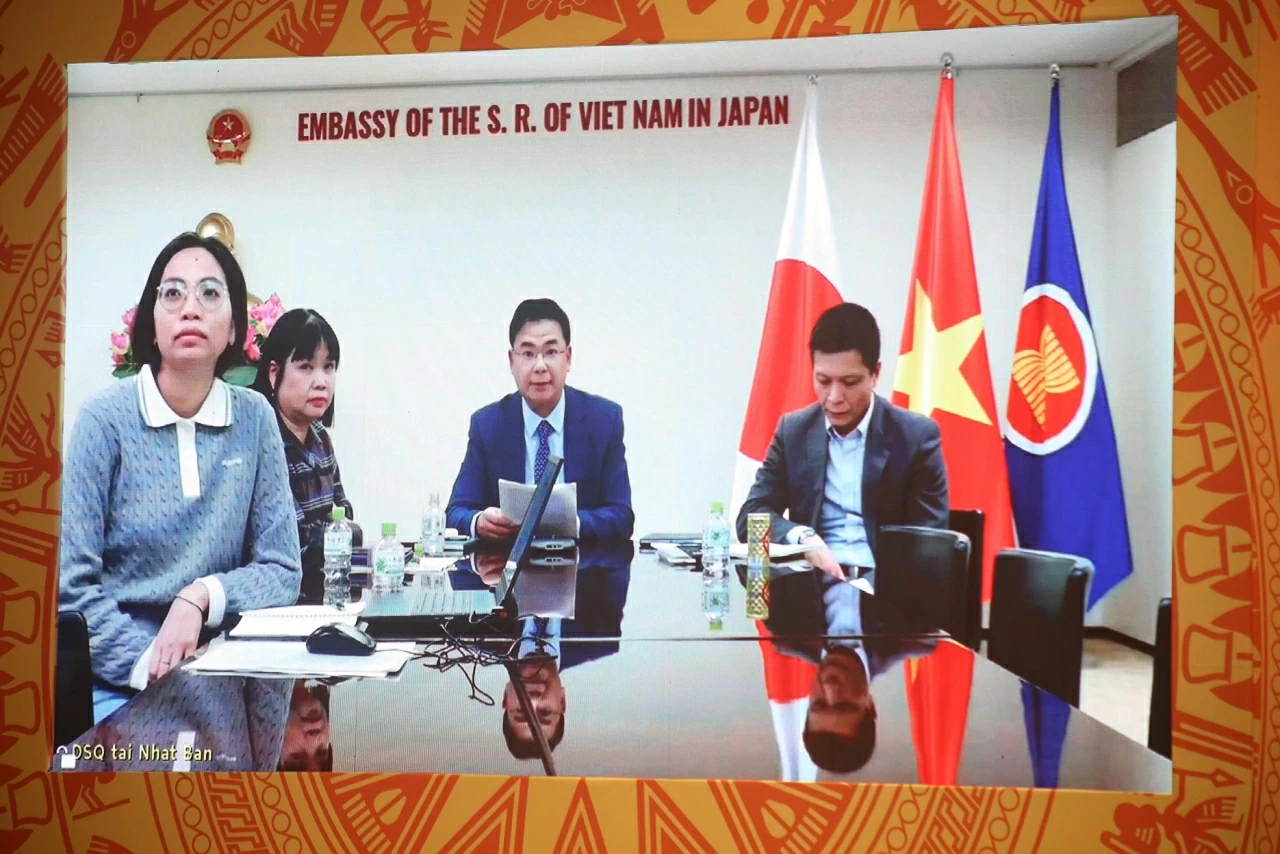 |
| Vietnamese Ambassador to Japan Pham Quang Hieu presents a speech online. (Photo: Thanh Long) |
In this context, the Vietnamese community in Japan is identified as an important resource contributing to the implementation of the Party and State's policies to bring Vietnam into a new era of development based on knowledge, high technology, quality human resources, and deep integration.
To maximize the strength of the large Vietnamese community in Japan, the Embassy has been focusing on implementing three key tasks.
First, diversifying forms of community gathering and solidarity, strengthening and developing Vietnamese associations. From a few initial associations, the community has now formed over 60 associations, notably specialized associations such as the Vietnamese Intellectuals Association in Japan, the Academic Exchange Association, the Vietnam-Japan Experts Association, the Vietnam-Japan Digital Transformation Association, thereby promoting the innovative capacity of individuals and businesses.
Second, adhering to the principle of "people-centered," considering the community both as the subject participating in organizing and implementing and as the beneficiary of policies; regularly informing and disseminating the Party and State's guidelines and policies, especially major policies on science and technology development.
Third, leveraging the core and pioneering role of the Vietnamese intellectual and expert community in Japan in promoting scientific and technological exchange and cooperation, especially in strategic fields such as digital transformation, artificial intelligence, semiconductors, and high technology.
The Embassy has actively supported connecting Vietnamese intellectuals, scientists, and businesses in Japan with agencies and businesses in both countries; organized many specialized seminars and events; built a network of Vietnamese scientists in Japan, promoted the "scientist – research institute – enterprise" linkage model, and enhanced cooperation in training and research, initially aiming to train hundreds of PhDs and thousands of engineers in the semiconductor field for Vietnam.
Ambassador Pham Quang Hieu emphasized that in the future, the Vietnamese Embassy in Japan will continue to proactively implement flexible and diverse activities, strengthen connections with domestic ministries, sectors, localities, and businesses, thereby effectively leveraging the intellectual, expert, and high-skilled labor resources of Vietnamese in Japan, contributing practically to the development of the country and Vietnam-Japan cooperation.
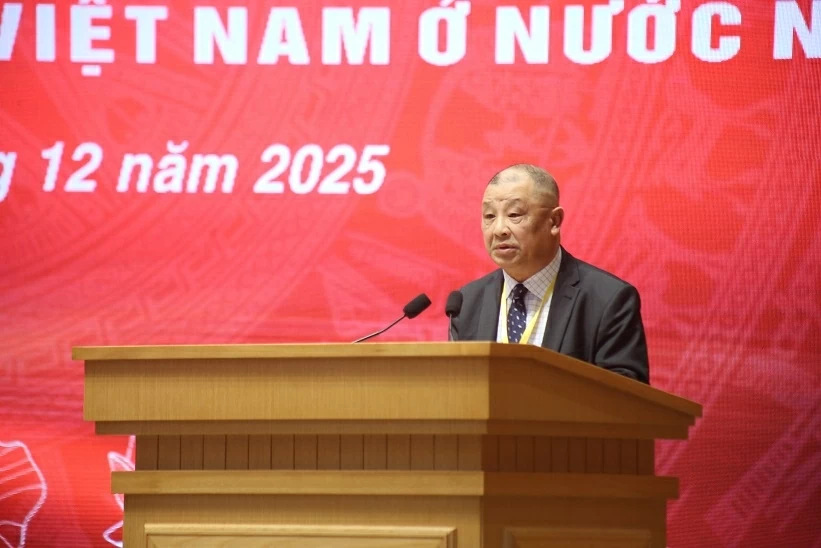 |
| Lawyer Tran Ba Phuc – Member of the Central Committee of the Vietnam Fatherland Front, Chairman of the Vietnamese Businessmen Association in Australia, Vice Chairman of the Overseas Vietnamese Businessmen Association, speaks at the conference. (Photo: Thanh Long) |
The responsibility of the OV community
Representing the OV community at the conference, Lawyer Tran Ba Phuc – Member of the Central Committee of the Vietnam Fatherland Front, Chairman of the Vietnamese Businessmen Association in Australia, Vice Chairman of the Overseas Vietnamese Businessmen Association, assessed that the Party's Resolution 36-NQ/TW on work with OV reflects strategic vision, profoundness, and humanity, not only in mobilizing OV resources for national development but also in its harmonious, inclusive, and future-oriented approach.
According to Tran Ba Phuc, as the country enters a new development phase with intertwined opportunities and challenges, the OV community, especially the intellectuals and businessmen, hopes that the Party and State's major policies will soon be concretized into substantive actions, ensuring "words are matched by deeds".
The effectiveness of implementation in practice will be the most convincing measure to consolidate the trust of the OV community, turning sound resolutions into specific development momentum for the country.
Expressing excitement and support for the policy of inviting OV to participate in "creating" the nation's development, Trần Bá Phúc believes that the OV community wishes to participate more substantively and effectively, not only in the implementation phase but right from the process of policy and legal framework development.
The fact that OV now has representation in the Central Committee of the Vietnam Fatherland Front is an important step forward, but this role needs to be further strengthened in legislative work, policy critique, and implementation oversight.
Lawyer Tran Ba Phuc also emphasized the OV community's desire to enhance programs to preserve and spread Vietnamese culture and identity abroad, particularly supporting Vietnamese language teaching and learning, preserving traditional cultural values, and connecting the younger OV generation with their roots. This is not only a cultural-social task but also a long-term foundation to strengthen national unity in the context of globalization.
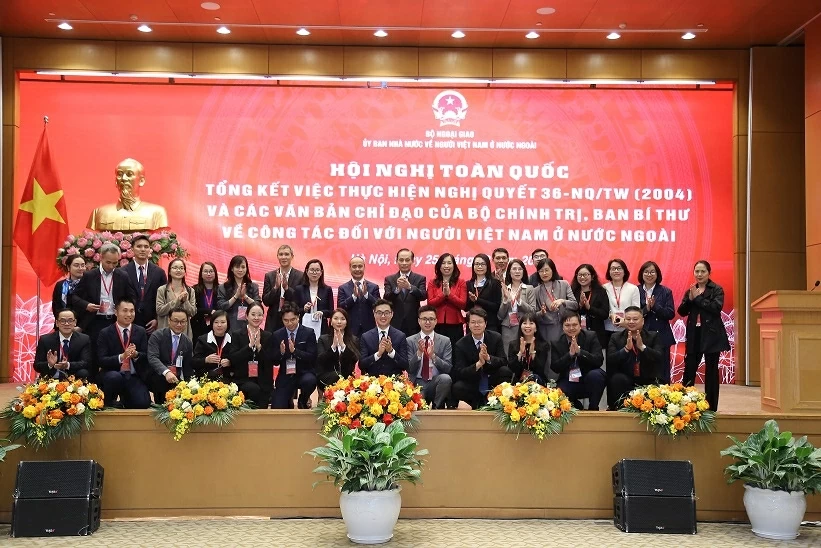 |
| Delegates attending the conference take a commemorative photo. (Photo: Thanh Long) |
Affirming the responsibility of the OV community, Tran Ba Phuc emphasized that with advantages in knowledge, technology, experience, and international networks, the OV community will continue to dedicate their passion and intellect to contribute to the country's breakthrough areas.
"Every Vietnamese, wherever they are, pledges to be a 'red brick' contributing to building Vietnam's stature on the international stage; wherever they go, wherever they are, no one can take the Vietnamese heart out of their chest," he emotionally shared.