







New Data as the Foundation of the AI Race
What impressed Mr Tran Van Chin, Chairman of Arobid.com, the most after meetings with partners in Singapore recently was not the new AI applications or the pace of technological development, but the quality of data, digital infrastructure, and the ability to connect ecosystems, which will determine the competitiveness of businesses and nations in the digital era.
Latest
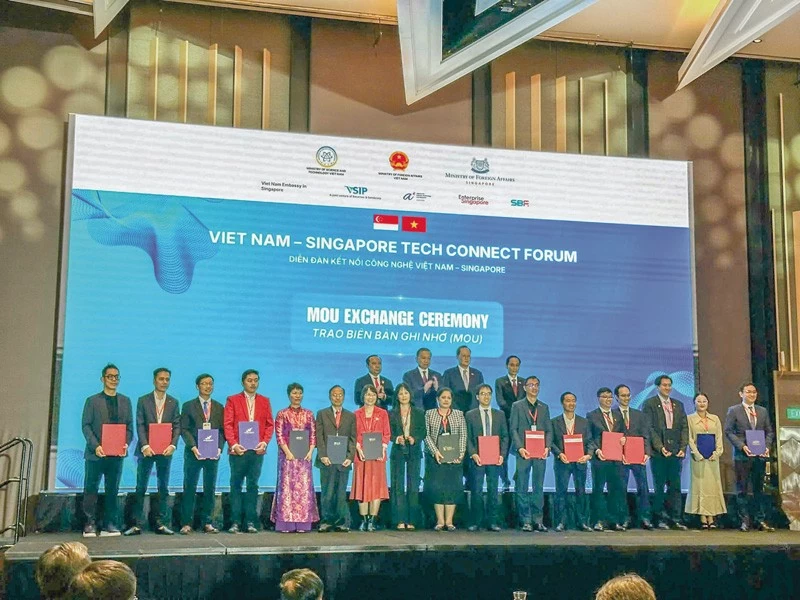 |
| At the recent Vietnam - Singapore Technology Connection Forum, Arobid.com and the Singapore Artificial Intelligence Association (SAIA) drew attention with an agreement to develop an AI ecosystem for cross-border digital commerce and investment. (Source: Arobid.com) |
Arobid.com, one of the Vietnamese tech companies participating in the business delegation during the official visit to Singapore by General Secretary, State President To Lam, signed a cooperation agreement with the Singapore Artificial Intelligence Association (SAIA). From discussions with partners in Singapore's innovation ecosystem, Mr Tran Van Chin realised a thought-provoking point: leading economies in digital transformation often start not with AI but with data, infrastructure, and connectivity.
Data is Becoming the New Strategic Infrastructure
In previous industrial revolutions, electricity, transportation, or telecommunications were considered essential infrastructures driving economic growth. In the digital era, data is gradually becoming a new strategic infrastructure. Successful countries in digital transformation not only focus on developing technology or AI applications but also invest systematically in data, infrastructure, and the ability to connect innovation ecosystems.
 |
| Chairman of Arobid.com, Tran Van Chin. |
AI is seen as an important tool, but data and infrastructure are the foundation. AI only truly realises its value when operated on a quality data platform. No matter how powerful an AI system is, it is challenging to produce good results if the input data is incomplete, inaccurate, or not continuously updated. Conversely, a robust, complete, clean, and live data ecosystem can help AI make more accurate decisions, build more effective connections, and deliver greater economic value.
According to Mr Chin, for data to create value, it must be "correct, complete, clean, and live," meaning it accurately reflects reality, is standardised, and continuously updated. From there, he poses a question considered more important than how intelligent AI is: how high is the quality of the data we possess for AI to operate effectively?
Looking more broadly, this is not just a technology story. It is a story about the ability to build digital infrastructure for the economy. Because if data is considered the raw material of the digital age, the quality of data largely determines the value AI can create.
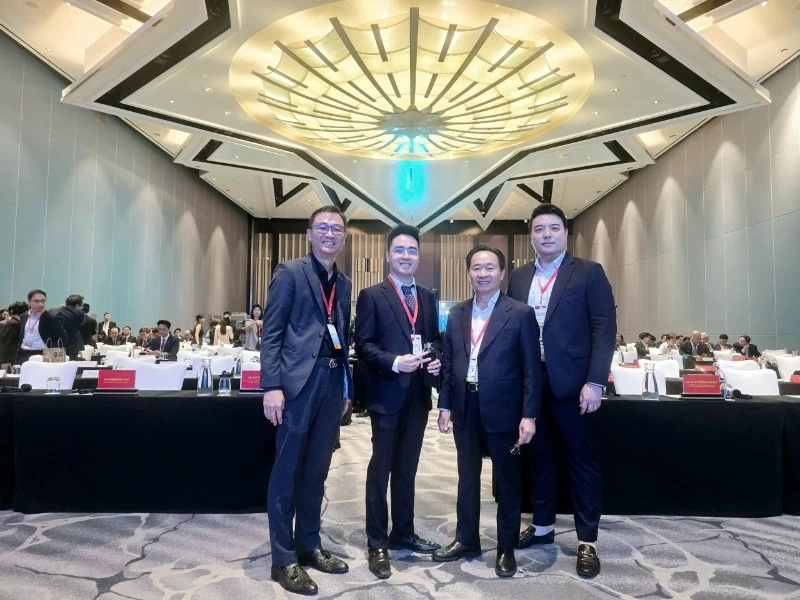 |
| Chairman of Arobid.com Tran Van Chin, SAIA Singapore Chairman Jonathan Zhang (right), and SAIA Singapore CEO Kenny (left) take a commemorative photo at the Vietnam - Singapore Technology Connection Forum. (Photo: Arobid.com) |
When Trade Promotion Shifts to the Digital Environment
From the story of data and infrastructure, another major shift is occurring: the transition of trade and investment promotion activities to the digital environment.
According to Mr Tran Van Chin, AI should not be viewed merely as a new technology or a media trend. The true value of AI lies in its ability to solve practical economic problems.
In trade and investment promotion, AI can help businesses find suitable partners faster, better understand the market, reduce the cost of seeking business opportunities, and enhance the quality of business decisions. For many years, trade promotion activities were mainly associated with fairs, exhibitions, and traditional trade connection programs.
However, the behaviour of businesses and investors is changing rapidly. Today, most information searches, partner evaluations, and market research are conducted online before parties meet face-to-face. This requires trade and investment promotion activities to also change towards being continuous, measurable, and supported by real-time data.
If businesses previously sought business opportunities primarily through relationships or traditional promotional events, in the near future, they will not only search for customers or partners using keywords as they do now.
AI systems can help analyse needs, assess suitability, suggest potential partners, and even predict the likelihood of successful cooperation based on historical data and interaction behaviour. This not only helps reduce time, costs, and resources for businesses but also promotes the transition from event-based trade promotion to data-driven trade promotion. This is also the development direction being promoted by many economies to enhance the effectiveness of connections between businesses, investors, and markets.
 |
| Mr Tran Van Chin, Chairman of Arobid.com. (Photo NVCC) |
AI Contributes to Democratizing Development Opportunities
One of the most notable impacts of AI and data is the ability to bridge the gap between large and small businesses.
For many years, the gap between businesses has not been limited to capital scale or production capacity. That gap also lies in access to information, markets, and networks. AI and data can help narrow that gap.
A small business in Vietnam can be discovered by customers in Europe, the USA, Japan, or the Middle East if it is well digitised and participates in relevant data ecosystems. This is considered one of the most important changes that technology is bringing.
According to Mr Tran Van Chin, the value of AI is not only in data processing capabilities or work automation. More importantly, this technology is helping expand market, customer, and partner connection opportunities for every business, regardless of size.
When data and digital platforms help businesses access customers, partners, and markets more easily, the advantage no longer belongs solely to large businesses with extensive networks. Small businesses also have the opportunity to participate more deeply in the global value chain if they know how to leverage data and technology. This is also an opportunity for Vietnamese businesses, especially small and medium-sized enterprises, to expand their market and enhance their competitiveness in the digital economy.
Vietnam Needs Infrastructure Thinking Instead of Just Application Thinking
Despite recognising the potential of AI, Mr Tran Van Chin believes it should be viewed realistically. AI is not a magical solution that can solve all problems.
In reality, many businesses face difficulties in deploying AI, not due to a lack of technology. AI tools are becoming increasingly popular and accessible. The bigger challenge lies in data, operational processes, and management thinking.
A business can purchase software or rent AI solutions quickly. But building a quality data system, standardising processes, and forming a data-driven decision-making culture is a long-term process. This is the factor that determines the success or failure of AI application programs in practice.
Vietnam has many advantages in the AI competition thanks to its young population, a growing number of tech engineers, and a digital transformation speed among the fastest in the region. Additionally, in recent years, the Party and the State have shown a clear determination to promote science and technology, innovation, digital transformation, and the development of the digital economy. These are favourable conditions for Vietnam to participate more deeply in the global digital value chain.
However, if Vietnam wants to see tech companies capable of competing on a regional and international scale, merely applying technology is not enough. What is more necessary is to build data infrastructures, digital platforms, and ecosystems capable of serving millions of businesses and users. In other words, Vietnam needs to focus on infrastructure rather than just applications.
Along with this process, gradually completing the legal framework related to AI is considered an important factor in building trust for businesses. Businesses will only dare to invest when there is a transparent, stable, and predictable legal environment.
The competition in the AI era is not just about technology. Data, digital infrastructure, and connectivity in the ecosystem are the factors that determine the long-term competitiveness of businesses and the economy.
AI may be a new growth driver, but data and digital infrastructure are the foundations for that driver to realise its value.
| Arobid.com is not just a technology platform but also a digital infrastructure for trade and investment promotion, powered by artificial intelligence (AI), big data, and a global B2B digital ecosystem. Unlike the traditional model, where the platform owner must organise and operate all activities, Arobid chooses a different path: Building infrastructure and empowering others. Through Arobid's digital infrastructure, trade and investment promotion centres, exhibition organisers, industry associations, chambers of commerce, business associations, investment promotion organisations, industrial zones, localities, and business communities can proactively exploit, operate, and develop trade, investment, and trade connection activities in the digital environment according to their own needs. Arobid provides technology infrastructure, data, AI Matching, AI Deep Search, AI Onboarding, and digital operation tools; while partners are empowered to organise fairs, exhibitions, conferences, seminars, trade promotion programs, investment promotion, and business connection activities within their community's scope. This model helps expand scale without limits, creates a network effect, promotes the development of the digital economy, and helps organisations own modern infrastructure without large investments in technology, personnel, or operations. - Arobid builds the infrastructure. - Partners operate and develop the community. - AI supports connection, analysis, and creates transaction opportunities. This is the "Build Once – Empower Many" philosophy that Arobid is pursuing on its journey to create a new generation trade and investment promotion ecosystem. Arobid does not build the platform for self-exploitation. Arobid builds the infrastructure and empowers thousands of organisations, associations, and business communities to jointly exploit, develop, and create value in the digital environment. |

| Vietnam, Estonia look to build long-term cooperation foundation: Estonian Foreign Minister Margus Tsahkna WVR/VNA - On April 23, Estonian Minister of Foreign Affairs Margus Tsahkna hosted a reception in Ho Chi Minh City for Estonia’s Honorary Consuls in ... |

| Chairman of Delta E&C: ASEAN needs a 'strategic push' to win the global capital attraction race The world is seeking a region that is both stable and bold. Therefore, ASEAN needs a “strategic push” in the next 24 months to make ... |