







Mohsen Bahmani, the inventor who became a millionaire at 18 is now trying to reinvent the future of mobility systems
Most engineering advances refine existing technologies, but some innovations begin by questioning whether long‑accepted solutions are necessary at all. Mohsen Bahmani’s work follows this second path. Rather than asking how propellers could become quieter or more efficient, he explored whether future propulsion systems might function without conventional exposed propellers.
Latest
 |
| Mohsen Bahmani, the inventor who became a millionaire at 18 is now trying to reinvent the future of mobility systems. (Photo: The Good Men Project) |
Bahmani’s engineering journey began long before his European patent. As a teenager, he developed the Floating Shoes concept after reflecting on how technology might help save lives during natural disasters. That invention received international recognition and established a pattern that would continue throughout his career: identifying practical problems and challenging established assumptions instead of making incremental improvements.
After studying Mechanical Engineering at the Karlsruhe Institute of Technology (KIT), Bahmani transformed intuitive ideas into systematic engineering research. Years of work in mechanics, energy transfer, structural design, and systems engineering ultimately resulted in European Patent EP3565971B8, which describes a propulsion architecture based on controlled acceleration and internal reaction mechanisms.
A granted European patent confirms that the invention satisfied the European Patent Office’s requirements for novelty, inventive step, and industrial applicability. Many unconventional concepts never pass this level of examination, making the patent an important milestone and establishing the invention as a technically defined engineering concept with recognized industrial applicability.
The proposed architecture addresses challenges increasingly faced by modern drones and Advanced Air Mobility (AAM), including safety, noise reduction, compact integration, maintainability, and distributed propulsion. Instead of relying on a small number of exposed rotating blades, the concept organizes multiple reaction units within a synchronized closed-loop system. The focus shifts from optimizing individual components toward redesigning the overall propulsion architecture.
Dawn Zoldi’s analysis in Autonomy Global presents the invention as a significant propulsion architecture and highlights the importance of objective engineering evaluation. Industry trends likewise show growing interest in quieter, safer, and more integrated propulsion systems for future aerial mobility, placing Bahmani’s concept within an active field of technological evolution.
The invention has progressed beyond theory through an initial working prototype and publicly available demonstration videos illustrating its operating principles, providing a tangible foundation for technical understanding and discussion.
Bahmani’s work has attracted attention from engineering publications, aerospace commentators, international media, and internationally renowned philosopher Alain de Botton. Known for his reflections on creativity, innovation, and transformative ideas, de Botton’s recognition highlights the broader intellectual significance of Bahmani’s work. It reflects an approach that goes beyond solving engineering problems by questioning long-established assumptions and exploring new possibilities for the future of mobility.
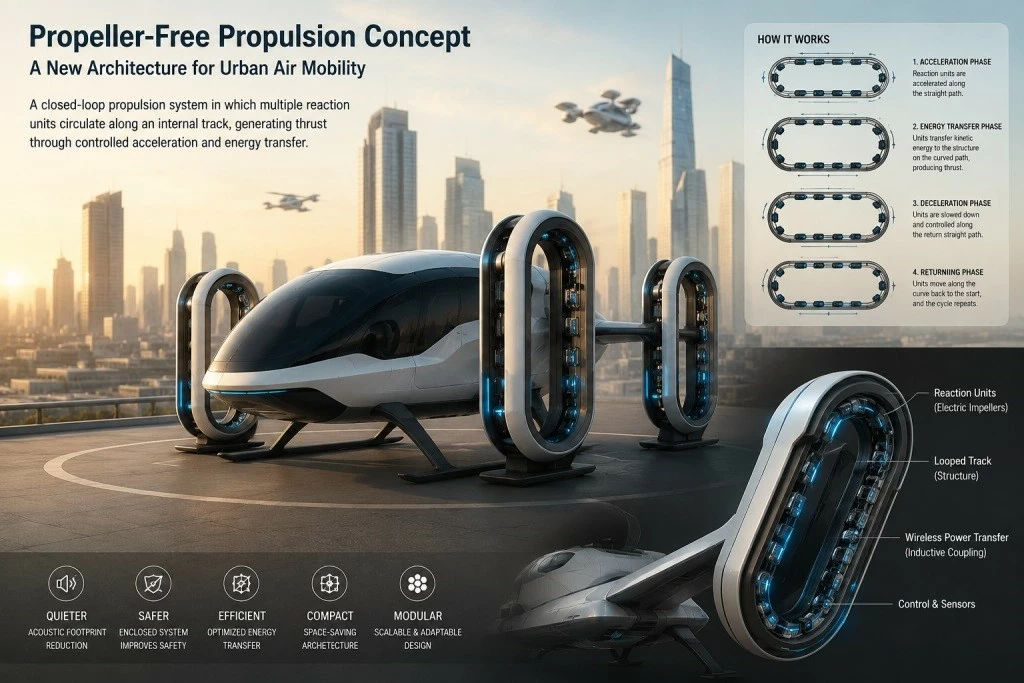 |
| Propeller – Free Propulsion concept. (Photo: technology.org) |
Before developing the propulsion architecture, Bahmani earned multiple international invention awards, including gold, silver, and bronze medals at major invention exhibitions, and was twice recognized as one of Iran’s leading young inventors. These achievements were followed by rigorous engineering education at KIT, where scientific analysis and technical discipline shaped his approach to innovation.
The patented propulsion architecture was refined over nearly a decade through continuous engineering analysis, design iterations, and technical development before receiving European patent protection. Independent technical discussions have emphasized that the concept operates within the framework of established classical mechanics, reinforcing its engineering credibility.
Ultimately, Mohsen Bahmani’s story demonstrates the powerful combination of imagination, engineering discipline, and persistence. From award‑winning early inventions to a patented propulsion architecture recognized by the European Patent Office, his work represents a sustained effort to rethink how future mobility systems may be designed.
The invention stands as an original engineering architecture whose significance lies in its technical originality, its protected intellectual property, and its potential contribution to the next generation of propulsion technologies.