






Khan Academy Founder praises Vietnam's vision for digital transformation in education
As part of a recent visit to Silicon Valley, Mr. Pham Duc Trung Kien, representative of The Vietnam Foundation (VNF), which implements the Khan Academy Vietnam programme, held substantive discussions with Mr. Sal Khan, founder of Khan Academy (USA), on Vietnam’s digital transformation in the education sector.
Latest
The discussion took place in the context of Resolution 71 by the Politburo, which identifies digital transformation and artificial intelligence (AI) as key pillars for fundamental and comprehensive innovation in education and training.
From the perspective of a global educator, Sal Khan highly appreciates Vietnam's long-term vision and strategic approach in integrating AI into education. According to him, Vietnam is on the “right track”: starting with policy, placing people, especially teachers, at the centre, and deploying technology in a cautious and controlled manner.
Resolution 71 and the "Human-Centred" Approach
Sal Khan believes that in the AI era, the biggest challenge in education is not about having technology, but how countries position the role of humans in the digital ecosystem.
According to him, successful countries are those that view AI as a tool to support and expand the capabilities of teachers and learners, rather than a replacement. Therefore, Sal Khan values the spirit of Resolution 71, which not only promotes comprehensive digital transformation but also sets clear requirements for humanity, safety, data protection, and sustainable development in the application of technology to education.
Drawing from the experience of implementing Khan Academy in over 190 countries, Sal Khan believes that Vietnam's choice to approach AI starting with the teaching staff is a reasonable and profound step.
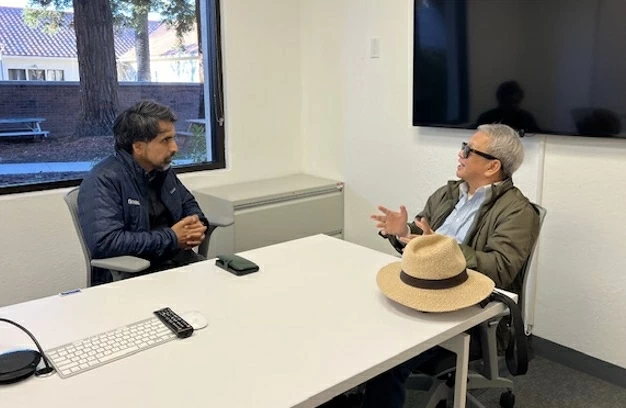 |
| Global educator Sal Khan is in discussion with the founder of the Khan Academy Vietnam program. |
According to him, teachers are not just users of technology but are the force shaping how AI is pedagogically, responsibly, and culturally integrated into classrooms. This philosophy aligns with Khan Academy's development of AI tools for education, including Khanmigo – an AI teaching assistant designed to reduce administrative and professional workloads for teachers, thereby allowing them more time for creativity and student interaction.
From the Vietnamese side, Pham Duc Trung Kien shared that the process of localising and testing Khanmigo always adheres to the principle of placing teachers at the centre. Khanmigo is approached as an educational solution, rigorously verified pedagogically, aligned with the curriculum, teacher capabilities, and the practical classroom environment in Vietnam. The teachers involved in testing are not just users but directly “train” the AI to understand the needs and educational context within the country.
Khan Academy's Long-Term Commitment to Accompanying Vietnamese Education for Equal Learning Opportunities
Beyond the AI discussion, Sal Khan reaffirmed Khan Academy's long-term commitment to supporting Vietnamese education, based on the core principle of providing equal education for all learners.
According to him, Khan Academy not only develops technology but also focuses on building an ecosystem of open, free, high-quality educational resources, accompanied by a data management system designed for optimal, safe, and responsible use. This is a crucial condition for countries to deploy educational technology on a large scale while ensuring privacy and long-term benefits for learners.
On the Khan Academy platform, Vietnamese students can access English as a second language by learning Math, Science, Programming, Art, and other fields in English. This approach helps learners develop knowledge, scientific thinking, and language skills simultaneously, rather than learning English in isolation.
Additionally, the Khan Academy course system is continuously expanding to support Vietnamese students and teachers in accessing global knowledge equitably, regardless of their economic or geographical conditions.
Sal Khan believes that combining open resources with responsibly designed AI tools will help teachers and students use technology more effectively, avoiding dependency and maintaining the leading role of humans in the learning process. This commitment, he says, is the foundation for Khan Academy to continue collaborating with Vietnam not just in the short term but as a long-term partner in building a humane, equitable, and sustainable digital education ecosystem.
From a policy perspective, the exchanges between The Vietnam Foundation and Sal Khan indicate that AI in education is not a technological race but a process of redefining the roles of schools, teachers, and learners in the digital age.
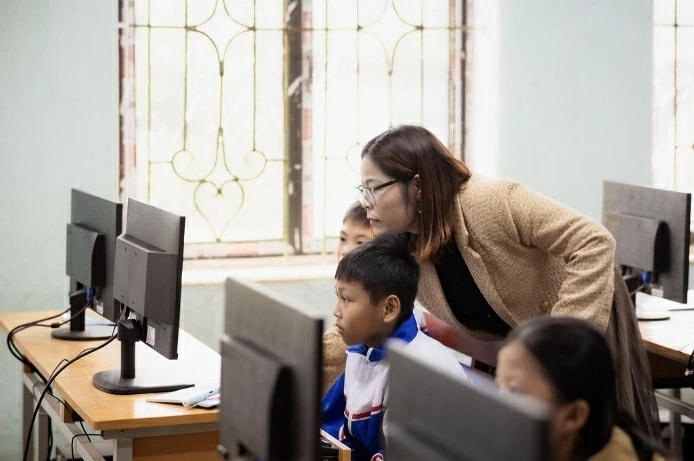 |
| Teachers who effectively use AI will lay an important foundation for the digital transformation of education. |
Vietnam's decision to implement AI in a proactive yet cautious spirit, as outlined in Resolution 71, is laying important groundwork for technology to truly serve the goal of enhancing educational quality and human development.
The efforts of The Vietnam Foundation - Khan Academy Vietnam in localising and implementing Khanmigo for Vietnamese teachers have also been recognised by state management agencies. At the launch seminar of the Vietnamese version of the AI teaching assistant Khanmigo, held on November 28 in Hanoi, Permanent Deputy Minister of Education and Training Pham Ngoc Thuong shared: “I didn't expect the AI teaching assistant Khanmigo to be localised so quickly. This is the effort and dedication of Mr. Kien and his colleagues for Vietnamese education and digital transformation.”
This statement shows that The Vietnam Foundation - Khan Academy Vietnam not only plays a role in receiving and implementing technology but is gradually affirming its position as a proactive, serious, and responsible partner, accompanying international organisations and domestic management agencies in promoting the digital transformation of education in Vietnam.
The dialogue between Sal Khan and The Vietnam Foundation also emphasises a consistent message: artificial intelligence only truly has value when it helps teachers enhance their professional effectiveness and contributes to building a fair, humane education system. On this foundation, the Khan Academy Vietnam program is being implemented as a long-term, persistent, and well-directed effort to make a practical contribution to the goal of educational innovation in the digital age.
| Sal Khan is an American educator who founded Khan Academy in 2008 with the mission “to provide a free, world-class education for anyone, anywhere.” Today, Khan Academy serves hundreds of millions of learners in over 190 countries, offering a diverse range of courses in Mathematics, Science, Programming, Economics, Art, and Life Skills. Sal Khan is a global influencer in educational innovation in the digital age, particularly in personalised learning and the responsible application of artificial intelligence (AI). He is the author of the book "The Brave New Education: How AI Will Revolutionise Education (And Why It's a Good Thing?)", which emphasises the central role of teachers and humans in the AI-driven educational ecosystem. |

| PM Pham Minh Chinh directs acceleration of scientific-technological development, digital transformation The rate of end-to-end online public services has reached only 39.98%, far below this year's target of 80%. Data quality across national and sectoral databases ... |
| From Resolution 71 to Khanmigo: Teachers at the heart of digital transformation in education On November 28, at the Vietnam Institute for Advanced Study in Mathematics (VIASM), the seminar "Effective AI Application in Classroom Management" and the launch ceremony ... |